
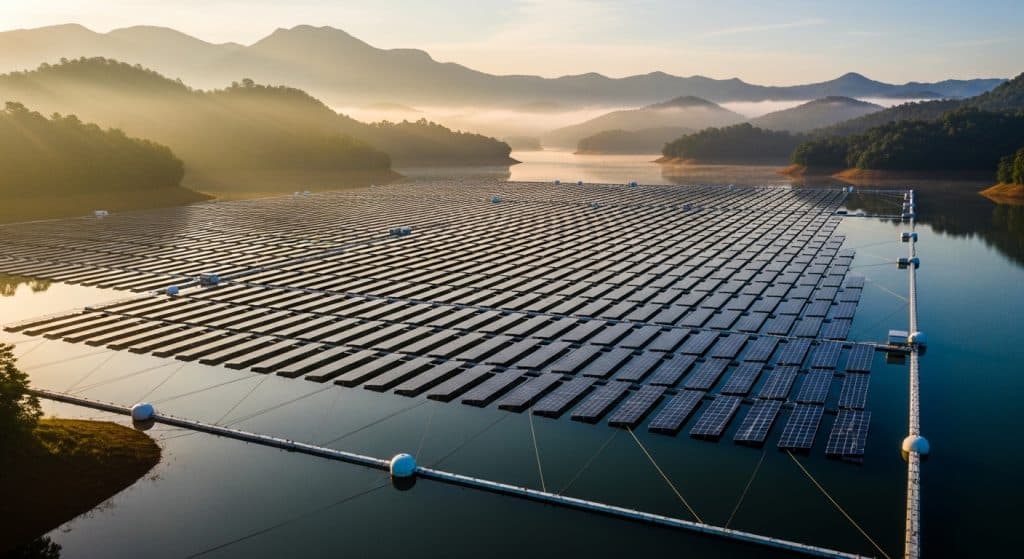
Across Asia and the Middle East, the clean-energy transition is entering a new phase — one that no longer relies solely on land. As governments confront rising land scarcity, competing land-use needs, and community resistance to large ground-mounted solar farms, they are increasingly turning to water surfaces for expansion. In this shift, floating solar mooring systems have emerged as the essential engineering backbone that makes floating solar both viable and bankable.
Although floating solar arrays often capture public attention with their dramatic visuals, the real determinants of performance and longevity sit below the waterline. The stability, safety, and financial value of every floating photovoltaic (FPV) plant depend on how well its mooring systems manage wind loads, wave forces, currents, and seasonal water-level variations. Consequently, as FPV scales across the region, the engineering beneath the surface is moving from an afterthought to a central factor in project success.
Floating Solar’s Rise — and Why Engineering Matters More Than Ever
Floating solar has advanced rapidly from niche pilot projects to strategic national infrastructure. For land-constrained economies like Singapore, South Korea, and Japan, FPV offers a practical way to add renewable capacity without occupying valuable ground. At the same time, the technology helps reduce evaporation in reservoirs, improves water quality, and enhances energy diversification.
Moreover, Southeast Asia alone holds several hundred gigawatts of FPV potential — a figure large enough to reshape energy portfolios and reduce dependence on fossil fuels. As a result, developers, investors, and policymakers now view FPV as a core part of the region’s decarbonisation pathway.
However, the shift from small inland installations to large utility-scale floating farms introduces new technical risks. Unlike ground-mounted systems, FPV arrays behave like semi-buoyant structures constantly influenced by natural forces. Therefore, they require engineering approaches that blend civil, marine, and electrical expertise. This is precisely where floating solar mooring systems play a defining role.
The Engineering Backbone: How Mooring Systems Keep FPV Plants Stable
A floating solar farm is, in many ways, a controlled maritime structure. It moves, flexes, and responds dynamically to weather and hydrodynamic forces. Mooring systems provide the stability necessary for safe operation while still allowing controlled movement that prevents structural stress.
Today, FPV mooring designs typically fall into three categories:
1. Catenary Mooring
Curved lines resting along the seabed absorb loads naturally through slack and shape. This approach is well suited for deeper reservoirs or larger platforms.
2. Taut Mooring
Tensioned lines limit movement and improve station-keeping. Developers often use this system in confined or shallow bodies of water.
3. Hybrid Systems
These combine slack and tensioned components to accommodate wide seasonal water-level changes, common in hydroelectric reservoirs.
Furthermore, anchor types — including helical screws, drag-embedded anchors, and concrete deadweights — must align with soil characteristics, installation constraints, and cost considerations. Selecting the right combination directly influences safety margins and long-term maintenance needs.
Importantly, a mooring line that is too slack allows excessive drifting, while one that is too tight accelerates fatigue in connectors and cables. Achieving the right balance is both an art and a science, which is why FPV engineering is increasingly recognised as a specialised discipline.
Movement Impacts Output — And Investors Understand This Well
One misconception about FPV is that panel stability only affects physical safety. In reality, it affects energy yield and financial returns. Even slight deviations from the intended tilt can reduce generation, and over time these losses compound across thousands of modules.
Therefore, engineers now use advanced simulation tools to evaluate:
- Wind pressure and gust analysis
- Wave-induced motion
- Mooring-line tension behaviour
- Long-term fatigue cycles
- Water-level fluctuations across seasons
These models allow developers to design plants that maintain optimal positioning throughout their lifespan. In turn, this results in higher capacity factors, better inverter performance, and reduced long-term operational risk.
The Often-Forgotten Weak Link: Power Cables Below the Surface
While mooring systems stabilise the structure, underwater power cables keep the plant functioning. These cables encounter constant bending, friction, and environmental exposure — similar to submarine cables used in offshore wind. However, FPV projects have historically lacked the same rigorous standards and protective measures.
Cable faults remain one of the most expensive and disruptive issues in FPV projects. When a cable fails, repairs require divers, downtime, and sometimes complete cable rerouting. Consequently, developers increasingly incorporate offshore cable-engineering practices into FPV design.
Best practices now include:
- Reinforced UV- and abrasion-resistant sheathing
- Anchored or buried cable paths to prevent dragging
- Bend restrictors at movement-heavy joints
- Corrosion-resistant connectors and transition points
- Detailed digital modelling to predict fatigue
Furthermore, leading developers design mooring and cable routing as one integrated system — improving reliability and reducing lifecycle risks.
Digitalisation: Floating Solar Becomes a Smart Maritime Asset
Digital transformation is accelerating across renewable-energy sectors, and FPV is no exception. Modern floating solar plants now integrate into virtual power-plant (VPP) platforms, enabling real-time monitoring of structural and electrical conditions.
Today’s FPV operators use:
- Tension sensors embedded in mooring lines
- Tilt and movement detectors
- Drone-based thermal imaging for module health
- Underwater ROVs for anchor inspections
- AI-driven analytics to flag early-stage anomalies
As a result, maintenance becomes predictive rather than reactive. Issues such as rising tension, drifting arrays, or early cable wear can be addressed well before failure occurs. This approach not only boosts safety but also enhances long-term financial performance — a key priority for asset owners.
Offshore FPV and Hybrid Energy Corridors: The Next Frontier
Given the strong performance of inland FPV, developers are now exploring sheltered coastal environments. Offshore FPV, although still emerging, could unlock much larger project sizes and create integrated renewable-energy hubs.
For example, coastal FPV installations could operate alongside offshore wind and green hydrogen plants, forming hybrid corridors capable of supplying consistent, diversified power. Such ecosystems would strengthen grid stability, reduce intermittency challenges, and support industrial decarbonisation.
However, achieving this vision requires more than engineering innovation alone. It also demands a skilled workforce capable of bridging disciplines — from hydrodynamics and structural simulation to subsea cable systems and advanced O&M strategies. Talent development will therefore determine which countries lead the next phase of floating solar growth.
Skills Will Shape Who Leads Asia’s Floating Solar Future
Floating solar mooring systems may not be visible to the public, but they anchor billions of dollars in infrastructure. As FPV grows in scale and ambition, the region increasingly needs engineers trained in modelling, cable reliability, digital monitoring, and predictive maintenance.
EnergyEdge supports this transition by offering specialised programmes in FPV design, cable engineering, mooring analysis, and operational excellence. To explore upcoming courses, visit the Training Calendar or contact [email protected].
Floating solar is no longer just an innovative alternative; it is becoming a core pillar of the renewable-energy future. Ultimately, its success will be shaped not by what floats on the surface, but by the engineering strength that keeps it anchored below.
Frequently Asked Questions (FAQ)
Floating solar mooring systems are the underwater anchors and lines that keep floating photovoltaic (FPV) platforms in place. They prevent drift, maintain the correct panel angle, and protect the structure from wind and wave forces. Without a reliable mooring setup, FPV arrays can move or tilt, reducing energy output and increasing mechanical risk.
Design begins with site assessment—water depth, soil type, wind, currents, and water-level changes. Engineers then model loads on each mooring line and choose configurations such as catenary, taut, or hybrid systems. Material durability, installation needs, and maintenance requirements shape the final design.
Common issues include metal corrosion, marine growth (biofouling), and tension fatigue in lines. Routine inspections using divers, drones, or sensors help detect wear early. Many operators now use monitoring tools that track mooring tension and predict maintenance needs.
Stable moorings keep FPV platforms properly oriented, preserving panel tilt and minimizing shading. Even slight movement can affect solar capture. A well-designed system improves energy consistency, reduces wear on electrical components, and extends system lifespan.
Advances include corrosion-resistant composite materials, improved hydrodynamic modelling, and AI-based monitoring for predictive maintenance. Modular mooring designs are also emerging, enabling easier installation and more reliable operation in diverse water conditions.
Relevant skills include mooring and anchoring design, FPV system engineering, and renewable-energy integration. EnergyEdge offers specialised courses such as Mooring and Anchoring Technology in FPV Systems and Power Systems with Solar, Storage, and DER Integration. Visit the Training Calendar or contact [email protected] for guidance.
