
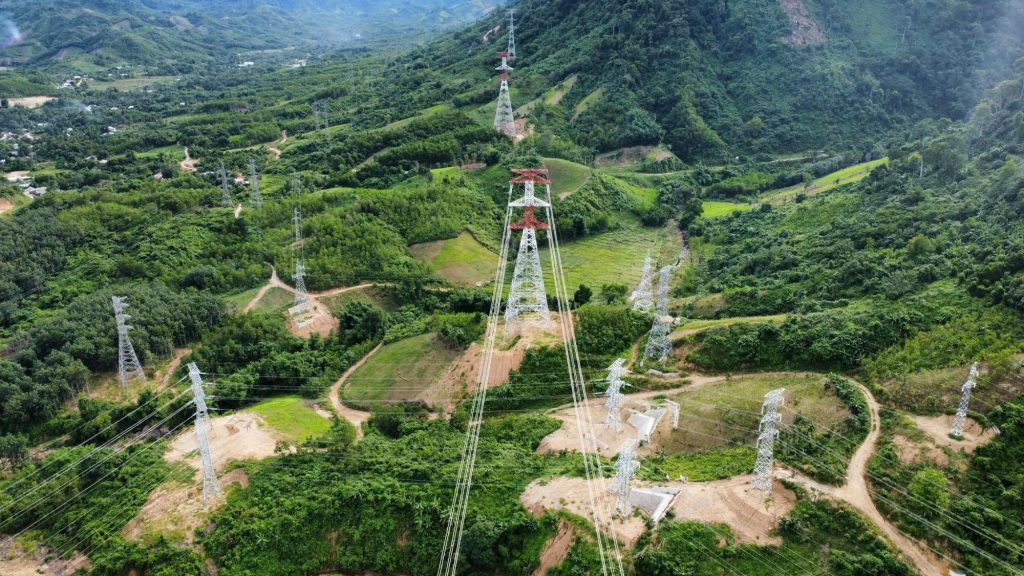
Indonesia is entering the most ambitious phase of grid construction in its history. PLN’s Electricity Supply Business Plan (RUPTL) 2025–2034 calls for roughly 47,758 circuit-kilometres of new transmission lines and around 107,950 MVA of additional substation capacity, backed by an estimated USD 183 billion of total power-sector investment. For the engineers, asset owners, EPCs, and suppliers operating in this market, transmission is no longer a back-office function — it is the critical bottleneck that will determine whether the country’s renewable and industrial ambitions are realised.
What a Power Transmission System Actually Is
A transmission system is the high-voltage backbone that moves bulk electricity from generation sources to the distribution networks that serve end users. In Indonesia this spans 150 kV, 275 kV, and 500 kV alternating-current (AC) corridors, an expanding role for high-voltage direct current (HVDC), and the substations, transformers, switchgear, protection relays, and overhead and underground (and increasingly submarine) cable systems that tie it all together. Under the RUPTL, around two-thirds of new line length will be built at 150 kV, with significant 500 kV AC and DC and 275 kV additions, while more than half of new transformation capacity is concentrated at 500 kV. Understanding this voltage hierarchy — and how protection, grounding, and power quality behave across it — is foundational to every decision that follows.
Current Projects and the Key Operators
PLN remains the dominant operator, but the RUPTL opens transmission development to private participation for the first time, widening the field for IPPs, EPC contractors, and equipment OEMs. The centrepiece is the Green Enabling Super Grid, roughly 48,000 km of new lines designed to bridge the gap between renewable resources concentrated in Sumatra, Kalimantan, Sulawesi, and Nusa Tenggara and demand centres in Java, Madura, and Bali.
Flagship interconnections include:
- Sumatra–Java (ISJ): A priority corridor of roughly 112 km that has adopted HVDC — via overhead lines or submarine cable — as the most technically feasible solution for moving Sumatra’s hydro and geothermal output to Java’s load centres.
- Sulawesi Backbone: PLN plans around 9,000 km of new lines in Sulawesi, lifting transmission capacity by about 1.5 times and interconnecting the currently separate northern and southern grids by 2028, supported by close to 1.6 GW of battery storage.
- Kalimantan–Java (IKJ) and the Sumba–Bali–Java corridor, alongside HVAC backbone strengthening at 500 kV in Sumatra to evacuate low-cost mine-mouth generation.
The supplier and contractor ecosystem is correspondingly broad. Inter-island and submarine projects have historically drawn in international players such as Sumitomo Corporation, J-Power Systems, Boskalis, and Japanese technical partners including Kansai Transmission and Distribution and JICA as a financier, alongside global converter and substation OEMs and a layer of local connector, conductor, and switchgear suppliers. For buyers, the practical implication is that supplier selection now happens in a more competitive, more international, and more technically demanding environment than ever before.
A Practical Guide to Selection
Selecting transmission equipment and partners in Indonesia is as much an engineering exercise as a commercial one. Five considerations consistently separate good outcomes from costly ones:
- Match technology to the corridor. Long, lossy, inter-island spans favour HVDC; dense regional networks favour reinforced HVAC and FACTS devices for voltage and stability support. Getting this wrong is expensive to reverse.
- Design for renewables from day one. Variable solar and wind change fault behaviour, inertia, and reactive-power needs. Equipment specified for a thermal-era grid may underperform once renewable penetration climbs.
- Insist on standards conformity and interface clarity. IEC/IEEE compliance, insulation coordination, and protection coordination must be verified across the whole chain, not device by device.
- Evaluate the total lifecycle, not the purchase price. Spares availability, local service capability, and warranty support in-country matter more than headline cost over a 30–40 year asset life.
- Scrutinise grid-readiness and environmental approvals. With renewable sites often far from demand, transmission and generation timelines must be synchronised, and right-of-way and marine permitting carefully managed.
A Practical Guide to Maintenance
The maintenance challenge scales with the asset base. As thousands of kilometres of new lines and hundreds of substations come online, operators must shift from reactive repair toward condition-based and predictive regimes. Priorities include disciplined testing and commissioning of HV systems before energisation; transformer health monitoring (oil analysis, partial-discharge testing, thermal management); protection-relay testing and coordination reviews; grounding and earthing integrity for safety and power quality; and submarine-cable fault inspection where inter-island links are involved. Digital substations and smart-grid monitoring — which the RUPTL embeds through HVDC, FACTS, reactive-power management, and digital-substation roll-outs across three phases from 2027 — make real-time diagnostics and rapid fault response increasingly achievable, but only where teams have the skills to use them.
The Critical Issue: A Capability Gap, Not Just a Capital Gap
The most under-discussed risk in Indonesia’s grid build-out is human capability. The financing gap is real — IEEFA notes realised transmission investment has averaged only around USD 1.4 billion a year against an RUPTL requirement closer to USD 2.4 billion — but money does not commission a digital substation or coordinate protection on an HVDC link. People do. Operators that want to grow their competencies should treat structured technical training as core infrastructure, not overhead.
This is where targeted upskilling becomes decisive. EnergyEdge offers a focused portfolio across exactly the disciplines this build-out demands, delivered in classroom and virtual formats and available in Jakarta, Singapore, and Kuala Lumpur. Teams building inter-island links can develop fundamentals through Transmission Lines: Design, Analysis and Applications and HVDC Systems Engineering – Principles, Features, Design & Operations, then extend to Design, Installation & Failure Investigations of Submarine Power Cable Systems. Substation and protection competencies are covered by Electrical Substation: Design, Construction & Commissioning, Planning, Design, Operation and Maintenance of Digital Substation, HV & MV Power System – Design, Protection & Coordination, and Relay Protection in Power Systems. For renewable integration and grid stability, Power Quality in Data Centres: Flexible AC Transmission Systems (FACTS) and Grid Forming Inverters Technologies and Smart Grid, Smart Metering and Power Quality Analytics are directly relevant. Maintenance and reliability are addressed through Testing, Commissioning and Maintenance of HV Electrical Systems, Transformer Operational Principles, Design, Selection, Maintenance and Troubleshooting for Oil and Gas and Utilities, and Grounding System Design, Testing and Power Quality Application, while planners can sharpen demand projections with Advanced Load Forecasting & Methodology.
Conclusion
Indonesia’s transmission decade will be won or lost on execution — synchronising generation with grid readiness, selecting the right technology for each corridor, maintaining a rapidly growing asset base, and above all closing the skills gap that sits behind every project milestone. Operators that pair disciplined engineering with deliberate, continuous capability building will be the ones that turn the RUPTL’s headline numbers into reliable, deliverable power.
Frequently Asked Questions
For long, partly submarine spans, HVDC moves large amounts of power over distance with lower losses than HVAC, and it prevents disturbances on one grid from cascading into the other. That combination is why HVDC — whether by overhead line or submarine cable — has been identified as the most feasible solution for the roughly 112 km Sumatra–Java corridor. It does, however, demand specialised converter, control, and protection expertise that AC-only teams typically lack.
Roughly 47,758 circuit-kilometres of new lines and around 107,950 MVA of additional substation capacity over the decade, with about two-thirds of line length at 150 kV and the bulk of new transformation capacity at 500 kV. Total power-sector investment is estimated near USD 183 billion, of which transmission alone runs to tens of billions.
PLN remains the dominant operator, but the RUPTL opens transmission development to private participation for the first time. Certain projects can also proceed under public-private partnership schemes. This widens the field for IPPs, EPC contractors, and equipment suppliers, while raising the bar on technical and commercial readiness.
Two gaps run in parallel. The financing gap is real — realised transmission investment has averaged around USD 1.4 billion a year against an RUPTL requirement closer to USD 2.4 billion. But the capability gap is just as decisive: digital substations, HVDC links, and FACTS devices cannot be commissioned or maintained without trained engineers, so workforce competency is a project-critical input, not overhead.
Match the technology to the corridor. Long inter-island spans favour HVDC; dense regional networks usually favour reinforced HVAC with FACTS devices for voltage and stability support. The decision should also account for renewable penetration, since variable solar and wind change fault behaviour, inertia, and reactive-power needs — equipment specified for a thermal-era grid may underperform as that mix shifts.
Operators need to move from reactive repair toward condition-based and predictive maintenance: transformer oil and partial-discharge monitoring, relay testing and coordination reviews, grounding integrity checks, and submarine-cable fault inspection on inter-island links. Digital substations and smart-grid monitoring make real-time diagnostics achievable — but only where teams have the skills to interpret and act on the data.
For inter-island and bulk-transmission work: Transmission Lines: Design, Analysis and Applications, HVDC Systems Engineering – Principles, Features, Design & Operations, and Design, Installation & Failure Investigations of Submarine Power Cable Systems. For substations and protection: Electrical Substation: Design, Construction & Commissioning, Planning, Design, Operation and Maintenance of Digital Substation, HV & MV Power System – Design, Protection & Coordination, and Relay Protection in Power Systems. For renewable integration, maintenance, and planning: Power Quality in Data Centres: Flexible AC Transmission Systems (FACTS) and Grid Forming Inverters Technologies, Smart Grid, Smart Metering and Power Quality Analytics, Testing, Commissioning and Maintenance of HV Electrical Systems, Transformer Operational Principles, Design, Selection, Maintenance and Troubleshooting for Oil and Gas and Utilities, and Advanced Load Forecasting & Methodology. Courses are available in classroom and virtual formats across Jakarta, Singapore, and Kuala Lumpur.
Yes. EnergyEdge runs scheduled and virtual instructor-led sessions, with delivery locations including Jakarta, and customised in-house training can be arranged for operator teams. Course details and registration are at petroedgeasia.net.
