
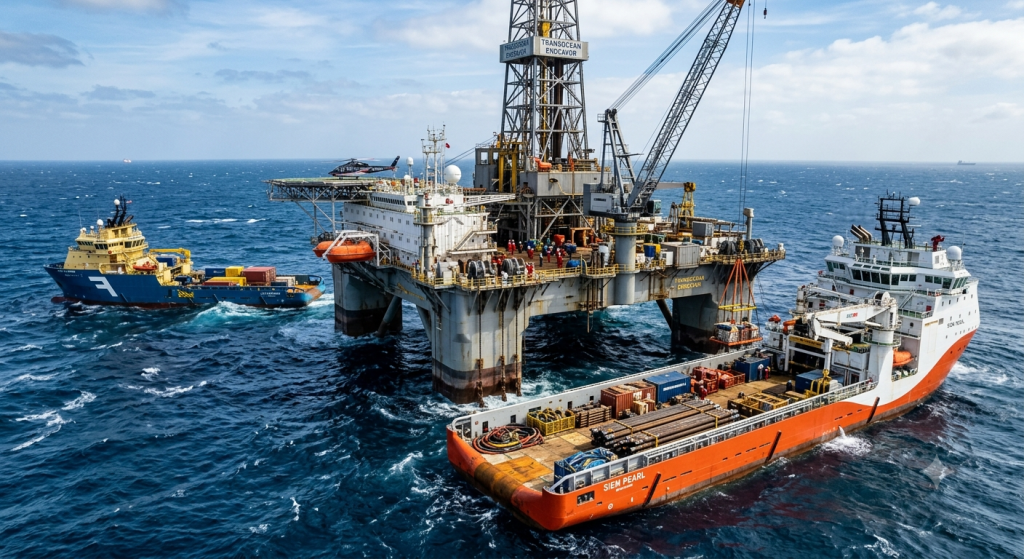
What is the oil and gas supply chain?
Definition (simple) and why it’s different from other industries
The oil and gas supply chain moves materials, equipment, and services from source to end use across the oil and gas industry. Unlike consumer goods chains, it involves long lead-time equipment, harsh operating environments, strict safety codes, and high-value contracts — where one missing certificate can stop a vessel sailing.
The 3 flows: materials, information/documents, and cash
Every project runs three flows in parallel: materials (pipe, valves, modules), information (queries, inspection reports, MDRs), and cash (advances, milestones, retentions). A delay in any one stalls the project.
Typical stakeholders
Key players: the operator (owns the asset), EPC/EPCM contractors (design and build), OEMs (manufacture equipment), logistics providers (freight, customs, marine transport), and inspection bodies (quality sign-off).
Oil & gas supply chain stages (upstream → midstream → downstream)
Upstream supply chain
Drilling rigs, completions equipment, wellheads, and production operations — high-value, long-lead items with tight HSE requirements.
Midstream supply chain
Pipelines, terminals, LNG facilities, and shipping move hydrocarbons between production and refining, requiring coordinated scheduling across multiple parties.
Downstream supply chain
Refining, petrochemicals, and distribution depend on continuous throughput, catalyst/chemical supply, and just-in-time delivery to avoid costly shutdowns.
Oil and gas supply chain and procurement — how procurement actually works
Procurement lifecycle
The cycle runs plan → source → award → execute → close-out, aligning technical scope with commercial strategy from the earliest project stage.
Vendor prequalification and bid evaluation
Vendors are prequalified on capability and capacity, then bids assessed through parallel technical and commercial evaluation before shortlisting.
Purchase orders, expediting, inspection, and documentation
Once awarded, POs trigger expediting, factory inspection, and document control so equipment arrives complete, compliant, and on schedule.
Typical procurement documents
RFQ, TBE/CBE, PO, ITP (inspection and test plan), and MDR (manufacturing data record) are the backbone documents of any award. See how these link to contract execution in our EPC contracts training course and how related disputes are resolved in procurement contracts, claims & disputes management.
Offshore supply chain management (what changes offshore)
Marine logistics basics
Vessel scheduling, weather windows, and port constraints govern offshore delivery, a missed weather window can push a shipment back weeks.
Critical spares strategy offshore
Operators balance spares availability against holding cost, since an offshore stockout is far costlier than an onshore one.
Common offshore failure points
Late materials, incomplete documentation, and QA holds at the quay are the three most common causes of offshore schedule slippage.
Tender management in oil & gas procurement (and how to avoid common mistakes)
Tender planning
Clear scope, a well-considered bid list, and realistic timelines prevent rework at evaluation.
Bid clarification + negotiation
Documenting every clarification and negotiated change in writing is the best defense against later disputes.
Award governance
Formal approval matrices, ethics declarations, and conflict-of-interest checks protect the integrity of the award decision.
KPIs that matter in the oil & gas supply chain
Delivery performance
OTIF (on-time-in-full), schedule adherence, and expediting effectiveness measure whether materials arrive when needed.
Cost performance
Track price variance, freight cost, demurrage, and claims value against budget.
Quality performance
NCR (non-conformance report) rate, rework hours, and vendor scorecards reveal recurring quality issues.
Inventory performance
Spares availability, inventory turns, and obsolescence rates show whether stock strategy matches operational risk — core themes in our materials management and lean & sustainable warehouse management courses.
Risk management playbook for oil & gas supply chains
Risk categories
Supplier, logistics, QA/QC, geopolitical, and compliance risk each need distinct mitigation approaches.
Mitigation checklist
Dual sourcing, independent QA surveillance, schedule buffers, and robust contract terms form the core of a resilient strategy.
Early warning signals
Lead-time drift, slipping document submissions, and rising NCR counts are the earliest indicators of trouble — explored further in our article on operational constraints and capability gaps in the oil and gas supply chain.
Practical checklist: 25 questions to ask before awarding a contract
Supplier capability + capacity: Proven experience on similar scope? Sufficient capacity for the schedule? Financial stability? Sub-vendor controls? Past performance references?
QA/QC and inspection readiness: Is the ITP agreed? Are hold points defined? Is third-party inspection scheduled? Are NCR procedures clear? Is the MDR structure agreed?
Logistics readiness: Are packing/preservation requirements specified? Is export/import documentation confirmed? Are routes and modes agreed? Is insurance adequate? Are Incoterms clear?
Contract terms: Are LDs (liquidated damages) defined? Is the warranty period appropriate? Is change control in place? Are payment milestones tied to verifiable progress? Are dispute mechanisms specified?
Recommended training paths
For procurement & contracts professionals
Build capability through our EPC contracts training course, procurement contracts, claims & disputes management course, and negotiation skills for energy professionals.
For project managers / EPC teams
Strengthen commercial context with upstream petroleum economics training alongside contract and claims management courses above.
For operations & maintenance / reliability teams
Focus on materials management, lean & sustainable warehouse management, and reliability engineering in oil and gas.
For a deeper look at how procurement supports the energy transition, read our deeper dive.
Frequently Asked Questions
It’s the end-to-end network moving materials, information, and cash from suppliers through upstream, midstream, and downstream operations.
Supply chain covers the full flow of materials and logistics; procurement is the sourcing and contracting function within it.
Vendor qualification, bidding, technical/commercial evaluation, purchase orders, expediting, and inspection through to delivery.
Late materials, documentation gaps, QA holds, and logistics constraints such as weather windows or port congestion.
It’s the coordination of marine logistics, spares, and QA for offshore assets — harder due to weather windows, vessel scheduling, and higher stockout costs.
Delivery (OTIF), cost (variance, freight, demurrage), quality (NCR rate), and inventory (availability, turns) KPIs.
Through parallel technical and commercial bid evaluation (TBE/CBE) against prequalification criteria.
RFQ, TBE/CBE, PO, ITP, and MDR documents track scope, evaluation, inspection, and manufacturing records.
Clear scope, documented clarifications, and formal award governance reduce ambiguity that leads to disputes.
Proactive expediting schedules, agreed inspection hold points, and disciplined documentation control.