
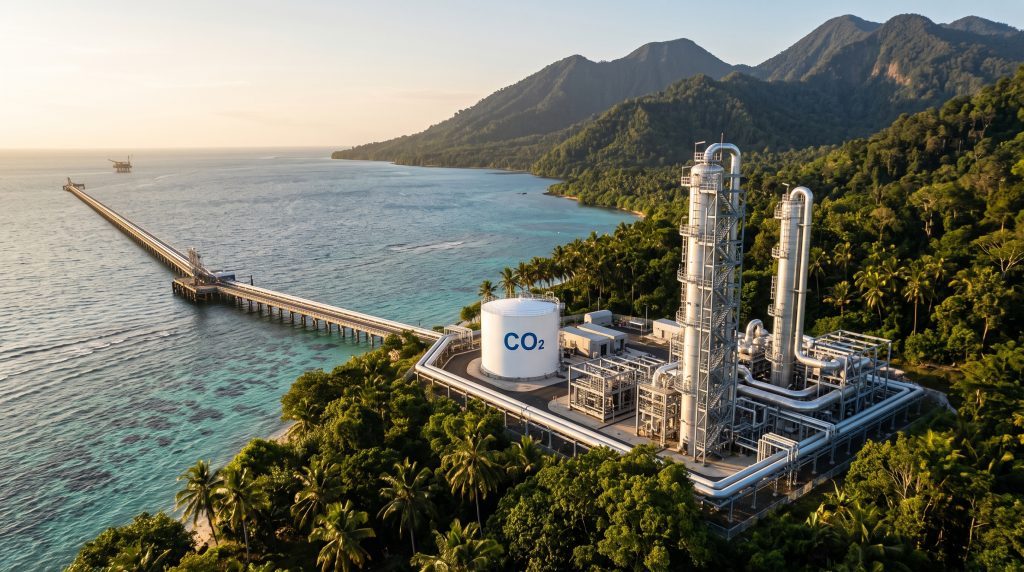
Carbon capture, utilisation and storage (CCUS), known in Indonesian as penangkapan, pemanfaatan, dan penyimpanan karbon, is a chain of technologies that captures carbon dioxide (CO₂) from industrial and energy sources, transports it, and then either uses it or stores it permanently in deep geological formations. Indonesia now has a dedicated legal framework, a large geological storage resource and a growing list of announced projects, which makes CCUS one of the most important project-development topics in the country’s energy sector.
This guide explains CCUS project development in Indonesia step by step. First, it covers regulation. Then it walks through capture, CO₂ transport, storage and MRV (measurement, reporting and verification).
What is CCUS and why does it matter for Indonesia?
CCUS captures CO₂ before it reaches the atmosphere. Operators then compress the captured CO₂, move it by pipeline, ship or truck, and inject it into a suitable rock formation deep underground, where they monitor it over time. However, where operators use CO₂ rather than store it, for example as an industrial input, the term CCU applies. For the wider regional picture, see our overview of carbon capture and storage in Asia.
For Indonesia, CCUS fits three national priorities at once. First, it supports the country’s Net Zero Emissions target for 2060. Second, it gives existing oil, gas, power and industrial assets a route to lower emissions. Third, it uses geological knowledge and engineering skills that the Indonesian upstream industry has built over many decades. In practice, sources of CO₂ for capture include gas processing, LNG, fertiliser and petrochemical plants, power generation and cement production.
How is CCS regulated in Indonesia?
Indonesia’s CCS rules build up in layers. The table below summarises the main instruments.
| Instrument | What it covers |
|---|---|
| MEMR Regulation No. 2 of 2023 | Foundation for CCS and CCUS within upstream oil and gas activities. |
| Presidential Regulation No. 14 of 2024 (Perpres 14/2024) | National framework for CCS: capture, transport and storage, including investment, licensing and cross-border CO₂. |
| SKK Migas guideline PTK-070/2024 | Technical and procedural guidance for CCUS development by cooperation contract contractors. |
Two routes to a storage project
Perpres 14/2024 provides two routes, and the right one depends on whether the developer already holds a working area.
| Working area route | Carbon storage licence area route | |
|---|---|---|
| Who it suits | Cooperation contract contractors (cost-recovery and gross-split PSCs) adding CCS to petroleum operations | Developers without an existing working area, including emitters and storage investors |
| How the area is obtained | Contractors add CCS to an existing working area | The Government awards a licence area by tender or limited selection. Unsolicited proposals go through limited selection, where the proposing investor has a right to match. |
| Approvals | A CCS plan with storage capacity certification goes in the plan of development (POD). SKK Migas (or BPMA for Aceh) approves the POD, and a first POD also needs MEMR approval. MEMR also approves the amendment to the cooperation contract. | An exploration licence (open to Indonesian entities and foreign permanent establishments), then a storage operation licence (Indonesian entities only) |
| Transport | No separate licence for transport within or between the contractor’s working areas when it is part of CCS under the contract | Developers need a carbon transportation licence |
| Revenue | Storage fees can be collected from carbon producers | Storage fees can be collected from carbon producers. Licence holders pay royalties to the Government on those fees. |
Transport licences and cross-border CO₂
Carbon transport requires its own licence. The Government can license pipelines, including subsea pipelines, for up to 20 years, and other modes such as ships and trucks for up to 10 years, in both cases with extensions available. Moreover, Perpres 14/2024 allows cross-border storage: operators must reserve at least 70% of storage capacity for domestic CO₂, and they may designate up to 30% for CO₂ from overseas producers that invest in or are affiliated with investments in Indonesia. Authorities are still developing the implementing details, so project teams should always check the latest official texts.
Stage 1: How is CO₂ captured?
Capture separates CO₂ from other gases at the source, using post-combustion, pre-combustion, oxy-fuel or process-stream methods. In Indonesia, announced projects centre on upstream gas and LNG facilities such as Tangguh, where CO₂ handling is already part of normal operations. Beyond these, other candidate sources include fertiliser and petrochemical plants, power generation and cement production.
Therefore, the quality of the captured CO₂ stream, especially its water content and impurities, matters for the next two stages. For a technology-by-technology comparison of capture methods, see our guide to carbon capture and storage in Malaysia.
Stage 2: How is CO₂ transported?
Next, operators dry and compress the captured CO₂ and move it to the storage site. Indonesia’s geography, with emitters and storage sites often on different islands or offshore, makes multi-modal transport an important design question: pipelines (including subsea), ships and, for small volumes, trucks. Because the Government licenses transport separately from storage, teams need to consider route planning and licensing together. The CO₂ Transport Networks for CCUS course looks at pipelines, shipping and storage as one transport network.
Flow assurance is central to transport design. In particular, engineers must manage phase behaviour, pressure and temperature changes, water content (which can cause corrosion if the CO₂ is not sufficiently dry), and the effect of impurities on the safe operating envelope. For pipeline operators, CO₂ Pipeline Integrity Management is a natural next topic.
Stage 3: Where and how is CO₂ stored?
Operators inject CO₂ into porous rock formations, usually at depths of around 800 metres or more, where it stays in a dense state. A good storage site has three things: enough pore space (capacity), the ability to accept CO₂ at the planned rate (injectivity), and a sealing layer above it (containment). Indonesia is considering two main storage types:
- Depleted oil and gas reservoirs: well-understood geology and existing data, with published estimates of roughly 10 Gt of CO₂ capacity.
- Deep saline aquifers: much larger potential, with 2024 estimates reaching hundreds of gigatonnes, but needing more site characterisation.
Over time, several mechanisms hold the injected CO₂ in place: structural trapping beneath the seal, residual trapping in the pore spaces, dissolution in formation water, and mineral trapping.
Indonesian project examples
Indonesian authorities have announced a portfolio of around 15 CCUS projects. For example, one of the best-known is the Tangguh Ubadari, CCUS, Compression (UCC) project in Papua Barat. The project partners announced the final investment decision in November 2024, the Government of Indonesia has designated the project a national strategic project, and the partners expect the initial phase to store about 15 million tonnes of CO₂ from Tangguh’s emissions. Meanwhile, developers are also evaluating areas such as the Sunda–Asri Basin offshore West Java as potential regional storage hubs. For a regional view, see our overview of CCS hubs in Asia.
The international standard: ISO 27914:2026
ISO 27914:2026 is the second edition of the international standard for geological storage of CO₂, published in March 2026 and replacing the 2017 edition. It sets requirements for onshore and offshore storage and covers site screening and feasibility, site characterisation, design and development, operation and preparation for project termination. It also includes integrated risk management and a method for quantifying the net mass of CO₂ stored. As a result, project teams in Indonesia can use it as a common technical reference when working with partners, financiers and regulators. In addition, Geological Carbon Storage: Picking the Right Reservoir covers storage site screening and selection.
Stage 4: What is MRV and why does it matter?
MRV stands for measurement (or monitoring), reporting and verification. It is how a project shows, with evidence, that the CO₂ it injects stays where it is meant to stay and that the quantities reported are correct. Teams plan MRV from the start of a project, so they do not have to add it at the end.
| Element | What it involves |
|---|---|
| Measurement / monitoring | Baseline surveys before injection; continuous measurement of injection rate, pressure and temperature; well integrity checks; subsurface imaging such as repeat seismic surveys; and, where relevant, near-surface and marine monitoring. |
| Reporting | Regular, consistent reports on the mass of CO₂ captured, transported and injected, and on the performance of the storage site, in the format required by the regulator and project agreements. |
| Verification | Independent review of the data and methods, which supports confidence among regulators, partners and, where applicable, carbon-credit programmes. |
Strong MRV also protects the project itself. In particular, good baseline data and clear monitoring plans make it easier to demonstrate safe performance throughout the injection period and in the preparation for closure. Frameworks for national carbon accounting continue to develop, so teams should design MRV plans to be flexible and well documented. The CCUS Well Design & Monitoring course looks at injection wells and monitoring design in detail.
What skills do Indonesian CCUS projects need?
Each stage draws on a different mix of engineering disciplines, so projects work best when these teams share a common vocabulary:
- Subsurface and storage: geology, reservoir engineering, CO₂ storage capacity and containment assessment.
- Wells: injection well design, integrity management and abandonment planning.
- Transport and flow assurance: CO₂ pipeline and shipping design, phase behaviour, corrosion control.
- Monitoring and MRV: monitoring design, data management, reporting and verification.
- Standards and regulation: ISO 27914, Indonesian CCS regulation, HSE and risk management.
EnergyEdge training programmes cover CO₂ storage, CO₂ transport, flow assurance, monitoring and ISO 27914, helping engineers and managers build these skills for project work in Indonesia and the wider region. For example, teams new to the topic can start with Introduction to Carbon Capture and Storage (CCS) for Non-Technical Professionals, and project managers may find CCS project risks and how to manage them useful.
Upcoming training on this topic
Scheduled courses on the EnergyEdge calendar that relate to the topics in this guide, including a session in Jakarta and virtual options. See also more CCS and CCUS courses.
| Course | Dates | Format / location |
|---|---|---|
| Carbon Capture, Utilization & Storage (CCUS) | 19 – 23 Oct 2026 | Virtual (VILT) |
| Carbon Capture and Storage (CCS): Project Risks & How to Manage Them | 16 – 20 Nov 2026 | Virtual (VILT) |
| CO₂ Transport Networks for CCUS | 23 – 25 Nov 2026 | Kuala Lumpur |
| Carbon Capture, Utilization & Storage (CCUS) Well Design & Monitoring | 30 Nov – 2 Dec 2026 | Jakarta |
| Applied Carbon Capture & Storage Geomechanics | 30 Nov – 4 Dec 2026 | Kuala Lumpur |
| Introduction to Carbon Capture and Storage (CCS) for Non-Technical Professionals | 7 – 9 Dec 2026 | Kuala Lumpur |
| Geological Carbon Storage: Picking the Right Reservoir | 26 – 30 Apr 2027 | Jakarta, Kuala Lumpur, Singapore and other locations |
Dates as listed on the EnergyEdge Training Calendar 2026 on 12 October 2026. Please check the calendar for the latest availability.
FAQ
CCUS stands for carbon capture, utilisation and storage. CCS covers capture, transport and storage. In addition, CCUS includes utilisation, which means companies use captured CO₂ as an input for other products or processes.
Several instruments apply together. First, MEMR Regulation No. 2 of 2023 covers upstream oil and gas. Second, Presidential Regulation No. 14 of 2024 sets the national CCS framework. In addition, implementing rules and guidelines such as SKK Migas PTK-070/2024 add technical detail.
Yes, within limits. Perpres 14/2024 allows cross-border storage, but operators must reserve at least 70% of a storage site’s capacity for domestic CO₂. Moreover, they may designate up to 30% for CO₂ from overseas producers that invest in, or are affiliated with investments in, Indonesia. However, authorities are still developing the implementing details, so please check the latest official texts.
Candidate sites include depleted oil and gas reservoirs and deep saline aquifers in Indonesia’s sedimentary basins, both onshore and offshore. However, teams must characterise and certify each site for capacity and containment before storage starts.
MRV means measurement (monitoring), reporting and verification. First, it shows how much CO₂ the project injected. Then, it confirms that the CO₂ remains safely stored.
ISO 27914:2026 sets requirements for geological storage of CO₂, from site screening to preparation for project termination. In addition, it includes a method for quantifying net stored mass.
Ringkasan dalam Bahasa Indonesia
CCUS (penangkapan, pemanfaatan, dan penyimpanan karbon) adalah rangkaian teknologi untuk menangkap CO₂ dari sumber emisi industri dan energi, mengangkutnya, lalu memanfaatkan atau menyimpannya secara permanen di formasi geologi bawah permukaan. Di Indonesia, kerangka regulasi mendukung pengembangan proyek CCUS. Misalnya, kerangka tersebut mencakup Peraturan Menteri ESDM Nomor 2 Tahun 2023, Peraturan Presiden Nomor 14 Tahun 2024, dan pedoman SKK Migas PTK-070/2024.
- 01PenangkapanPisahkan CO₂ di sumbernya
- 02TransportasiPipa, kapal, atau truk
- 03PenyimpananReservoir terdeplesi atau akuifer salin dalam
- 04MRVPengukuran, pelaporan, verifikasi
Tahapan proyek dimulai dari penangkapan karbon. Selanjutnya, operator mengangkut CO₂ melalui pipa, kapal, atau truk. Kemudian, mereka menyimpan CO₂ di reservoir minyak dan gas bumi yang telah terdeplesi atau di akuifer salin dalam. Terakhir, MRV (pengukuran, pelaporan, dan verifikasi) memastikan bahwa CO₂ tersimpan dengan aman.
ISO 27914:2026. Selain itu, standar ini menjadi acuan internasional untuk penyimpanan geologis CO₂.
Pertanyaan yang sering diajukan
Apa itu CCS dan CCUS?
CCS adalah penangkapan dan penyimpanan karbon. Sementara itu, CCUS menambahkan unsur pemanfaatan, yaitu penggunaan CO₂ hasil tangkapan sebagai bahan baku atau input proses lain.
Apa saja jalur perizinan CCS di Indonesia?
Perpres 14/2024 mengatur dua jalur. Pertama, kegiatan CCS di dalam wilayah kerja melalui kontrak kerja sama. Kedua, kegiatan CCS di wilayah izin penyimpanan karbon melalui izin eksplorasi, kemudian izin operasi penyimpanan. Selain itu, pengangkutan karbon memerlukan izin tersendiri.
Apa yang dimaksud dengan MRV dalam proyek CCS?
MRV adalah proses pengukuran (pemantauan), pelaporan, dan verifikasi. Dengan demikian, proses ini menunjukkan jumlah CO₂ yang disuntikkan serta kinerja lokasi penyimpanan.
