
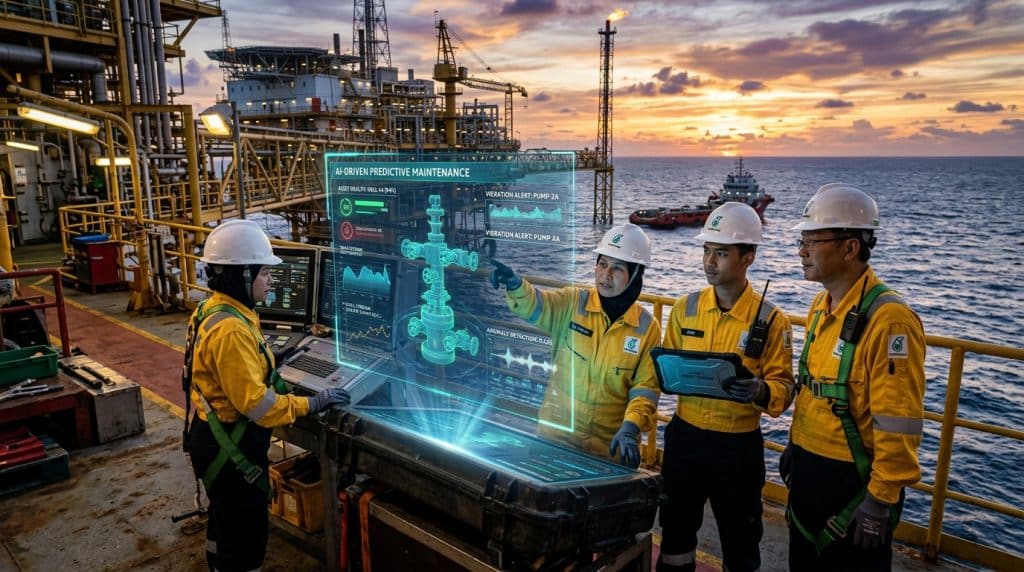
Artificial intelligence has moved from the conference-circuit buzzword stage into the operational core of Malaysia’s upstream sector. What was a scattering of proof-of-concepts two years ago is now a coordinated, capital-backed transformation led by the national oil company and echoed across the region. For operators, service companies and the engineers who run their assets, the question is no longer whether to adopt AI, but how quickly they can build the data foundations and human capability to use it well.
PETRONAS sets the regional pace
No company has signalled its intent more clearly than PETRONAS. Group CEO Tengku Muhammad Taufik has framed AI as an “indispensable foundational technology” for navigating the energy trilemma of security, affordability and sustainability — language that has translated into one of the most comprehensive digital programmes anywhere in the industry.
At the centre sits the myPROdata platform, the digital gateway to Malaysia’s upstream data. PETRONAS is evolving it from a conventional data repository into an AI-powered engine: myPROdata 2.0 introduces generative-AI semantic search for the Malaysia Bid Round, with the longer-term ambition of an integrated database powered by “agentic AI” capable of autonomously performing tasks such as seismic interpretation and reservoir analysis.
The partnership activity behind this is striking. At Energy Asia 2025 in Kuala Lumpur, PETRONAS, through Malaysia Petroleum Management, signed memoranda with Amazon Web Services, Microsoft, SLB, Halliburton, Accenture, Iraya Energies, Rystad Energy and S&P Global — all focused on agentic AI and high-performance computing. A further round of agreements at ADIPEC 2025 added Beicip-Franlab, ConocoPhillips, Shell, TotalEnergies and PTTEP, targeting seismic imaging and AI/ML development. PETRONAS Carigali separately signed with seismic-AI specialist Geoteric, whose software has reduced interpretation cycle times by up to 90%. And through TriCipta — a venture with Beicip-Franlab and Malaysian firm AFED Digital launched in 2025 — PETRONAS is co-developing a suite of AI tools spanning exploration, development and production. The commercial logic is blunt: deliver “advantaged barrels,” found faster and produced more economically, to help sustain domestic output near two million barrels of oil equivalent per day through 2026–28.
Where AI is actually being applied
The use cases now in play map closely to the workflows that define a working oilfield.
Subsurface and exploration. Machine learning is being used to interpret seismic volumes, characterise reservoirs and quantify subsurface uncertainty in heterogeneous formations where porosity and permeability defy conventional modelling. EnergyEdge’s Subsurface Uncertainty Quantification using Machine Learning – Improved Reservoir Management through Data Driven Predictions and Advances in 3D Seismic Interpretation and Attributes speak directly to this shift, while Applied Machine Learning and Data Science for Upstream Professionals – Quantitative Approaches to Reservoir and Field Performance builds the underlying data-science foundation.
Drilling and production optimisation. Operators are mining drilling datasets to lift rate of penetration and cut non-productive time, and applying real-time analytics to artificial-lift systems. Courses such as Modelling Drilling Data with Statistics and AI in Python – Optimize Drilling Efficiency through Data Science Innovation, The Automated Oilfield: AI and Drilling Optimization, and Data Analytics Workflows for Artificial Lift, Production and Facility Engineers address these workflows hands-on.
Asset integrity and predictive maintenance. This is where regional peers are scaling fastest. Shell’s AI-driven predictive maintenance programme, built on C3.ai and Azure, has cut unplanned downtime sharply across upstream and downstream assets; BP has deployed digital twins on offshore platforms for remote corrosion and valve inspection. For Malaysia’s ageing offshore infrastructure, the same techniques — sensor data feeding ML models that flag failures weeks ahead — are increasingly essential. Digital Twin Engineering – From Concept to Deployment in Oil & Gas Operations, Smart Oilfield and Sensor Technology, Computer Vision and Real-Time Analytics and Managing Integrated and Digitalized Oil and Gas Assets cover this territory.
The energy transition and the back office. AI is also entering CCS workflows — reflected in CCS Analytics: AI-Based Carbon Capture & Storage — and finance functions, through Budgeting & Forecasting In The Artificial Intelligence Era – Empowering Energy Finance Professionals and the Power BI® – Business Data Analytics course. The full range sits within EnergyEdge’s Data Analytics, Machine Learning & Artificial Intelligence portfolio.
The critical issues operators must confront
The technology is the easy part. The hard part — and where most value leaks away — is organisational. Four issues deserve board-level attention.
1. Data foundations come first. Agentic AI is only as good as the data beneath it. Many operators still struggle with fragmented, poorly labelled, siloed datasets. The standardisation work — common data models, clean historians, governed access — is unglamorous but non-negotiable. AI projects that skip it stall at the pilot stage.
2. The talent gap is the binding constraint. TalentCorp estimates roughly 697,000 Malaysian workers across 22 sectors — oil and gas prominently among them — will be significantly affected by AI and automation within three to five years. Microsoft’s 2026 Malaysia Work Trend Index found 78% of knowledge workers already using AI weekly, yet only 22% felt adequately trained and just 34% reported a clear company AI policy. That gap between enthusiastic adoption and capability is precisely where risk concentrates. Closing it requires structured, role-specific upskilling for both technical staff and the non-specialists who must learn to work alongside these tools — the gap that Introduction to Artificial Intelligence For Non-Data Scientists In Oil & Gas and the leadership-focused Strategic Applications of Artificial Intelligence for Business Leaders in Energy are designed to address. HRDC-claimable training, available through providers such as EnergyEdge, lowers the cost of doing this at scale.
3. Governance and “shadow AI.” When staff adopt tools faster than policy can keep up, proprietary data leaks become a real hazard — one Penang manufacturer reportedly pasted source code into a public chatbot. Operators need clear usage policies, secure internal deployments and verification protocols before, not after, scaling.
4. From pilots to scaled value. The industry’s recurring failure mode is the perpetual proof-of-concept. The operators capturing real returns — Repsol now runs AI across 60 production use cases — treat AI as a managed portfolio with measurable KPIs, cross-functional squads pairing domain experts with data scientists, and a deliberate path from pilot to enterprise scale.
The bottom line
Malaysia has the national backing, the operator commitment and a young, digitally fluent workforce to lead Southeast Asia’s AI-enabled energy transition. The differentiator will not be access to algorithms — those are increasingly commoditised — but the discipline to build clean data, govern its use, and systematically grow the human capability to turn data into barrels. Operators that invest now in both infrastructure and people will be the ones producing the advantaged barrels of the next decade.
Frequently Asked Questions
AI has moved well beyond pilots into the operational core of the upstream sector. The most active areas are subsurface interpretation (using machine learning to read seismic data and characterise reservoirs), drilling and production optimisation, and predictive maintenance of physical assets. It is also entering carbon-capture workflows and finance functions such as budgeting and forecasting. The shift is being driven from the top, with PETRONAS framing AI as foundational rather than experimental.
PETRONAS is running one of the most comprehensive digital programmes in the global industry. Its myPROdata platform — the digital gateway to Malaysia’s upstream data — is being upgraded to myPROdata 2.0 with generative-AI semantic search for the Malaysia Bid Round, with a longer-term goal of an “agentic AI” engine that can autonomously perform tasks like seismic interpretation. It has signed major partnerships with AWS, Microsoft, SLB, Halliburton, Accenture, Shell, TotalEnergies and others, launched the TriCipta AI venture for subsurface intelligence, and engaged seismic-AI specialist Geoteric to accelerate exploration.
Three stand out. First, subsurface and exploration analytics, where ML cuts seismic interpretation cycle times dramatically and improves reservoir characterisation. Second, drilling and production optimisation, lifting rate of penetration and reducing non-productive time. Third, predictive maintenance and asset integrity, which prevents costly unplanned downtime on ageing offshore infrastructure. These map directly to EnergyEdge courses such as Subsurface Uncertainty Quantification using Machine Learning – Improved Reservoir Management through Data Driven Predictions and Modelling Drilling Data with Statistics and AI in Python – Optimize Drilling Efficiency through Data Science Innovation.
Agentic AI refers to systems that don’t just analyse data on request but can autonomously carry out multi-step tasks — for example, running a seismic interpretation workflow or surfacing investment-ready prospects with limited human prompting. For E&P, the appeal is speed and scale: de-risking investment decisions and shortening the path from data to drilling. It is the direction PETRONAS has signalled for its data platform, though it depends entirely on clean, well-governed underlying data to work reliably.
By shifting maintenance from reactive or calendar-based to predictive. Sensor data feeds machine-learning models that detect abnormal patterns and flag likely failures weeks in advance, so crews intervene before equipment breaks. Regional peers demonstrate the payoff: Shell’s AI-driven predictive maintenance programme has sharply cut unplanned downtime, and BP uses digital twins for remote corrosion and valve inspection. Relevant training includes Digital Twin Engineering – From Concept to Deployment in Oil & Gas Operations and Smart Oilfield and Sensor Technology.
No. The technology is increasingly commoditised; the binding constraints are organisational. The first is data: fragmented, poorly labelled, siloed datasets cause projects to stall, so common data models and governed access are non-negotiable prerequisites. The second is people — the capability to use these tools well. Operators that skip the unglamorous data-foundation work rarely get past the pilot stage.
It is the defining challenge. TalentCorp estimates roughly 697,000 Malaysian workers across 22 sectors — oil and gas prominently among them — will be significantly affected by AI and automation within three to five years. Microsoft’s 2026 Malaysia Work Trend Index found 78% of knowledge workers already using AI weekly, yet only 22% felt adequately trained and just 34% reported a clear company AI policy. That gap between enthusiastic adoption and actual capability is where most operational risk concentrates.
Shadow AI describes employees adopting AI tools faster than company policy can govern them — for instance, pasting proprietary data into public chatbots, which has already caused data leaks at some Malaysian firms. The answer is not to ban AI but to get ahead of it: issue clear usage policies, provide secure internal deployments, and train staff on verification and data-handling protocols before scaling. A “minimum viable policy” today beats a perfect one in six months.
The recurring failure mode is the perpetual proof-of-concept that never scales. Operators capturing real returns treat AI as a managed portfolio with measurable KPIs (time saved, downtime avoided, accuracy gained), run small pilots with clear metrics, and deliberately scale what works. Pairing domain experts with data scientists in cross-functional teams — rather than leaving AI to an isolated data unit — is consistently what bridges the gap from experiment to embedded capability.
Capability-building has to span both technical specialists and the non-specialists who must work alongside these tools. Foundational and leadership awareness can start with Introduction to Artificial Intelligence For Non-Data Scientists In Oil & Gas and the Strategic Applications of Artificial Intelligence for Business Leaders in Energy webinar, while practitioners can progress to hands-on courses like Applied Machine Learning and Data Science for Upstream Professionals – Quantitative Approaches to Reservoir and Field Performance and Assessment Based Training – Python Programming & Analytics for the Oil & Gas Sector – Maximising Value from Data Assets. As an HRD Corp registered training provider, EnergyEdge’s programmes are claimable, which lowers the cost of upskilling at scale. The full portfolio sits under EnergyEdge’s Data Analytics, Machine Learning & Artificial Intelligence training courses.
