
AI in Oil and Gas: Moving from Pilot to Operations
AI in oil and gas has moved beyond pilot projects and proof-of-concept dashboards. The real test is now operational. Can AI in oil and gas operations genuinely improve reservoir decisions, reduce downtime, strengthen asset reliability and help technical teams manage complex operating data?
That question matters in Southeast Asia. Malaysia, Indonesia, Singapore and Thailand each face different energy pressures — upstream competitiveness, asset performance, gas and LNG system reliability, digital infrastructure growth and workforce capability. In each market, AI in oil and gas industry applications are becoming part of how operators plan, monitor and optimise.
The IEA’s Southeast Asia Energy Outlook 2024 frames the region’s long-term outlook around energy demand, security, affordability and emissions. These forces shape how quickly energy companies can adopt digital technologies and scale new operating models.
AI and digital twins are not just technology trends. Used well, they can become practical operating disciplines. Used poorly, they add complexity to organisations already managing legacy assets, fragmented data, cybersecurity requirements and uneven workforce readiness.
KEY INSIGHT
The strongest AI in oil and gas applications do not start with technology. They start with a clear operational problem — reducing non-productive time, improving equipment reliability, interpreting subsurface uncertainty, or optimising production. Technology is the enabler, not the strategy.
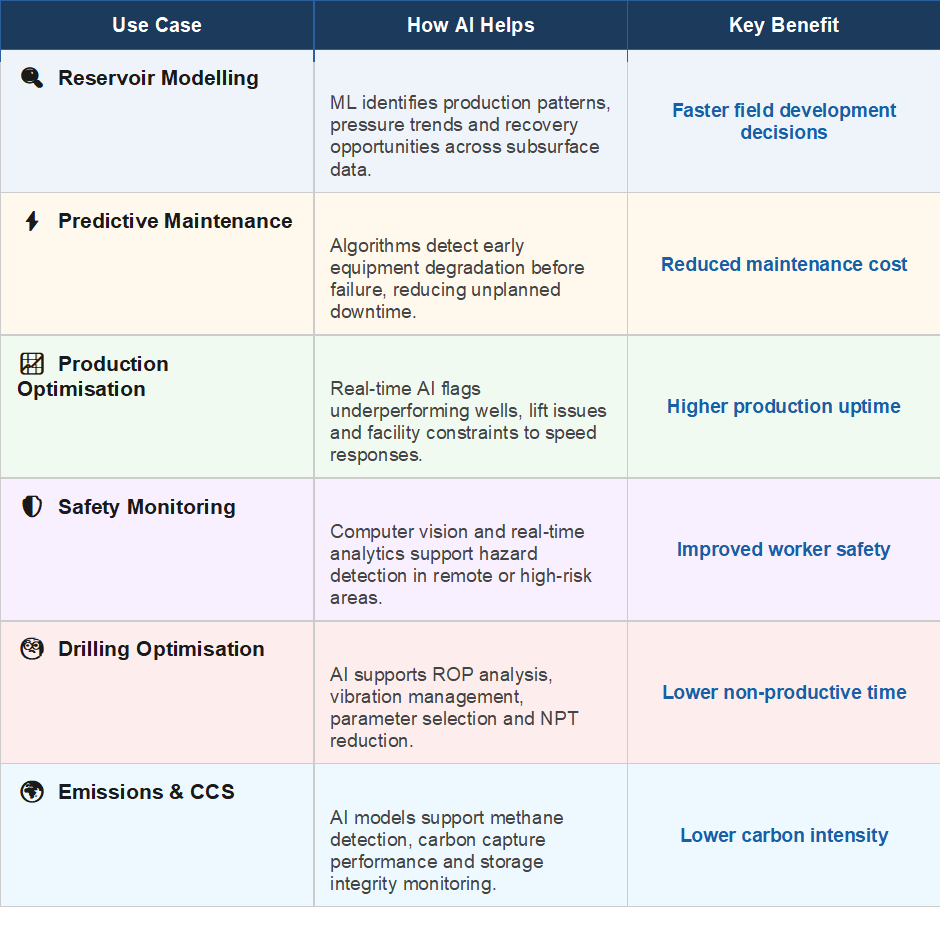
INFOGRAPHIC: AI USE CASES IN OIL & GAS
Where AI creates operational value — six proven application areas
What AI in Oil and Gas Operations Needs to Solve
The strongest applications of AI in oil and gas focus on clear operational problems: reducing non-productive time, improving equipment reliability, interpreting subsurface uncertainty and optimising production. AI in oil and gas operations should avoid broad transformation claims — operators need to assess whether AI helps teams make better decisions under uncertainty.
A model has limited value if the organisation cannot act on its output. AI also creates a wider energy-system challenge. The IEA notes that AI development and deployment depend heavily on data centres, making computing infrastructure an increasingly important part of the energy system. AI adoption therefore requires reliable power, secure data infrastructure, cloud strategy, cyber resilience and clear emissions considerations.
The practical question is not whether AI can analyse data. It can. The harder question is whether technical teams can trust AI outputs in decisions that affect production, safety, capital and compliance.
RISK TO WATCH
AI governance is not optional. Without clear model validation, refresh cycles and decision ownership, AI systems can degrade silently — generating outputs that appear credible but no longer reflect operating reality. This risk is highest when AI is embedded in safety-critical workflows without adequate human oversight.
Malaysia: AI Moves Closer to Upstream Capability
Malaysia offers one of the clearest regional examples of AI entering core upstream work. PETRONAS, through Malaysia Petroleum Management, announced collaborations to advance seismic imaging, artificial intelligence in oil and gas, machine learning and high-performance computing for Malaysia’s upstream sector.
This matters because the focus areas sit close to high-value technical decisions. Seismic imaging, subsurface interpretation and high-performance computing shape exploration, development planning and recovery strategy. In this context, machine learning oil and gas applications are not digital add-ons — they can influence how operators reduce uncertainty, screen opportunities and prioritise capital.
Malaysia has also formalised national AI coordination through the National AI Office, signalling a broader focus on AI governance, talent and ecosystem development. For the oil and gas sector, AI adoption is not only a technology decision. It also requires governance, risk controls and workforce capability. Technical teams must understand how models work, where assumptions sit, and when human judgement should override automated recommendations.
Indonesia: Reservoir Performance as a Practical AI Use Case
Indonesia presents a different but equally practical opportunity. AIQ announced a strategic agreement with SKK Migas in November 2025 to deploy its Reservoir Performance Advisor module from the AR360 Intelligent Reservoir Management solution across upstream operations in Indonesia.
Reservoir performance is a credible entry point for AI. The problem is commercially material, technically complex and data-heavy. Machine learning for reservoir management can help teams identify patterns across production history, pressure behaviour, well performance and subsurface data. It can also support faster scenario comparison when conventional workflows become slow or manual.
AI does not replace reservoir engineering. Subsurface uncertainty quantification using machine learning must remain grounded in geological context, production history and engineering judgement. Engineers, geoscientists and field development teams do not need to become full-time data scientists. They do, however, need enough analytical fluency to challenge outputs and recognise weak assumptions.
Singapore: Digital Infrastructure and AI Readiness
Singapore’s relevance to AI in oil and gas is less about domestic upstream production. Its role lies in digital infrastructure, LNG, energy systems, trading, risk analytics and regional decision support. Singapore’s National AI Strategy 2.0 has moved from strategy into implementation, with continued investment in AI adoption, development and deployment across sectors.
For energy companies, Singapore can serve as a hub for commercial analytics, LNG portfolio management, market intelligence and regional planning. Infrastructure also shapes Singapore’s AI pathway: its Green Data Centre Roadmap aims to provide at least 300 MW of additional data centre capacity in the near term, with more capacity supported by greener energy deployment.
This matters because AI systems depend on electricity, cooling, connectivity and secure digital architecture. Companies using AI across oil, gas, LNG and power systems must consider those requirements early. Singapore’s energy transition also remains closely linked to gas. The Energy Market Authority identifies natural gas as one of Singapore’s “Four Switches,” giving Singapore a specific role where AI in oil and gas industry applications connect to energy reliability, gas systems and regional resilience.
Thailand: Operator-Led AI and Workforce Readiness
Thailand provides another useful regional perspective. The Asian Technology Excellence Awards recognised PTTEP in 2025 under the “AI – Oil & Gas” category, pointing to growing operator-level use of AI in performance improvement and organisational capability.
Thailand’s strongest opportunities may sit in mature field performance, maintenance optimisation, production efficiency and asset integrity. These areas allow operators to apply AI in oil and gas without redesigning entire asset systems. Thailand’s National AI Strategy and Action Plan 2022–2027 aims to build human capacity alongside technology, an important signal that workforce readiness is part of the national digital agenda.
INFOGRAPHIC: REGIONAL AI READINESS — SOUTHEAST ASIA
Country-by-country AI opportunity and capability snapshot
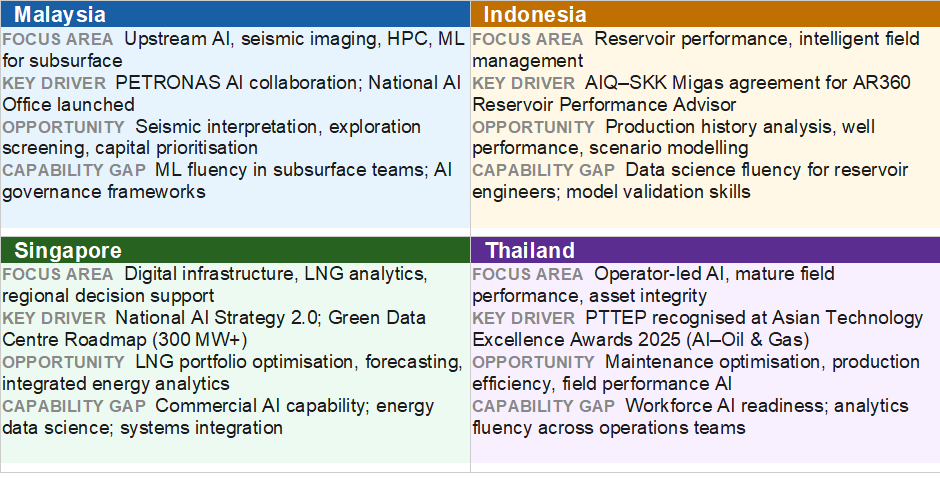
Sources: PETRONAS Activity Outlook 2026–2028 · AIQ–SKK Migas announcement Nov 2025 · Singapore National AI Strategy 2.0 · Asian Technology Excellence Awards 2025
Digital Twins Require Governance, Not Just Visualisation
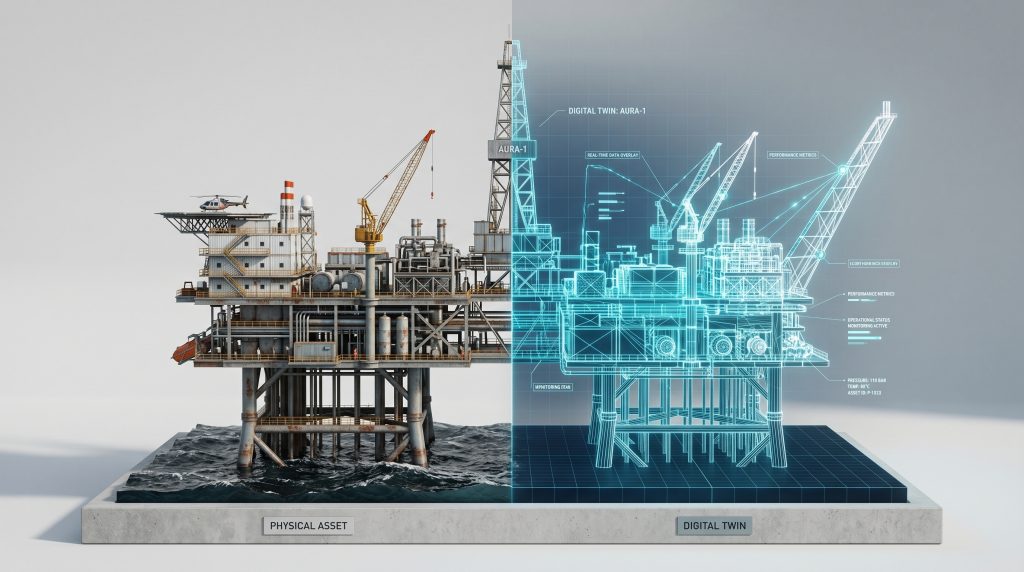
Digital twin oil and gas technologies are often described as virtual models of physical assets, systems or processes. That definition is useful, but incomplete. In real operations, a digital twin creates value only when it supports better decisions. A useful twin connects asset data, operating conditions, engineering assumptions, model logic and performance indicators.
Teams must also maintain and validate the model over time. Without updates and governance, a digital twin can become a misleading representation of reality. Digital twin engineering is therefore both a technical and a management discipline. Operators need to define trusted data sources, validation ownership, refresh cycles and decision rules.
Digital twin applications in oil and gas can support production optimisation, equipment monitoring, facility performance, emissions tracking, process safety reviews and maintenance planning. They work best when applied to defined operational questions. They work poorly when teams build broad digital replicas without clear decision rights.
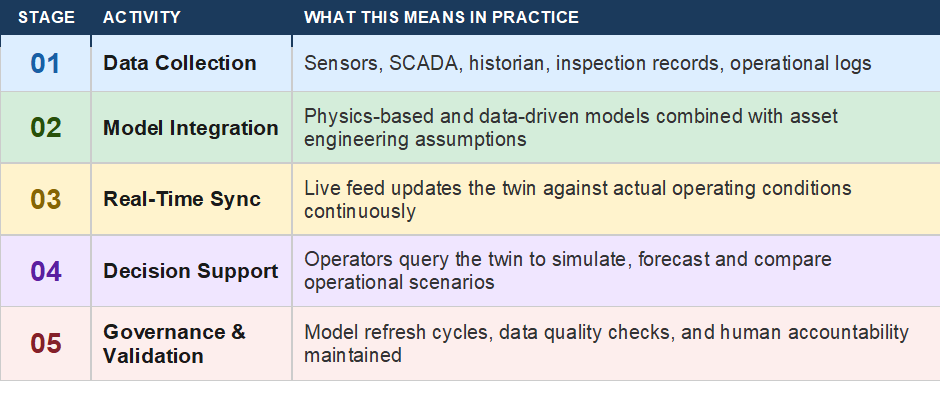
INFOGRAPHIC: DIGITAL TWIN LIFECYCLE
How a digital twin creates operational value — five stages
| Build your digital twin capability with EnergyEdge EnergyEdge’s Digital Twin Engineering in Oil and Gas Operations course is designed for engineers and technical professionals who want to understand how to build, validate and govern digital twins in real operational settings — not just in theory. → Explore the Digital Twin Engineering course at EnergyEdge |
AI Use Cases Must Stay Operationally Specific
The most credible AI applications in oil and gas remain use-case driven. In drilling, AI drilling optimisation can support parameter selection, rate-of-penetration analysis, vibration management and non-productive time reduction. In production, real-time production optimisation in digital oilfield environments can help teams identify underperforming wells, artificial lift issues and facility constraints.
Maintenance teams benefit from predictive models that detect early signs of equipment degradation. These create value only when maintenance planning, spare parts availability and inspection capacity can support action. Root cause analysis for preventing operational failures offers another example. AI can support pattern recognition across incident history, operating conditions and maintenance data, but still requires knowledge of equipment history, human factors and operating context.
Computer vision and real-time analytics may also support inspection, safety monitoring and remote operations. These tools improve visibility in hazardous or hard-to-access locations. Operators must still assess false alarm rates, field conditions and response capability.
ENERGYEDGE PERSPECTIVE
The technology stack matters. The capability stack matters more. AI in oil and gas operations only delivers returns when the teams using it can interpret outputs, validate assumptions and make decisions from probabilistic information — not just fixed reports.
The Capability Gap Behind AI Adoption
The industry often focuses on technology platforms. Capability remains the harder barrier. AI training for oil and gas professionals has become more important because AI adoption will not remain inside data science teams. Engineers, managers, maintenance teams and business leaders will all interact with AI-enabled workflows.
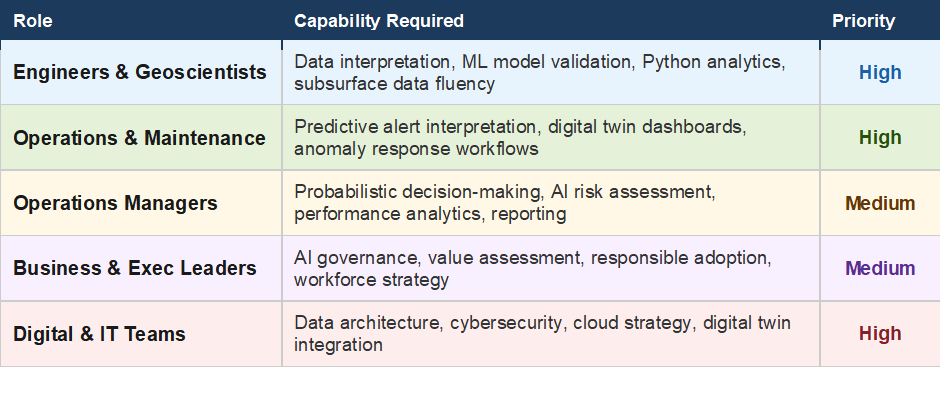
Engineers need stronger data interpretation skills. Operations teams need to understand how predictive systems generate alerts. Managers must make decisions from probabilistic outputs. Business leaders need a clearer view of AI risk — where AI creates value, where it introduces uncertainty and where human oversight remains essential.
Artificial intelligence for non-data scientists in oil and gas is therefore a practical workforce requirement. The goal is not to turn every engineer into a machine learning specialist. The goal is to build enough fluency for teams to use AI responsibly and question it intelligently.
Data analytics oil and gas capability forms part of the same foundation. Python, Power BI and visual analytics tools can help technical teams move from static reporting to active interpretation. Python programming and analytics for the oil and gas sector can support reservoir analysis, production surveillance, drilling data modelling and operational forecasting.
INFOGRAPHIC: AI CAPABILITY REQUIREMENTS BY ROLE
What different teams need to work effectively with AI in oil and gas
| Close the AI capability gap across your team EnergyEdge delivers practical AI and digital training across applied machine learning for upstream professionals, Python analytics, Power BI, smart oilfield technology, and AI training for oil and gas professionals — designed for technical teams, not data science specialists. → View all AI and digital courses at EnergyEdge |
AI, Digital Twins and the Energy Transition
AI in oil and gas industry applications also matter for the energy transition. Operational efficiency, emissions monitoring, methane detection, carbon capture performance and energy management all require better data and stronger analytics. CCS analytics and AI-based carbon capture and storage show how modelling and monitoring can support lower-carbon operations.
Southeast Asia will not follow one single transition pathway. Some markets will continue to rely on gas for reliability. Others will expand renewables, storage and regional power connectivity. More complex energy systems require stronger forecasting, modelling and operational analytics. AI in oil and gas will not resolve the energy transition by itself, but it can improve how companies understand assets, manage uncertainty and make decisions.
TRANSITION IMPLICATION
Emissions monitoring, methane leak detection, carbon capture performance tracking and energy optimisation all require the same capabilities as AI in oil and gas operations: reliable data, validated models and teams who can interpret probabilistic outputs. Building AI capability now is also building energy transition capability.
What This Means for Oil and Gas Organisations
AI and digital twins should not sit outside core operations as innovation projects. Organisations need to link them to asset strategy, operating risk, workforce capability and measurable outcomes. Malaysia’s strongest near-term opportunity sits in upstream AI, seismic imaging, machine learning and high-performance computing. Indonesia’s opportunity is closely tied to reservoir performance and intelligent field management.
Singapore’s role is more likely to involve digital infrastructure, energy systems, LNG analytics and regional decision support. Thailand’s opportunity centres on operator-led AI adoption and workforce readiness.
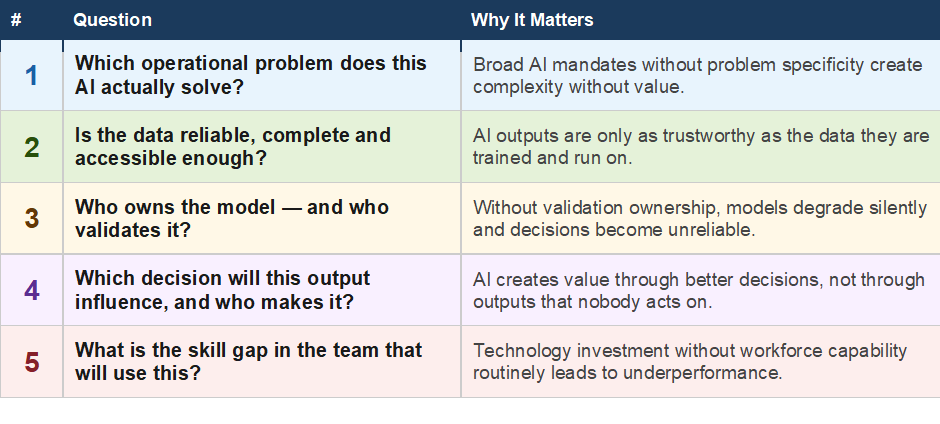
INFOGRAPHIC: 5 QUESTIONS EVERY AI DECISION NEEDS
What leaders must answer before committing to AI in oil and gas operations
Conclusion: AI Will Reward Disciplined Operators
AI in oil and gas will not remove uncertainty. It will not replace engineering judgement, eliminate operational risk or resolve structural energy challenges. Its value is more practical: improved pattern recognition, asset visibility, forecasting and decision support.
The organisations that benefit most may not be those with the largest AI announcements. The stronger performers will connect AI in oil and gas operations to real problems, govern models carefully, invest in capability and maintain technical accountability.
For Southeast Asia’s oil and gas sector, AI and digital twins are not just digital transformation tools. They are tests of operational maturity. Companies that treat them as disciplined operating capabilities will be better positioned to manage uncertainty, improve performance and build a workforce ready for the next phase of the energy industry.
| Stay ahead with EnergyEdge insights and training EnergyEdge publishes regular market insights and delivers specialist training for oil and gas professionals across Asia and beyond. Whether your team is preparing for AI adoption, digital transformation or energy transition capability, we can help. → Get insights and training updates from EnergyEdge |
Frequently Asked Questions
AI in oil and gas refers to the application of machine learning, data analytics, computer vision and predictive modelling to operational challenges in upstream, midstream and downstream energy. Common applications include reservoir modelling, predictive maintenance, drilling optimisation, production management, safety monitoring and emissions tracking.
A digital twin in oil and gas is a virtual model of a physical asset, system or process that connects real-time data, engineering assumptions and model logic to support operational decisions. Digital twin oil and gas applications include facility monitoring, production optimisation, equipment reliability and process safety.
Machine learning oil and gas applications include reservoir performance analysis, well production surveillance, predictive maintenance, drilling parameter optimisation, anomaly detection and subsurface data interpretation. Machine learning is most effective when applied to specific, data-rich operational problems with clear decision outcomes.
Malaysia, Indonesia, Singapore and Thailand are each adopting AI in oil and gas in different ways. Malaysia is focused on upstream AI and seismic imaging. Indonesia is deploying intelligent reservoir management. Singapore is building digital infrastructure and LNG analytics capability. Thailand is advancing operator-led AI adoption in mature field operations.
AI training for oil and gas professionals should cover applied machine learning, data interpretation, Python analytics, digital twin engineering, Power BI and smart oilfield technology. The goal is not to create data scientists, but to build AI fluency across engineering, operations and management roles.
Oil and gas digital transformation is the process of integrating digital technologies — including AI, digital twins, cloud computing, IoT and data analytics — into core operations, commercial decisions and workforce capability. Transformation is most successful when it is linked to specific operational problems, governed carefully and supported by workforce development.
