
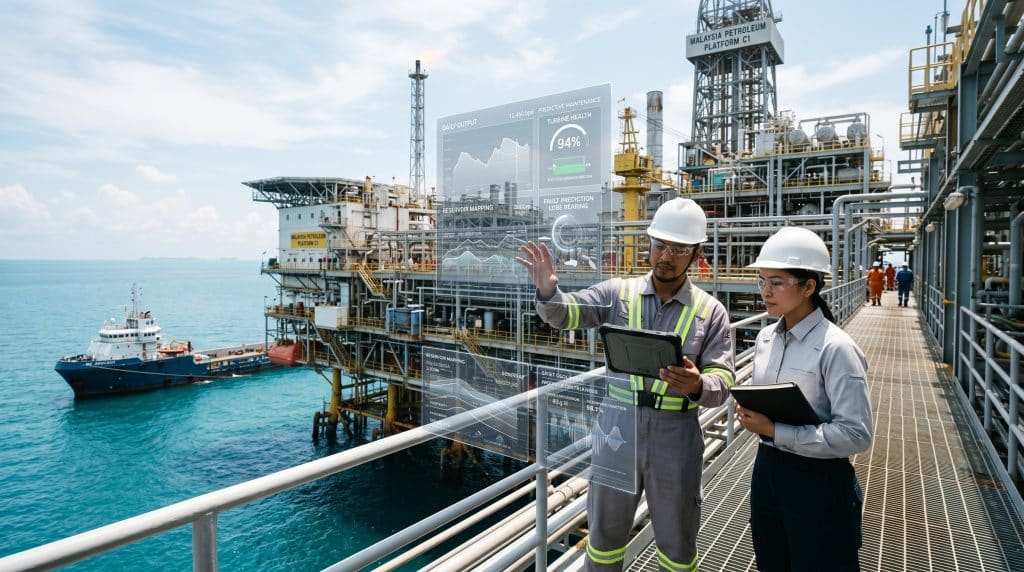
AI skills for oil and gas professionals in Malaysia are moving into the mainstream
AI skills for oil and gas professionals in Malaysia are becoming an operating requirement, not a specialist digital add-on. Engineers, technical specialists and managers now work with larger volumes of operational, engineering and commercial data than they did even a few years ago. They also face tighter expectations on speed, cost discipline and decision quality. That shift is changing what competence looks like across subsurface, wells, production, maintenance, planning and commercial roles.
Malaysia’s wider workforce agenda is moving in the same direction. TalentCorp and MyDIGITAL launched the MyMahir National AI Council for Industry in May 2025 to align AI talent development with industry needs. TalentCorp’s oil and gas impact study, published in September 2025, also highlights AI, automation and CCUS as important areas for future capability-building in the sector.
The broader economy adds to that pressure. DOSM reports that Malaysia’s digital economy contributed 23.4 per cent, or RM451.3 billion, to the national economy in 2024. DOSM also reported total labour demand of 9.21 million jobs in the fourth quarter of 2025, which confirms that skilled capability remains in demand across sectors. For oil and gas employers, the issue is clear. They compete for talent in the same market as other data-led industries, but they must apply those skills inside more complex and risk-sensitive operating environments.
That is why companies are defining training needs more precisely. Phrases such as AI training oil and gas and data analytics oil and gas training may be useful shorthand, but they do not answer the real question. Companies need to decide which roles need what level of capability, and how that capability will improve real operating and commercial decisions.
Why AI skills for oil and gas professionals in Malaysia are becoming more important
In oil and gas, digital capability matters only when it improves a real decision. That may involve interpreting production data faster, spotting weak signals in equipment behaviour, comparing subsurface scenarios more rigorously, or linking technical assumptions to project economics. These are practical problems, not abstract digital ambitions.
Malaysia’s market conditions make this more urgent. Many firms must manage mature assets, cost pressure, workforce renewal and transition-related obligations at the same time. MIDA’s 2025 workforce commentary reflects that wider shift. It identifies AI, automation, data analytics and digital infrastructure as skills that will become increasingly important over the next five to ten years.
This does not mean AI replaces engineering judgement. It means the industry now expects professionals to apply that judgement faster and with better use of data. As a result, machine learning literacy and data interpretation are moving into roles that were once treated as purely domain-based.
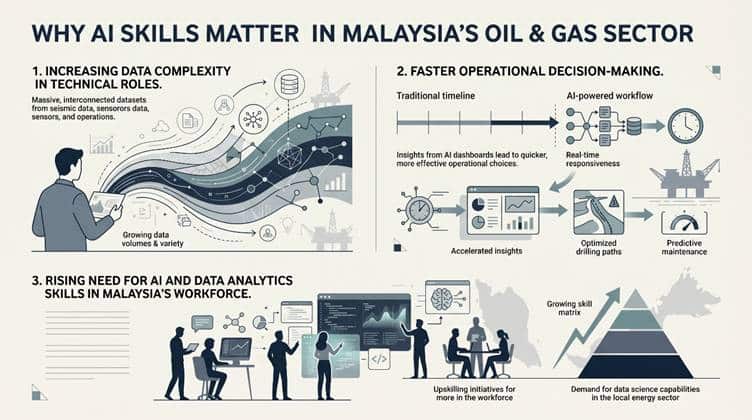
Three forces are driving demand for AI and data analytics skills in Malaysia’s oil and gas sector: growing data complexity, faster decision cycles and rising workforce capability needs.
The capability gap goes beyond coding and software exposure
A common mistake is to frame the challenge as a shortage of advanced data scientists. In practice, the bigger gap often sits between domain expertise and digital judgement. Many engineers understand wells, facilities, rotating equipment or reservoir behaviour very well. Fewer feel confident testing data quality, challenging model assumptions or identifying when an apparently plausible output should not be trusted in operations.
Managers face a related problem. They may approve digital initiatives without a clear basis for judging whether a model improves the workflow or simply adds another reporting layer. MIDA’s view of future workforce demand is useful here because it links digital capability with commercial acumen rather than treating it as a separate technical topic.
Malaysia’s labour data reinforces the point. With labour demand at 9.21 million jobs in Q4 2025 and skilled vacancies still open, firms are competing for talent in an already constrained market. In oil and gas, that makes it difficult to rely on external hiring alone. Companies need to raise the analytical fluency of existing engineers, technical specialists and managers.
The most valuable capability therefore lies in the middle ground. A production engineer does not need to become a specialist machine learning developer. That engineer does need to understand what the data excludes, how uncertainty is represented, whether the model is drifting, and when human review should override algorithmic confidence. The same logic applies to maintenance, integrity, planning and commercial teams.
What AI and data analytics skills matter most in oil and gas roles
For engineers and technical practitioners, the first priority is disciplined data interpretation. That includes data quality, context, missing values, outliers, bias and uncertainty. In upstream settings, it also includes the ability to judge whether a model is identifying correlation or surfacing something operationally meaningful. A machine learning oil and gas course only adds value when it teaches professionals how to challenge outputs in real workflow conditions.
The second priority is working fluency in tools and methods. In many organisations, that starts with accessible capabilities such as Power BI business data analytics or Python programming & analytics for the oil & gas sector. It can then progress to more specialised areas such as subsurface uncertainty quantification using machine learning or applied machine learning and data science for upstream professionals. These topics matter because they map to real technical problems in reservoir management, surveillance, forecasting and field performance.
For managers and team leaders, the requirement is different. They do not need to build models themselves. They do need to frame the right use case, test whether the workflow has improved, understand the business cost of false positives and false negatives, and decide where human challenge remains essential. For many companies, the immediate priority is not advanced data science but building AI skills for oil and gas professionals in Malaysia that strengthen day-to-day technical judgement.
That is why adjacent capabilities matter as well. Topics such as project economics, risk and decision analysis for oil & gas and technical report writing and presentation skills in the AI era can directly support better digital decision-making. In practice, many digital initiatives succeed or fail at the point where analysis has to be interpreted, explained and defended.
How oil and gas roles are evolving as digital capability expands
The organisational shift under way is less about creating large new AI departments and more about reshaping existing roles. Reservoir engineers are using data-driven predictions alongside classical subsurface analysis. Reliability teams are using digital signals to sharpen prioritisation. Planning and commercial teams are linking technical uncertainty more directly to risk-adjusted value. TalentCorp’s wider AI-readiness work points to the same pattern, where current occupations evolve through new skill requirements rather than disappear outright.
This creates demand for hybrid roles. Companies need analytics translators, technically credible digital leads, data-literate discipline experts and managers who can bridge operations with digital systems. They also need stronger capability beyond technical teams. Once digital tools influence planning, asset prioritisation or risk review, AI literacy becomes relevant to decision-makers as well as practitioners.
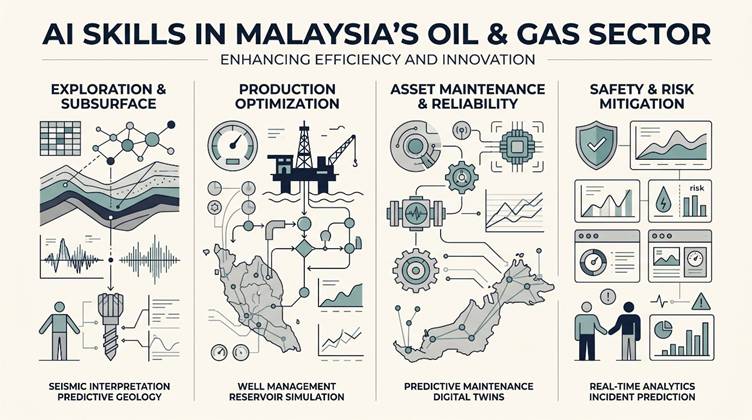
AI capability in oil and gas now spans subsurface work, production optimisation, asset reliability, safety and real-time decision support.
Choosing the right training pathway for AI skills in oil and gas
Many organisations still make training decisions based on labels rather than fit. Terms such as AI training oil and gas, data analytics oil and gas training, or AI course for oil and gas professionals do not say much by themselves. The better starting point is the workflow bottleneck. Companies should ask where decisions slow down, where uncertainty remains poorly handled, and where better data use could improve performance.
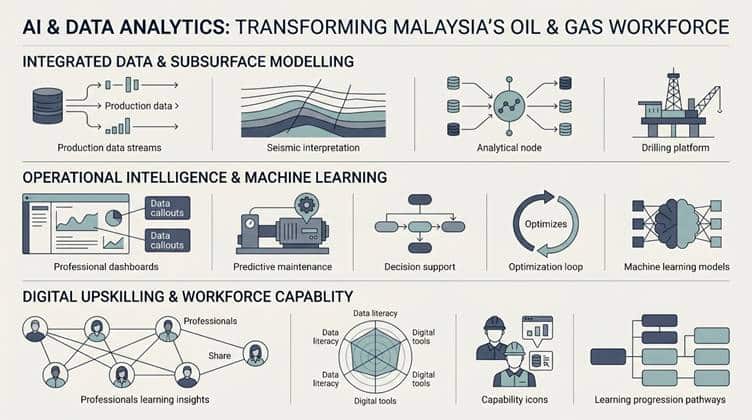
Building relevant AI capability requires a mix of data interpretation, applied analytics, operational intelligence and workforce upskilling.
Build capability by role, not by trend
A practical learning strategy is usually layered. Foundational programmes may focus on data handling, dashboards and interpretation. Practitioner-level learning may cover Python, statistics, machine learning basics and applied use cases. Specialist pathways may move into reservoir prediction, subsurface analytics or optimisation.
Adjacent development is often just as important. Skills such as critical thinking and decision-making for engineers and managers, well, reservoir and facilities management (WRFM), and cost engineering, financing and risk management integrating AI tools help professionals use digital tools inside real asset and commercial decisions. Those themes all appear naturally within EnergyEdge’s current training calendar.
Link training to real operating decisions
Reflecting how industry needs are evolving, EnergyEdge has continued to build out course offerings that connect AI, data analytics and digital decision-making with practical applications across oil and gas and the wider energy sector. The strongest value comes when learning is tied to real operating work rather than treated as a stand-alone digital topic.
Current examples in the training calendar range from subsurface uncertainty quantification using machine learning and applied machine learning and data science for upstream professionals to Power BI business data analytics, Python programming & analytics for the oil & gas sector, and adjacent decision-focused topics such as project economics, risk and decision analysis for oil & gas. This kind of spread reflects a useful industry reality: companies rarely need one single digital skill. They usually need a mix of analytics, judgement and domain context.
Governance, economics and execution still shape capability-building
Training choices do not sit outside policy and governance. Malaysia’s National Guidelines on Artificial Intelligence Governance and Ethics, launched in September 2024 under MOSTI, emphasise safety, ethics, transparency, accountability and responsible use. That matters even when oil and gas applications are operational rather than consumer-facing. Companies are expected to govern AI deployment, explain model outputs and maintain accountability.
This raises the bar for capability-building. Training should not cover tools alone. Professionals also need to know when model outputs can be trusted, when human intervention is required, and how decisions should be documented. For managers, the issue is not only digital opportunity but model risk as well.
Economics matters just as much. Training budgets compete with maintenance, project delivery, reliability improvement and cost control. Generic awareness programmes often lose momentum when budgets tighten. The stronger business case is practical. Companies invest more confidently when training leads to faster interpretation, better prioritisation, stronger technical challenge and more disciplined decisions.
Conclusion
AI skills for oil and gas professionals in Malaysia are becoming part of core professional practice. National workforce initiatives, digital economy growth, labour market pressure and governance expectations all point in the same direction. More technical and managerial decisions will depend on data-rich workflows, and more value will depend on whether professionals can interpret those workflows with discipline.
The organisations that respond best will be those that build AI skills for oil and gas professionals in Malaysia in ways that are tied to real operating work, governance expectations and commercial decision-making. That is the real capability challenge now emerging for the sector. It is also the standard against which providers, programmes and internal learning strategies will increasingly be judged.
Frequently Asked Questions
AI skills matter more because oil and gas teams now handle larger volumes of operational, engineering and commercial data. In Malaysia, this is happening alongside wider digitalisation, tighter cost control and stronger pressure for better technical decisions. For many companies, the goal is not AI adoption alone. The goal is better judgement from engineers, specialists and managers.
The most useful skills include data interpretation, dashboard analysis, basic machine learning literacy and digital decision-making. For technical roles, this means understanding uncertainty, spotting poor data quality and using tools such as Power BI or Python in a practical way. For managers, it means evaluating use cases, challenging outputs and linking analytics to business decisions.
Generic analytics training often focuses on tools in isolation. Data analytics oil and gas training is more useful when it is linked to real operating contexts such as production optimisation, reservoir uncertainty, maintenance planning, integrity management or project economics. The value comes from applying analytics to industry decisions, not just learning software features.
A strong machine learning oil and gas course should be grounded in realistic workflows and technical problems. Companies should look for training that helps participants understand data quality, uncertainty, model limits and practical use cases. The best programmes combine analytical methods with domain judgement.
The strongest candidates are often production engineers, reservoir engineers, geoscientists, maintenance and reliability teams, asset managers, technical planners and commercial decision-makers. The need now goes beyond specialist digital roles. In practice, any role that depends on data and operational decisions can benefit from relevant AI training oil and gas.
Companies should start with the decision problem, not the course label. A useful AI course for oil and gas professionals should match the role, the workflow and the business objective. Training works best when it is tied to real technical or operational challenges, not broad digital awareness alone.
