
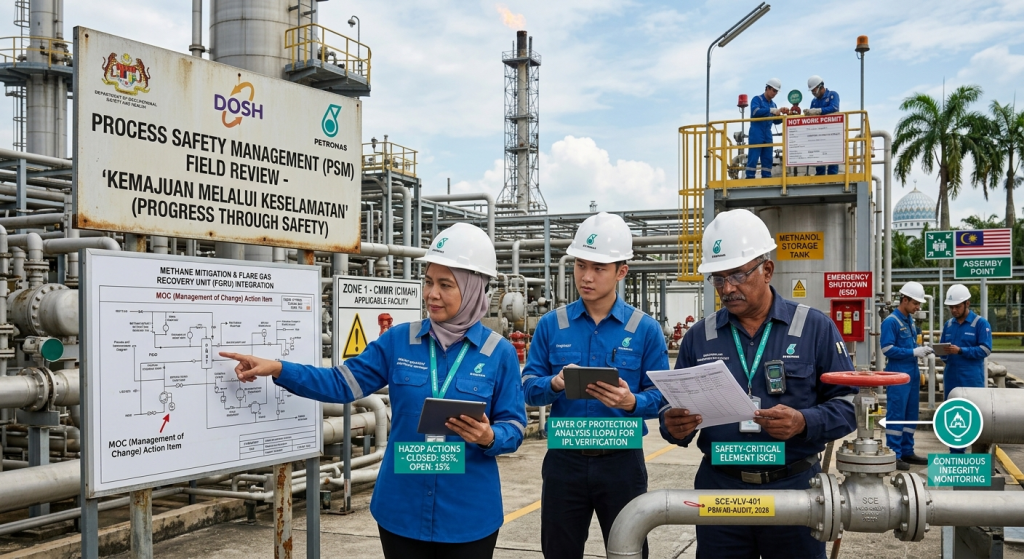
Process Safety Management (PSM) is the disciplined framework that keeps hazardous processes — refineries, gas plants, petrochemical units, offshore facilities — from turning small deviations into catastrophic loss of containment. Unlike occupational safety, which targets slips, trips and personal injury, PSM is aimed squarely at major accident prevention: fires, explosions and toxic releases with the potential to kill many people and destroy an asset in seconds. For Malaysia’s energy and process operators, PSM is not optional. It is the operating philosophy that underpins licence to operate.
Why PSM Matters in Malaysia
Malaysia regulates major accident hazards primarily through the Occupational Safety and Health Act 1994 (OSHA 1994) and the Control of Industrial Major Accident Hazards (CIMAH) Regulations 1996, enforced by the Department of Occupational Safety and Health (DOSH). Facilities that store or process dangerous substances above defined threshold quantities are classified as Major Hazard Installations (MHIs) and must submit a Safety Report and an on-site Emergency Response Plan to DOSH; non-major installations must still demonstrate that their activities are safe. Crucially, the OSHA 1994 (Amendment) Act 2022, in force from 1 June 2024, sharply increased penalties for duty-holder failures — meaning the cost of weak process safety governance is now materially higher. A well-run PSM system is how operators satisfy these obligations and protect their people, communities and balance sheets.
The Core Elements of PSM
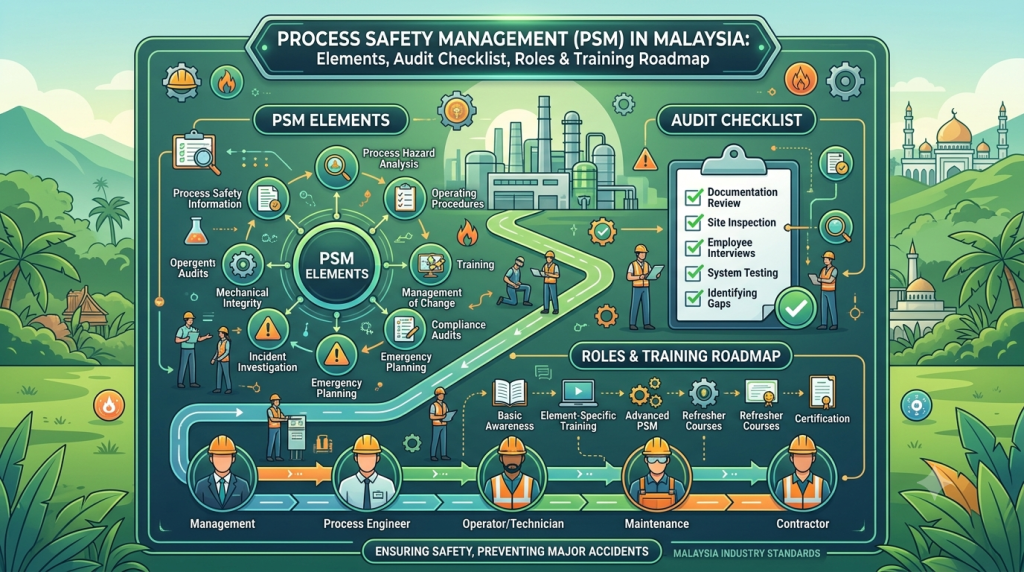
Most robust PSM systems are built around a recognised set of interlocking elements (drawn from OSHA’s PSM standard, the IChemE Process Safety competency framework, and CIMAH). A practical Malaysian model covers:
- Process Safety Information — accurate P&IDs, chemistry, material safety data, and design limits.
- Process Hazard Analysis (PHA) — systematic identification of hazards (HAZOP, What-If, LOPA).
- Operating Procedures — clear, current, and followed.
- Training & Competency — verified capability for anyone touching the process.
- Contractor Management — extending PSM discipline to third parties.
- Pre-Startup Safety Review (PSSR) — confirming readiness before hazards go live.
- Mechanical Integrity / Asset Integrity — inspection, testing and maintenance of critical equipment.
- Safe Work / Permit-to-Work — controlling hot work, confined space and line breaking.
- Management of Change (MOC) — no modification without hazard review.
- Incident Investigation — learning from near-misses before they escalate.
- Emergency Planning & Response — aligned with the CIMAH ERP requirement.
- Compliance Audits — periodic verification that the system works in practice.
PSM Audit Checklist (Copy & Use)
Use this as a rapid self-assessment. Score each item as Compliant / Partial / Gap.
PROCESS SAFETY MANAGEMENT — SELF-AUDIT CHECKLIST
[ ] Process Safety Information current, complete and accessible
[ ] PHA (HAZOP/LOPA) completed, revalidated within cycle, actions closed
[ ] Operating procedures reviewed, dated, and matched to field reality
[ ] Competency matrix in place; training records current for all roles
[ ] Contractor PSM requirements defined, communicated and verified
[ ] Pre-Startup Safety Review conducted before every startup/modification
[ ] Mechanical integrity: inspection & testing of safety-critical equipment on schedule
[ ] Permit-to-Work system audited; high-risk activities controlled
[ ] Management of Change process applied to ALL changes (incl. temporary)
[ ] Incident & near-miss investigations completed with root cause + tracked actions
[ ] Emergency Response Plan tested; drills documented; DOSH submission current
[ ] CIMAH Safety Report reviewed and up to date (MHI facilities)
[ ] Safety-critical alarms, SIS and relief devices verified and maintained
[ ] Management review of PSM performance with leading & lagging indicators
Role-Based Guidance
Process & Safety Engineers own the technical backbone — PHAs, safeguards, integrity limits and MOC reviews. Their credibility rests on knowing why a safeguard exists, not just that it exists.
Supervisors & Operations Leaders convert PSM from paper to practice. They enforce permit-to-work, resist “just this once” shortcuts, and are the last line of defence against normalised deviance.
HSE / Process Safety Managers own the system: audit schedules, competency assurance, incident learning, indicator reporting and the regulatory interface with DOSH. Their challenge is keeping PSM live rather than a filing exercise.
How PSM Connects to HAZOP, LOPA and SIL
PSM is the umbrella; HAZOP, LOPA and SIL are the load-bearing analytical layers beneath it. A HAZOP systematically surfaces process deviations and their consequences. Where a hazard scenario needs deeper scrutiny, LOPA (Layer of Protection Analysis) quantifies whether existing safeguards are sufficient — and, where they are not, drives a SIL (Safety Integrity Level) requirement for a Safety Instrumented System under IEC 61511. Each feeds the PSM elements above: HAZOP populates Process Hazard Analysis, LOPA/SIL define mechanical integrity and testing regimes, and MOC ensures none of it silently degrades over time. EnergyEdge delivers this full chain through its IChemE-approved Process Hazard Assessment using the HAZOP Technique, Layer of Protection Analysis (LOPA) including SIL Determination, and Functional Safety & Safety Instrumented Systems (SIS) courses.
The Competency Gap — And Why Employers Value PSM Skills
Malaysia has hundreds of registered MHIs, yet the pool of certified Major Hazard Competent Persons (MHCP) has grown far more slowly — a documented shortage that leaves risk management stretched thin. For employers, this scarcity makes structured process safety competency a premium, not a nicety. Personnel who can lead a HAZOP, defend a SIL determination, run a credible incident investigation, or sign off an MOC directly reduce insurance exposure, regulatory risk and unplanned downtime. That is why energy companies increasingly treat PSM capability as a strategic capability to build, not buy — moving from ad-hoc courses to deliberate competency roadmaps that pair technical process safety with the commercial disciplines that surround major projects.
That wider picture matters because process safety failures rarely sit in isolation from project economics and execution. Building depth across the Process Safety Management & Engineering Applications and Accident Investigation programmes, then extending into Project Economics, Risk and Decision Analysis for Oil & Gas, Cost Engineering, Financing and Risk Management, EPC Contracts and EPCIC Contract Drafting and Management, gives organisations engineers who understand both the barrier and the balance sheet. Certification-track options such as PMP and PMI-RMP, alongside Upstream Petroleum Economics and petroleum geoscience and exploration pathways, round out a workforce that can carry safety discipline from exploration through project delivery.
Frequently Asked Questions
Comprehensive PSM compliance audits are typically conducted at least every three years, with higher-risk elements (permit-to-work, MOC, integrity) reviewed more frequently through internal checks. PHAs such as HAZOP should be revalidated every five years or whenever significant change occurs. For CIMAH MHIs, the Safety Report must be kept current and resubmitted when the installation materially changes.
An HSE Management System (HSE-MS) is broad, covering occupational health, personal safety and environment across the organisation. PSM is narrower and deeper, focused specifically on preventing low-frequency, high-consequence major accidents in hazardous processes. A strong HSE-MS keeps individuals safe day to day; PSM keeps the whole facility from catastrophic failure. Mature operators run PSM as a specialised discipline within their overall HSE-MS.
