
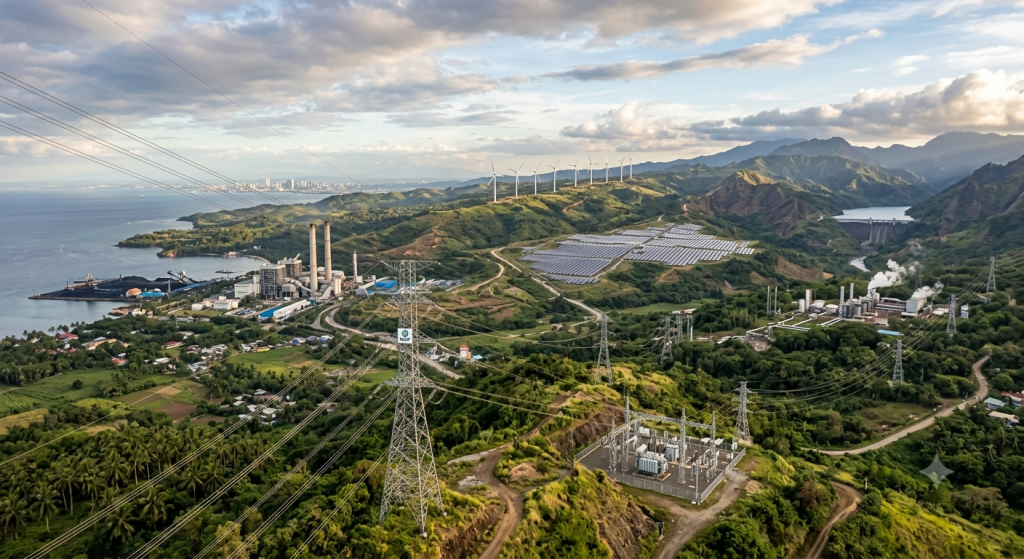
The Philippines is entering one of the most demanding periods in its power sector history. Electricity demand is projected to climb by roughly 5.5% a year, and the country needs an estimated USD 80 billion in energy infrastructure investment by 2028 to keep pace. At the same time, the rapid build-out of data centres, most of it concentrated in Metro Manila, Central Luzon, and emerging edge markets, is adding a new and unusually demanding category of load onto a grid that is already stretched. Industry estimates put ICT sector baseload requirements at 300 to 500 MW by 2026 alone, on top of ordinary economic growth in demand, and electricity use from Philippine data centres is expected to rise sharply through 2030.
Layered on top of this is the country’s decarbonisation agenda. The Philippine Energy Plan and the Renewable Energy Roadmap target 35% renewables in the power mix by 2030 and 50% by 2040, even as a coal moratorium keeps existing coal capacity running and gas and nuclear projects move through development. Regionally, ASEAN’s Plan of Action for Energy Cooperation and the broader push toward an interconnected ASEAN Power Grid are reshaping how utilities plan interconnection, cross-border trade, and emissions accounting, while national mechanisms such as the Green Energy Auction, the Renewable Portfolio Standard, and the Energy Virtual One-Stop Shop are accelerating renewable project approvals.
Put together, these forces (surging demand, data centre growth, grid strain, carbon targets, and evolving regional regulation) are driving a sharp rise in demand for specialised, practitioner-level training. Below are ten courses from EnergyEdge that map directly onto these trends.
1. HV & MV Power System Design, Protection & Coordination
As utilities rush to interconnect new generation and high-density data centre loads, demand for engineers who understand system planning, protection schemes, and grounding has surged. This course addresses the transmission and distribution bottlenecks that are now the single biggest constraint on the Philippines’ data centre ambitions.
2. Introduction to Power Systems
With smart grids, renewable integration, and grid restructuring becoming standard utility priorities, this foundational course equips engineers, technicians, and managers with the grounding they need to work across a modernising, increasingly complex power system.
3. Design, Implementation, and Operations of Battery Energy Storage Systems (BESS)
BESS has become the default answer to grid instability caused by variable solar and wind output, and the course’s optional module on BESS design for data centre environments speaks directly to the reliability and backup power needs driving Philippine hyperscale investment.
4. Utility-Scale Hybrid Solar PV Plants with Battery Energy Storage Systems (BESS)
Solar remains the fastest route to the Philippines’ 2030 renewables target, but standalone solar cannot solve grid stability. This course covers the hybrid PV-BESS architecture that developers now favour for peak shaving and ancillary services in emerging Southeast Asian markets.
5. Wind Turbine Technology, Master the Art of Selection and Optimise the Farm Performance
With the Philippines holding some of the region’s strongest offshore wind potential and the DOE actively courting offshore wind investment, technical skills in turbine selection and farm performance optimisation are increasingly scarce and increasingly valuable.
6. Introduction to Geothermal Exploration and Development
The Philippines is already one of the world’s top geothermal producers, and geothermal’s baseload reliability makes it an attractive complement to intermittent solar and wind. This course brings subsurface and technical professionals up to speed on exploration and early-stage development.
7. Geothermal Project Finance Analysis and Modelling
As renewable auctions and green financing mechanisms multiply, commercial and finance teams need to model project economics accurately. This course covers the contract structuring and IRR frameworks that determine whether a geothermal, solar, wind, or storage project is bankable.
8. Hydrogen Value Chain and Certification Pathways: Southeast Asia Focus
Asia Pacific is on track to become the largest hydrogen market globally, and Southeast Asia is positioning itself as a green hydrogen exporter. This course addresses the certification and emissions accounting frameworks that will shape cross-border hydrogen trade under emerging ASEAN standards.
9. Carbon Capture Utilization & Storage (CCUS) Explained
With governments across the region pursuing net-zero commitments under the Paris Agreement, CCUS is moving from concept to deployment. This course gives technical and non-technical professionals a working understanding of capture, transport, storage, and monitoring.
10. Carbon Management Strategies for Hard-to-Abate Industries
Power utilities and heavy industry alike are under growing pressure to publish credible decarbonisation roadmaps. This course covers the full range of levers, from energy efficiency and electrification to fuel switching and hydrogen, needed to build a bankable carbon management strategy.
Why These Courses Matter Right Now
Three forces explain why this specific mix of courses is seeing rising enrolment. First, data centre growth is forcing utilities and IPPs to rethink transmission, protection, and storage design at a pace the grid was not originally built for. Second, the Philippines’ renewables targets, reinforced by ASEAN-wide energy cooperation frameworks and cross-border grid ambitions, are pulling solar, wind, geothermal, and hydrogen from pilot scale into utility scale. Third, carbon accountability, driven by national net-zero commitments and increasing scrutiny of ICT sector emissions, is turning carbon management from a compliance afterthought into a core commercial skill. Professionals who combine technical grounding in power systems with fluency in storage, renewables, and carbon strategy are best positioned to lead this transition.
Frequently Asked Questions
Data centres draw continuous, high-density loads that behave differently from ordinary industrial demand. Utilities and developers need engineers who understand protection, interconnection, and backup power design well enough to serve hyperscale tenants without destabilising the surrounding grid.
Yes. Geothermal provides steady baseload power that complements variable solar and wind generation, and the Philippines is one of the world’s largest geothermal producers. Exploration, development, and project finance skills remain in strong demand.
Regional initiatives such as the ASEAN Plan of Action for Energy Cooperation and the push toward an interconnected ASEAN Power Grid are shaping cross-border trade, emissions accounting, and certification standards, which in turn influence how local utilities and developers plan and staff projects.
Battery storage smooths the mismatch between when solar and wind generate power and when it is actually needed, stabilises the grid, and increasingly serves as backup capacity for data centres and other critical loads.
The list spans technical roles (power system engineers, storage and renewable energy specialists, geoscientists) and commercial roles (project finance analysts, sustainability and carbon management professionals), reflecting how broadly the energy transition is reshaping skill requirements across the sector.
