
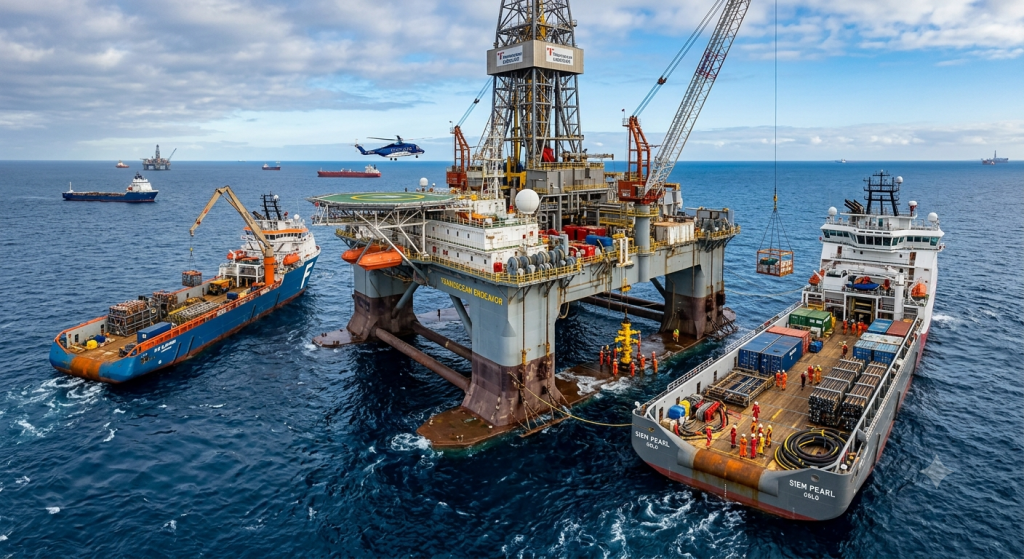
Extended reach drilling (ERD) is a directional drilling technique used to reach targets far from the surface location, typically expressed through a high ratio of horizontal displacement to true vertical depth (TVD). It allows operators to access reservoirs that would otherwise require a new platform, pad, or facility. This guide is written for drilling engineers, subsurface teams, and operations and project leads who plan, execute, or review ERD campaigns.
In this guide:
- What ERD is and how it differs from horizontal and multilateral drilling
- When ERD makes sense as a development concept
- A step-by-step ERD planning workflow
- The key technical challenges and how they’re mitigated
- Field-ready operational best practices
- Risk, HSE, and well integrity considerations
- The KPIs used to measure ERD performance
- Frequently asked questions
For teams building broader upstream capability, our upstream training hub is a useful starting point.
What is extended reach drilling?
ERD definition (measured depth vs true vertical depth)
ERD wells are commonly defined by a measured depth (MD) to true vertical depth (TVD) ratio of roughly 2:1 or greater, though the working definition varies by operator and basin. What matters operationally is that the extended horizontal displacement introduces friction, hydraulics, and stability challenges that don’t scale linearly with depth.
ERD vs horizontal drilling vs multilateral drilling
Horizontal drilling turns the wellbore to intersect a reservoir along its lateral extent, usually with more moderate displacement. Multilateral wells branch a single wellbore into multiple laterals from one main bore. ERD is distinguished by displacement and reach rather than trajectory shape alone, and it can be combined with horizontal or multilateral designs. See our directional, horizontal, and multilateral drilling course for a deeper comparison.
Why operators use ERD
Operators choose ERD to cut facility costs, work around surface access constraints, reach subsea tie-backs from a single platform, and reduce the environmental footprint of new infrastructure by drilling further from existing pads.
When ERD is the right choice (use cases)
Offshore platforms and subsea developments
ERD lets a single offshore platform reach multiple subsea targets, reducing the need for additional platforms or subsea infrastructure.
Onshore pad drilling and surface access constraints
Where surface rights, terrain, or environmental sensitivity limit new pad locations, ERD allows access to reservoirs from existing pads.
Reaching stranded pockets and maximizing recovery
ERD can extend the economic life of existing facilities by unlocking stranded reserves that would not otherwise justify new infrastructure.
ERD planning workflow (step-by-step)
- Define objectives and constraints — target location, slot availability, and facility or rig limits.
- Well trajectory design — build, hold, and drop sections, with anti-collision analysis against nearby wellbores.
- Torque & drag modelling — build a friction management plan before spud.
- Hydraulics and hole cleaning plan — model cuttings transport across the full displacement.
- Casing design and running strategy — account for higher torque and drag loads on long strings.
- BHA selection and directional approach — choose rotary steerable or motor-based systems suited to the trajectory.
- Drilling fluids strategy — manage equivalent circulating density (ECD), shale inhibition, and lubricity.
- Operational readiness — confirm rig capability and contingency plans before starting the section.
Key technical challenges in extended reach drilling
Torque and drag increase with displacement and raise stuck-pipe risk; friction reducers and lubricants, along with accurate torque and drag modelling, are standard mitigations.
Hole cleaning and cuttings transport become harder to manage as horizontal section length increases, requiring flow rate optimization and, often, wiper trips.
ECD management is critical in long horizontal sections with narrow drilling windows between pore pressure and fracture gradient.
Wellbore stability in reactive shales requires inhibitive fluid systems to prevent swelling or collapse over extended open-hole exposure times.
Casing running and cementing across long, high-angle sections demand careful centralization and simulation to achieve zonal isolation.
Tool limits — MWD/LWD reliability and downhole motor or rotary steerable system performance can constrain how far a well can practically be extended.
ERD operational best practices (field-ready checklist)
- Real-time monitoring: track torque, drag, ECD trends, and stick-slip indicators daily.
- Tripping practices: follow controlled tripping speeds and monitor for early signs of stuck pipe.
- Wiper trips and reaming: schedule proactively in long sections rather than reactively.
- Contingency planning: define sidetrack criteria and keep fishing tools and procedures ready.
Managed pressure drilling is often paired with ERD in narrow-window sections; see our MPD training course for related risk-control techniques.
ERD risks, HSE, and well integrity considerations
Major risk categories in ERD include technical (stuck pipe, losses), schedule, cost, and safety risks. Barrier thinking and well integrity checkpoints should be built into every phase, from design through completion. Capturing lessons learned through a structured post-well review template helps reduce repeat issues on subsequent ERD campaigns.
ERD KPIs (how to measure performance)
Drilling dysfunction indicators — vibration, stick-slip, and torque spikes are early warning signs worth monitoring in real time.
ROP vs NPT tradeoffs — faster rates of penetration are only valuable if they don’t increase non-productive time.
NPT categories — track stuck pipe, losses, and tool failures separately to identify recurring root causes.
Cost per meter / cost per section — a standard efficiency benchmark across ERD campaigns.
Conclusion and next steps
- ERD extends reach and reduces facility costs, but requires disciplined planning across trajectory, torque and drag, hydraulics, and fluids.
- The biggest risks — stuck pipe, poor hole cleaning, and ECD management — are manageable with the right modelling and real-time monitoring.
- Strong KPIs and lessons-learned processes turn each ERD campaign into better performance on the next one.
To build ERD planning capability in your team, see our Extended Reach Drilling training course, or explore our advanced well engineering course for broader technical depth. Teams new to directional concepts may also benefit from Drilling Essentials for New Engineers and Non-Technical Professionals.
Frequently Asked Questions
ERD is a directional drilling method for reaching targets with a high ratio of horizontal displacement to true vertical depth, often from a single surface location.
Horizontal drilling focuses on lateral reservoir contact; ERD is defined primarily by extreme reach and displacement, and can incorporate horizontal sections.
Limits typically come from torque and drag, hydraulics and hole cleaning, tool reliability, and rig capability.
Poor hole cleaning, differential sticking, and excessive torque and drag are common causes; friction management plans and monitoring reduce risk.
Longer displacement multiplies friction along the wellbore, increasing torque, drag, and the risk of stuck pipe if not modelled and managed.
Optimized flow rates, appropriate fluid rheology, and scheduled wiper trips all support effective cuttings transport.
Lubricity, shale inhibition, and rheology for hole cleaning are the key properties to manage.
Equivalent circulating density reflects the effective downhole pressure while circulating; in ERD’s narrow drilling windows, managing ECD is critical to avoid losses or kicks.
ROP versus NPT, NPT by category, cost per meter, and drilling dysfunction indicators are the core metrics.
When rig capability, tool reliability, or subsurface risk make the required displacement impractical or uneconomic compared to alternatives like a new platform or pad.
