
A less forgiving operating environment
HAZOP in Malaysia is becoming more strategically important as the country’s high-hazard industries move into a more demanding phase of execution. A recent national activity outlook pointed to sustained work across upstream, gas, maritime and lower-carbon segments through 2028. Around the same time, the Energy Commission’s 2026 review described a more complex domestic environment. It highlighted rising demand, industrial expansion, electrification, data-centre growth and tighter expectations around safety and reliability. In that setting, hazard review is no longer just a technical workshop requirement. It has become a test of process safety governance under conditions of greater asset complexity and less tolerance for operational failure.
That shift matters because complexity is rising on several fronts at once. Gas remains commercially important. Offshore development continues. Lower-carbon infrastructure is also moving from policy ambition into engineering and permitting. Public reporting over the past year has pointed to continued deepwater gas expansion work offshore Malaysia. The first offshore assessment permit under the CCUS Act 2025 has also been issued. Mature hydrocarbon systems, newer subsea tie-ins and early-stage carbon-management infrastructure now sit within the same operating landscape. That mix increases the importance of structured hazard identification and stronger operational follow-through.
Gas, LNG and project complexity are raising the stakes
The market backdrop supports that interpretation. The IEA reported that global natural-gas demand grew by 2.7% in 2024. Emerging and developing Asian economies accounted for around 40% of additional demand. IGU’s 2025 World LNG Report put global LNG trade at 411.24 million tonnes in 2024. GIIGNL’s 2025 annual report separately recorded 406 million tonnes of global LNG trade, alongside 492 MTPA of liquefaction capacity and 1,188 MTPA of regasification capacity. The precise numbers differ by methodology, but the direction is clear. Gas and LNG remain central to Asian energy systems. That keeps pressure on the reliability and safety of Malaysia’s gas-related infrastructure.
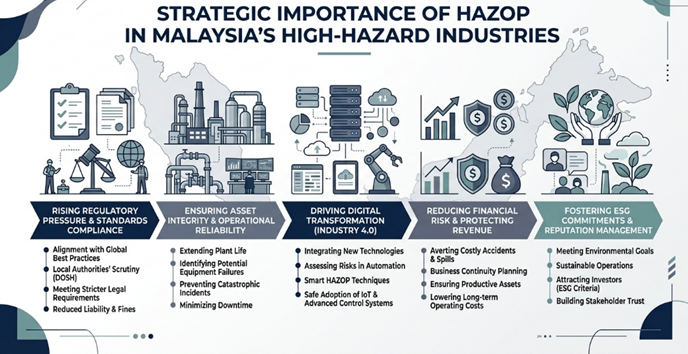
Why HAZOP in Malaysia is under greater pressure: rising asset complexity, gas infrastructure risk, brownfield change and lower-carbon project interfaces.
The Putra Heights incident and the problem of interface risk
The Putra Heights pipeline fire brought this issue closer to home. Public findings released by the Department of Occupational Safety and Health concluded that the affected pipe met technical specifications. The investigation also found that part of the line lacked full support because the surrounding ground was soft and damp. Over time, repeated cyclic loading created stress lines and fatigue striations until failure occurred. Gas escaped and ignition followed. The remedial programme then required temporary replacement works, non-destructive testing, pressure testing, soil stabilisation and further geotechnical review.
What makes the incident important for HAZOP in Malaysia is not only the technical diagnosis. It is the reminder that major failures do not arise from design, operations, geotechnical conditions, monitoring or maintenance in isolation. They emerge where those factors intersect. That is exactly where a HAZOP study can look complete in governance terms yet still underperform in practice. A workshop may record deviations, consequences and safeguards. It may still fail to test how local ground conditions, support assumptions, degraded states, monitoring quality and follow-through interact over time. Putra Heights therefore matters not just as a pipeline integrity case. It also shows how interface risk can slip past procedural comfort.
The real weakness is not the method
HAZOP itself is not the problem. The method remains robust when teams apply it with enough design maturity, operating realism and disciplined closure. The more serious weakness lies in the operating model around it. Many organisations still treat HAZOP as a procedural milestone rather than as part of a live major hazard management system. In a simpler cycle, that distinction can remain hidden. In a more complex one, it becomes visible much faster.
The priorities of recognised industry bodies point in the same direction. The Energy Institute’s current process-safety programme includes barrier health management, the challenges of introducing new technologies into existing facilities, ammonia safety, upstream normally unattended facilities and process-safety competency. That emphasis is revealing. The issue is not whether companies can convene a review meeting. The issue is whether barrier management, management of change and process safety governance are strong enough for more integrated and technically diverse asset portfolios.
Industry safety data reinforces that conclusion. IOGP’s 2024 fatality and permanent impairment dataset covers 3.4 billion work hours from 51 companies. Separate IOGP process-safety material states that member-company data recorded 175 fatalities across 86 process safety events between 2007 and 2024. Long-term safety performance has improved, but major process hazards have not disappeared. That leaves HAZOP, LOPA, functional safety and related disciplines under more pressure to surface weak assumptions before operations do it instead.
Weak performance usually shows up after the workshop
One reason organisations overestimate HAZOP performance is that weakness rarely announces itself during the session. It usually appears later. It shows up in actions that remain open too long, safeguards that teams accept too easily, assumptions that no one challenged hard enough, or recommendations that never make their way into operating limits, maintenance strategy, alarm philosophy or management-of-change discipline.
That is where HAZOP in Malaysia often becomes a governance issue rather than a facilitation issue. Many organisations know how to run the workshop. Fewer convert the workshop into measurable operational risk reduction. The question is not simply whether the team completed the review. The question is who owns the action, who tests whether the safeguard is credible, who reopens assumptions when conditions change, and whether the output truly connects to asset integrity and line accountability. Those choices determine whether the study shapes decisions or simply documents them.
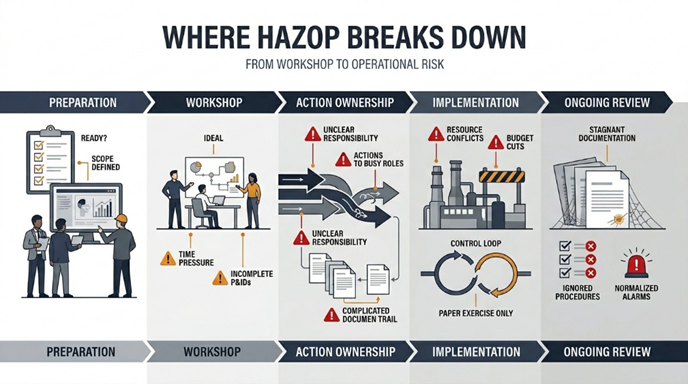
Where value is lost: HAZOP failures often emerge after the workshop through weak action ownership, poor follow-through and limited integration with operations.
Competence is still being mistaken for participation
This is why capability deserves more attention than terminology. Search and market language often gravitates towards phrases such as process safety training, oil and gas training, a safety engineering course or asset management training. Those labels can be useful. They can also oversimplify the issue. In major-hazard industries, attendance does not equal competence.
In practice, that capability depends on more than familiarity with the workshop format. It depends on stronger grounding in HAZOP team leader training, process safety management and process safety engineering. That is especially true when teams are expected to challenge cross-disciplinary assumptions rather than simply record them. Those needs become more important when organisations face brownfield complexity, degraded operating states or unfamiliar interfaces across engineering, operations and maintenance. The wider market also reflects that broader capability demand, with adjacent offerings in HAZOP, process safety, LOPA, investigation and reliability disciplines.
A multidisciplinary room can still fail to challenge the right things. Specialists may understand their own discipline well. Yet they may be less prepared to interrogate cross-functional interfaces, degraded operating states, human-factor implications or safeguard independence. The result is rarely an obviously poor HAZOP. More often, it is a respectable-looking review that leaves important uncertainty insufficiently tested. That makes competence a strategic issue, not an administrative one.
This is also where EnergyEdge fits naturally into the discussion. As a provider of HAZOP and related process-safety training, EnergyEdge sits within the capability ecosystem that supports industry practice. The relevant question is not whether teams recognise the method. The real question is whether they can apply it with enough rigour, challenge and follow-through to influence operational risk meaningfully in Malaysia’s higher-risk operating environment.
Related disciplines shape HAZOP performance
Teams do not apply HAZOP in isolation. Layer of Protection Analysis (LOPA), SIL determination, root cause analysis, incident investigation and Tripod Beta all shape how effectively a business turns hazard identification into real operational learning and risk reduction. These disciplines sit close to HAZOP in practice because they test whether safeguards are credible, whether escalation has been properly understood and whether lessons are being converted into stronger controls. That relationship is also visible in adjacent disciplines such as LOPA, Tripod Beta and investigation-related capability.
If barrier management is weak, management of change is superficial, or lessons from incident investigation never return to hazard reviews, then the HAZOP workshop becomes less a living control and more a periodic ritual.
That is particularly relevant after events or near misses. Methods such as Apollo Root Cause Analysis and Tripod Beta can improve the quality of learning. Deeper practitioner development also matters. That includes Tripod Beta Practitioner – Bronze Level and Tripod Beta Practitioner – Silver Level capability. These are not peripheral topics. They shape how organisations interpret weak signals, investigate breakdowns and feed lessons back into process safety governance.
This matters for HAZOP in Malaysia because the asset base is becoming more varied. Mature infrastructure still matters. Gas networks still matter. Lower-carbon systems now add new interfaces and operating states. In that setting, organisations need stronger continuity between hazard identification, incident learning, safeguard verification and operational follow-through. A HAZOP team that works in isolation cannot compensate for weaknesses elsewhere in the risk-governance system.
Digitalisation raises the bar rather than lowering it
Digitalisation will not solve these weaknesses on its own. Malaysian industry and regulatory outlooks continue to emphasise digital readiness. Operators are using more analytics, remote monitoring and surveillance tools to understand asset behaviour. Those capabilities matter. They should improve visibility of degradation, transient conditions and operational drift. But they also remove excuses. Once more operating data becomes available, teams can no longer treat HAZOP as a static design ritual detached from live evidence. It has to sit within a more dynamic loop that links engineering, inspection, maintenance, operations and emergency response.
The same logic applies to transition infrastructure. Malaysia’s first offshore assessment permit under the CCUS Act 2025 shows that carbon-management projects are entering the project system. These projects introduce unfamiliar combinations of transport interfaces, storage risk, containment questions and long-duration monitoring obligations. The challenge is not whether legacy HAZOP techniques can still be used. They can. The challenge is whether teams apply them with enough rigour to address new hazard combinations rather than assuming that conventional hydrocarbon habits will transfer automatically.
What stronger HAZOP governance looks like
For practitioners, the practical question is not whether HAZOP still matters. It does. The better question is what distinguishes strong practice from procedural completion.
Several traits stand out. Timing matters. When teams use HAZOP too late, it becomes a validation exercise instead of a decision-shaping one. Action ownership matters more than action logging. If line accountability is weak, drift becomes almost inevitable. Teams also need to examine interface risk more explicitly, especially where brownfield integration, geotechnical conditions, temporary operations or cross-system dependencies are present. They need to test barrier quality rather than assume it. They also need to judge competence by the quality of challenge and closure, not by attendance alone.
Stronger governance also depends on disciplines that sit close to HAZOP in day-to-day operations. These include asset integrity and life extension, maintenance and reliability best practices, and a clearer connection between hazard review outputs and the way equipment condition, degradation and barrier performance are managed over time. A hazard review can identify risk clearly, yet still fail to influence outcomes if integrity management, maintenance planning and barrier verification remain weak or disconnected.
That is what stronger HAZOP in Malaysia should look like in practice. It should connect more firmly to management of change, barrier health, operating discipline and post-incident learning. Organisations that build those connections are more likely to extract real insight from the method. Organisations that do not may still complete the workshop, but they are less likely to reduce risk when operating conditions become difficult.
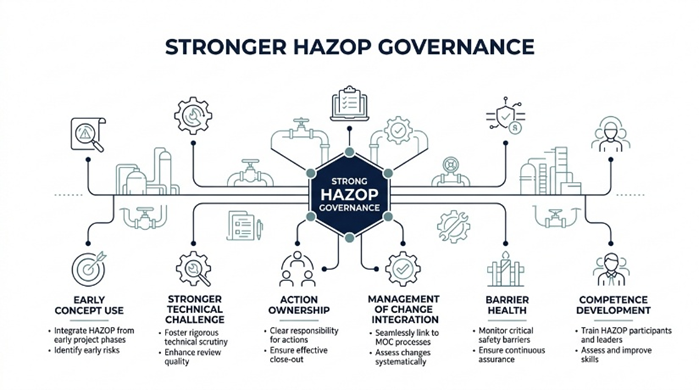
What stronger HAZOP governance requires: earlier use, better challenge, clearer ownership, stronger change control, barrier verification and deeper competence.
Why this matters now
In a slower and simpler cycle, a merely adequate HAZOP could still appear sufficient because the wider system had more room to absorb weakness. In the current cycle, that margin is narrowing. Gas remains commercially relevant. Offshore and subsea work continues. Lower-carbon infrastructure is adding unfamiliar interfaces. Public scrutiny of critical-energy assets is unlikely to ease. Under those conditions, HAZOP in Malaysia becomes more than a process-safety topic. It becomes a useful proxy for organisational discipline: how well a business challenges assumptions, manages uncertainty and converts technical findings into operational action.
Conclusion
HAZOP in Malaysia is becoming a strategic issue because the environment around it has become harder to navigate with procedural comfort alone. The Putra Heights incident showed how major hazards can form at the intersection of engineering assumptions, local ground conditions, surveillance and organisational follow-through. Market data shows that gas and LNG remain material to Asia’s energy mix. Regulatory and industry outlooks also point to rising system complexity and stronger expectations around reliability, safety and delivery performance.
In that setting, HAZOP will continue to matter only to the extent that organisations treat it as part of an active risk-governance model rather than as a completed workshop. Where ownership is weak, interface risk remains underexplored and competence is assumed rather than demonstrated, the method will survive in governance documents while underperforming at the point where major-hazard risk is actually shaped. Where those disciplines improve, HAZOP can still do what senior practitioners expect of it: reduce uncertainty, test assumptions earlier and improve operational decision quality in systems that are becoming more connected, more visible and more difficult to manage well.
Frequently Asked Questions
HAZOP, or Hazard and Operability Study, is a structured review method used to identify process deviations, safeguard gaps and operational hazards in high-hazard facilities. HAZOP in Malaysia matters because energy and process assets are becoming more complex. At the same time, expectations around safety, reliability and operational discipline continue to rise.
HAZOP in Malaysia is becoming more important because the operating environment is less forgiving than before. Mature assets, brownfield modifications, gas infrastructure, offshore developments and lower-carbon projects all increase interface risk. That puts more pressure on organisations to ensure that hazard reviews are rigorous, well governed and properly followed through.
Common weaknesses in a HAZOP study include weak preparation, incomplete operating input, limited cross-functional challenge, over-reliance on the facilitator and poor action close-out. In many cases, the method itself is not the problem. The larger issue is weak governance around how findings are reviewed, owned and translated into operational controls.
HAZOP supports process safety by helping teams identify deviations, test safeguards and assess how failures could escalate under real operating conditions. When it is done well, it supports operational risk reduction by improving design decisions, management of change, barrier performance and action tracking.
HAZOP is used to identify hazards, deviations, causes, consequences and existing safeguards. Layer of Protection Analysis (LOPA) goes further by testing whether the available layers of protection are sufficient to reduce risk to an acceptable level. HAZOP is often the starting point, while LOPA provides deeper analysis for higher-risk scenarios.
Organisations can strengthen HAZOP capability in Malaysia by improving preparation, defining clearer competency expectations and involving the right technical and operational personnel. They also need to test safeguard quality more rigorously and ensure stronger ownership of post-workshop actions. Capability development matters as well, especially where HAZOP links closely with process safety management, root cause analysis, Tripod Beta, incident investigation and LOPA.
