

The LNG industry has entered a phase where operational execution matters as much as capital delivery. New trains, phased start-ups and project restarts are increasing the number of “first-time” operating scenarios. At the same time, many organisations are thinning their most experienced shift and maintenance cohorts. The result is a familiar but widening risk: workforces look qualified on paper, yet struggle to perform consistently under real plant conditions.

Global LNG trade grew by 2.4% in 2024 to 411.24 million tonnes (IGU). The 2023 value is back-calculated from the stated growth rate.
Recent market indicators point to a broader, more distributed LNG system. The International Gas Union (IGU) reports global LNG trade grew 2.4% in 2024 to 411.24 million tonnes, connecting 22 exporting markets with 48 importing markets. It also notes Europe’s LNG imports fell by 21.22 million tonnes year-on-year to 100.07 million tonnes, while Asian spot import demand rebounded in China and India.
Supply momentum is also returning. The IEA expects global LNG supply growth to accelerate further in 2026, while warning that geopolitical tensions and weather still threaten price stability. Volatility increases the cost of downtime, late cargoes and avoidable flaring events. It also tightens tolerance for avoidable human error during start-up and changeover periods.
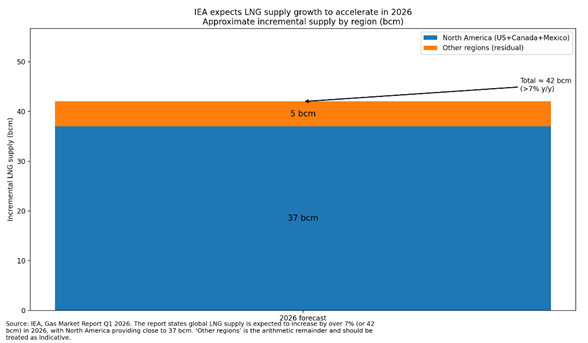
IEA expects global LNG supply to increase by over 7% (around 42 bcm) in 2026, with North America providing close to 37 bcm of incremental supply.
Against that backdrop, “skills” becomes more than a training-line item. It becomes a constraint on safe throughput, reliability and commercial performance.
Current operating conditions are creating a commissioning-heavy risk profile
The near-term project mix pushes operators into complex, transient operations more often. That mix spans brownfield expansions, offshore LNG and long-paused projects returning to site.
- US expansions and scale effects. On 9 February 2026, Oil & Gas Journal reported that Cheniere filed with FERC for a Corpus Christi Stage 4 expansion. The filing covers four liquefaction trains, each rated at around 6 million tonnes per annum (6 MTPA). It also references new tanks, a third marine berth, and major pipeline and compression works. Each of those elements adds interfaces, line-ups and commissioning campaigns. Those campaigns are where competence gaps surface fastest.
- Offshore LNG and new execution patterns. In December 2025, Eni announced the start-up of Congo LNG Phase 2. The press release describes an integrated configuration that includes the Nguya FLNG unit, offshore infrastructure, and a converted unit for gas treatment and compression. It also states overall capacity reaches 3 MTPA. Offshore LNG concentrates technical and human factors risk. It compresses marine, process, and maintenance decision-making into tighter teams.
- Project restarts and organisational discontinuity. TotalEnergies’ 29 January 2026 announcement confirms the full restart of Mozambique LNG activities. It states more than 4,000 workers are mobilised at Afungi, and it reiterates first LNG in 2029 with project progress at around 40%. Restarts bring their own hazards. Teams inherit design decisions made years earlier. They also inherit configuration changes done during suspension.
These updates share a common operational feature. They increase the frequency of non-routine operations. That is precisely where certification-based readiness tends to overstate real capability.
Complexity inside LNG facilities is rising, even when nameplate stays flat
Many LNG sites now operate with tighter margins and denser system coupling. This trend raises consequence severity when things drift off the design path.
More coupling, less slack
Modern LNG sites often run with deeper integration across gas treatment, liquefaction, utilities, storage and marine systems. Optimisation reduces buffer. It can also compress the time available to respond to deviations.
Higher change velocity during operations
Debottlenecking and reliability upgrades happen while plants remain online. Brownfield work adds SIMOPS complexity. It also increases permit-to-work load and interface risk.
Digital dependence, plus cyber-physical exposure
Control and safety systems still protect the plant. Yet digital integration has changed how faults propagate. Many trips now involve layered interactions between control logic, machine protection and operator response. The competence requirement shifts with that reality. Teams need “system sense”, not only process knowledge.
Certification and competence are not interchangeable
Many organisations rely heavily on formal credentials. A Liquefied natural gas course can build foundational understanding. Liquefied natural gas certification courses can also help standardise minimum knowledge across sites and contractors. That value remains real.
The problem sits elsewhere. Certification usually confirms that someone has learned content. Operational competence confirms that someone can deliver outcomes under the plant’s real constraints.
Three differences matter most in LNG operations:
- Site specificity. Competence depends on the actual configuration. Refrigerant cycles, driver selections, BOG strategy, ESD cause-and-effect, and marine systems differ by site. Generic training cannot cover every interaction pathway.
- Transient performance. Major risk clusters around start-ups, shutdowns, cooldowns, warm-ups, loading, and trip recovery. These scenarios demand judgement under time pressure. Certificates rarely prove that ability.
- Team performance. LNG safety often depends on coordination. Control room decisions, field execution and marine actions must align. A certificate sits with an individual. Risk sits with the team.
This gap explains why many operators still experience “qualified but unready” outcomes during commissioning and abnormal events.
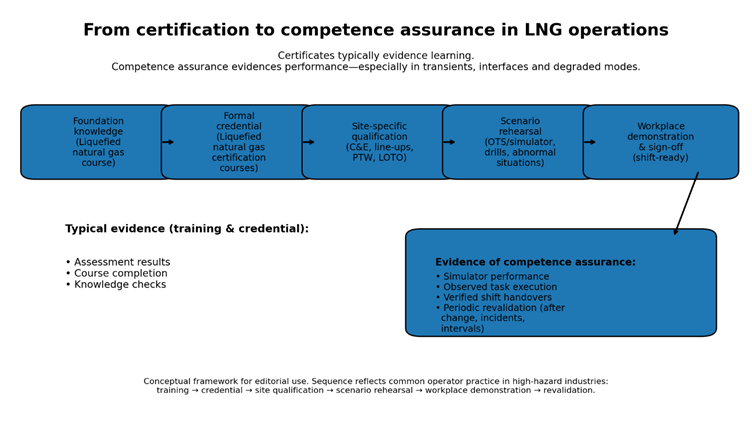
A competence assurance pathway that extends beyond certification: site-specific qualification, scenario rehearsal, verified workplace demonstration, and periodic revalidation.
Where capability gaps most often appear in LNG operations
The most material gaps rarely sit in steady-state operating routines. They appear in degraded modes and infrequent scenarios.
Abnormal situation management and weak-signal recognition
Operators can recite textbook responses. Yet many teams struggle with early pattern recognition. Alarm floods, subtle trend divergence and instrument bias can create false confidence. The plant then reaches a harder-to-control state.
Control logic and protection layer understanding
A persistent gap involves “what happens next”. Operators need to anticipate how interlocks interact, especially when PSD, ESD, F&G and rotating equipment protections trigger together. In many plants, the first minutes after a trip decide whether recovery stays controlled.
Field–control room integration
Interface failures remain common precursors to events. Typical failure modes include:
- Incomplete isolation verification
- Wrong valve alignment during changeover
- Ambiguous handover communication
- Contractor interfaces during simultaneous work
These are competence issues. They are also culture and discipline issues.
Mechanical integrity translated into operability
Ageing assets and efficiency drives increase exposure to degraded equipment operation. Teams need stronger “reliability-informed operations” capability. That includes how to operate safely with vibration trends, fouling, compressor performance loss, or utility constraints.
Marine interface and terminal–vessel coordination
Terminal operations combine process hazards with marine dynamics. ESD links, loading arm behaviour, BOG return control, and communications protocols all require consistent execution. Shipping adds another competence layer. That layer becomes more important as volumes grow and berth utilisation tightens.
How operators are evolving competence development
Leading operators now treat capability as a managed system. Training remains part of it, but it no longer serves as the primary assurance mechanism.
1) Scenario-based rehearsal, not just classroom learning
High-fidelity simulation and structured drills support rare-event readiness. The strongest programmes connect scenarios to site-specific hazards and recent incidents. They also measure performance, not attendance.
This approach also supports commissioning risk. It lets teams rehearse start-up and trip recovery sequences before the plant forces the learning.
2) Evidence-based competence and periodic revalidation
Organisations increasingly demand proof of task capability. They use workplace demonstrations, supervised sign-offs, and periodic reassessment. This matters in LNG because competence decays when teams do not practise rare sequences.
It also helps contractor governance. It gives operators a stronger basis to manage safety-critical tasks during turnarounds and brownfield tie-ins.
3) Cross-discipline integration around “interfaces”
The most valuable competence work often sits at boundaries. Operators now integrate training across operations, maintenance, marine, and instrumentation roles. They also run joint drills that test communications and decision hand-offs.
This shift reflects the industry’s risk reality. Events often arise from interface friction, not from a single person’s knowledge gap.
4) Stronger competence frameworks for LNG shipping operations
Industry societies have also sharpened expectations. SIGTTO’s publications include updated guidance on the minimum content for LNG carrier training courses at management level (published in 2026, per SIGTTO’s publications listing). Such documents matter because terminals cannot separate their risk profile from the vessel interface.
This trend also highlights a useful distinction. LNG competence needs to cover end-to-end operations. It spans custody transfer, marine emergency response, and terminal–vessel coordination.
Regulatory and economic implications are tightening the competence bar
Regulators increasingly ask how operators manage risk in practice. Paper compliance no longer satisfies scrutiny after a near-miss.
In the United States, PHMSA issued an advance notice of proposed rulemaking in May 2025 to gather input on potential amendments to LNG facility safety regulations. The detailed regulatory outcome remains uncertain, but the direction is clear. Operators will need to demonstrate robust management systems. Competence assurance sits inside that requirement.
Economics reinforce the same pressure. IGU data shows LNG trade continues to grow and diversify. The IEA expects accelerating supply growth in 2026, but it also flags ongoing volatility risk. In that environment, avoidable outages carry larger penalties. So do safety events, which now attract faster scrutiny from investors and counterparties.
Decarbonisation adds another layer. Many LNG projects now describe lower-carbon features and emissions controls. For example, Eni notes “advanced technologies to reduce [the Nguya FLNG’s] carbon footprint” in its Congo LNG Phase 2 announcement. Whether or not those technologies meet external expectations, they still alter the operating envelope. They introduce new constraints, new monitoring practices, and new failure modes.
Conclusions and near-term considerations
The LNG skills gap has shifted from a pipeline problem to an operational risk problem. Growth in trade and a return of supply-side momentum are pushing more assets into start-up and high-change conditions. Those conditions expose the limits of certification-led readiness.
Formal training still matters. Liquefied natural gas training provides common language and baseline knowledge. Yet certification alone cannot prove a team’s ability to manage transients, interfaces, and degraded modes. Those capabilities decide whether a site runs safely through commissioning peaks, brownfield change, and commercial volatility.
The most realistic near-term trajectory looks incremental, not revolutionary. Operators will keep certificates as entry gates. They will then lean harder on competence evidence, scenario rehearsal, and interface discipline. That shift aligns with the operational environment now visible in expansions and restarts, from US brownfield growth to offshore LNG and large-scale project remobilisation.
As LNG systems become more complex and more interconnected, the industry will need to treat competence as a living control layer. Certification can support that layer. It cannot replace it.
Frequently Asked Questions
1) Why does the LNG skills gap feel sharper now than five years ago?
Project ramp-ups, phased start-ups, and asset restarts increase the frequency of transient operations. Those conditions expose capability gaps faster than steady-state operations do. Market volatility also raises the cost of small operational errors.
Many organisations treat certification as proof of readiness for high-consequence operations. In reality, certification typically evidences knowledge and baseline understanding. It rarely proves performance in trips, recoveries, or complex interfaces.
They usually surface during start-up and shutdown sequences, trip response and recovery, and loading operations. They also appear during SIMOPS, brownfield tie-ins, and contractor-heavy turnarounds.
It means a team can operate the real plant safely under its real constraints. That includes correct anticipation of control logic and protection layer behaviour, disciplined line-ups and isolations, and clear handovers across roles.
Early-career operators often need stronger mental models and disciplined routine execution. Experienced hires often need accelerated site-specific qualification, especially for cause-and-effect, alarms, and abnormal operations. Both groups benefit from scenario rehearsal, but for different reasons.
Yes, for standardising minimum knowledge across shifts, contractors, and multi-site organisations. They help reduce variance in baseline understanding. They still need an operational layer that tests performance and reinforces behaviours under real conditions.
Many are shifting from “training completed” metrics to evidence-based competence. They use simulation, structured drills, observed task sign-off, and periodic revalidation. They also focus more on interfaces, not only individual proficiency.
