
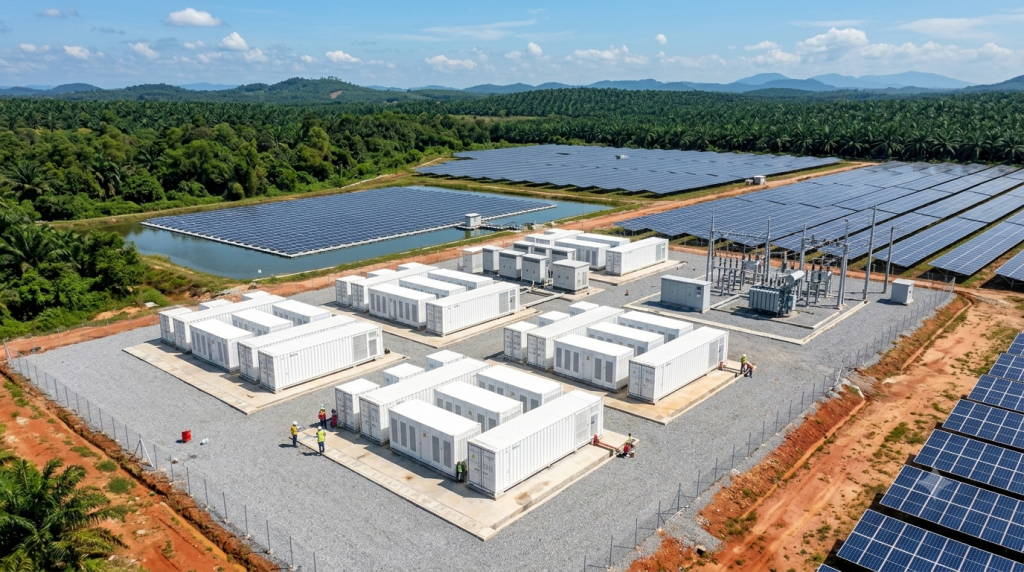
Battery Energy Storage Systems (BESS) have moved from pilot projects to core infrastructure across the energy sector. As grids absorb more solar and wind, and as industrial users chase reliability and cost savings, BESS has become one of the fastest-growing areas of capital investment — and one of the fastest-growing skills gaps.
What is BESS? In simple terms, it’s a system that stores electrical energy in batteries so it can be discharged later — smoothing out the mismatch between when power is generated and when it’s needed.
Who needs training? Engineers moving from conventional power into storage, project managers coordinating EPC delivery, O&M teams responsible for keeping systems safe and available, and HSE professionals who need to understand risks that don’t exist in traditional plant.
This guide walks through what a solid BESS training programme should cover: design fundamentals, safety, commissioning, grid integration, and the standards landscape — plus what a good course syllabus looks like. Throughout, we point to relevant courses from EnergyEdge’s BESS training portfolio that go deeper into each area.
What is a BESS (plain-English overview)
A BESS is built up in layers. Individual cells are grouped into modules, modules are assembled into racks, and racks are housed in containers (or rooms, for larger installations). This layered structure matters for safety and maintenance — a fault can often be isolated at the module or rack level rather than taking the whole system offline.
Around the batteries sits the equipment that makes the system useful:
- PCS (Power Conversion System) / inverters – convert DC battery power to AC for the grid, and vice versa during charging
- EMS (Energy Management System) – the “brain” that dispatches the system, manages state of charge, and coordinates with the grid or plant controller
- Transformers – step voltage up or down to match grid or plant requirements
- Protection systems – relays, breakers, and monitoring that isolate faults before they escalate
BESS design fundamentals
Good design starts with getting the basics right, and most course confusion traces back to two numbers:
- Power (MW) – how fast the system can charge or discharge
- Energy (MWh) – how much total energy it can store
A system might be described as “20 MW / 40 MWh” — meaning it can discharge at 20 MW for up to two hours. Sizing is driven by the intended use case:
- Peak shaving – reducing demand charges by discharging during high-price periods
- Frequency response – fast, short bursts to stabilise grid frequency
- Renewables firming – smoothing the variability of solar or wind output
Design also needs to account for degradation — batteries lose capacity over time and cycles. Course content here should stay high-level (rates vary by chemistry, usage pattern, and thermal management) but should give learners the vocabulary to read a degradation curve and understand its commercial implications.
For a deep dive into this area, EnergyEdge’s Design, Implementation, and Operations of Battery Energy Storage Systems (BESS) course covers battery chemistries, system design and optimisation, and the contracts that govern BESS projects — with an optional module on BESS design for data centre environments.
Safety and risk (must-have section)
This is the section no BESS course can skip. The central concern is thermal runaway — a chain reaction where a cell overheats, triggers neighbouring cells, and can lead to fire or gas release. Training should cover how it starts, how it propagates, and why containment design matters as much as prevention.
From there, courses typically address:
- Fire protection concepts – detection, suppression approaches, and ventilation strategy
- Hazard identification – electrical, chemical, and thermal hazards specific to storage
- Emergency response overview – what first responders and site personnel need to know before an incident, not during one
A useful teaching tool is a simple risk framework:
| Risk | Cause | Controls | Monitoring |
| Thermal runaway | Cell defect, overcharge, physical damage | Cell-level BMS limits, spacing, fire suppression | Temperature, voltage, gas sensors |
| Arc flash | Insulation failure, loose connections | PPE, lockout/tagout, enclosure design | Thermal imaging, periodic inspection |
| Grid fault propagation | Protection miscoordination | Relay coordination studies, interlocks | SCADA alarms, protection testing logs |
Teams who need to go beyond fundamentals should look at Safety and Performance Aspects of Batteries for Energy Storage Systems for Utilities (Large Scale), which covers battery chemistries, battery management systems (BMS) and their interaction with the EMS, and battery safety in detail for utility-scale applications.
Commissioning & testing (what happens before COD)
Before a BESS reaches Commercial Operation Date (COD), it goes through structured testing:
- FAT (Factory Acceptance Testing) – verifying equipment performance at the manufacturer’s facility
- SAT (Site Acceptance Testing) – confirming the system performs correctly once installed
- Performance testing – checking availability, response time, and dispatch accuracy against contractual guarantees
- Protection and interlocks – confirming that safety systems trip correctly and that mechanical/electrical interlocks prevent unsafe states
A course covering commissioning should give learners a working sense of the test sequence and the documentation trail it produces — not just the concepts. This is one of the strengths of the Design, Implementation, and Operations of BESS course, which walks through EPC processes, commissioning practices, and O&M strategies as part of its curriculum.
Grid integration basics
Connecting a BESS to the grid introduces its own technical layer:
- Interconnection overview – studies, agreements, and technical requirements utilities typically impose
- Power quality and harmonics – how inverter-based resources can introduce distortion, and why filtering and studies matter
- Control modes – the distinction between grid-following systems (which synchronise to an existing grid signal) and grid-forming systems (which can establish voltage and frequency independently). This is a nuanced, evolving area — good training presents it accurately rather than oversimplifying.
Grid integration is easiest to learn in the context of a real hybrid project. Utility-Scale Hybrid Solar PV Plants with Battery Energy Storage Systems (BESS) focuses specifically on grid stability, design integration, and lifecycle asset management for combined solar-plus-storage assets. For those working on the commercial side, Battery Energy Storage Systems (BESS) in Electricity Markets and Trading covers how storage assets are monetised through revenue stacking once they’re connected to the grid.
Standards & compliance (high-level)
Standards and codes for BESS vary by country and by project, so training should avoid over-claiming specific requirements. What’s useful is a general map of the categories involved:
- Safety standards (design, installation, and testing safety)
- Electrical standards (equipment and interconnection requirements)
- Fire codes (suppression, spacing, and egress requirements)
Learners should leave a course knowing which categories apply to their project and where to go to confirm current, jurisdiction-specific requirements.
What a good BESS course syllabus looks like
A well-structured programme is typically delivered over two days or in modular form:
Day 1 – Fundamentals & Sizing Introduction to BESS technology, components, sizing methodology, use cases, and degradation basics.
Day 2 – Safety, Commissioning & O&M Thermal runaway and fire protection, hazard identification, FAT/SAT processes, performance testing, grid integration basics, and standards overview.
BESS Glossary
- PCS – Power Conversion System, converts DC to AC and back
- EMS – Energy Management System, dispatches and monitors the system
- SOC – State of Charge, how full the battery currently is
- SOH – State of Health, remaining capacity relative to original
- C-rate – the rate at which a battery is charged or discharged relative to its capacity
Common Misconceptions
- “BESS is just a big battery.” It’s a full system of power electronics, controls, and protection working together.
- “All BESS fires start the same way.” Causes vary — cell defects, damage, and electrical faults all require different controls.
- “Grid-forming and grid-following are interchangeable terms.” They describe fundamentally different control strategies with different grid roles.
Build Your Team’s BESS Competency
Ready to move from concepts to practical, job-ready skills? EnergyEdge offers a full pathway of BESS training courses, depending on where your team needs the most depth:
- Design, Implementation, and Operations of Battery Energy Storage Systems (BESS) – the core course covering chemistry, system design, EPC, commissioning, and O&M, with an optional data centre module
- Safety and Performance Aspects of Batteries for Energy Storage Systems for Utilities (Large Scale) – a focused deep-dive into battery safety, BMS, and utility-scale performance
- Utility-Scale Hybrid Solar PV Plants with BESS – grid stability, design integration, and lifecycle asset management for hybrid solar-plus-storage projects
- BESS in Electricity Markets and Trading – for teams focused on revenue stacking and commercial strategy
Frequently Asked Questions
MW measures power — how fast energy flows. MWh measures energy — the total amount stored or delivered.
Like any energy infrastructure, BESS carries risks — primarily thermal and electrical — that are well understood and manageable with proper design, monitoring, and emergency planning.
A foundation in electrical or power engineering helps, but professionals from project management, HSE, and O&M backgrounds can build practical BESS competency through structured training without a deep specialist background.
