
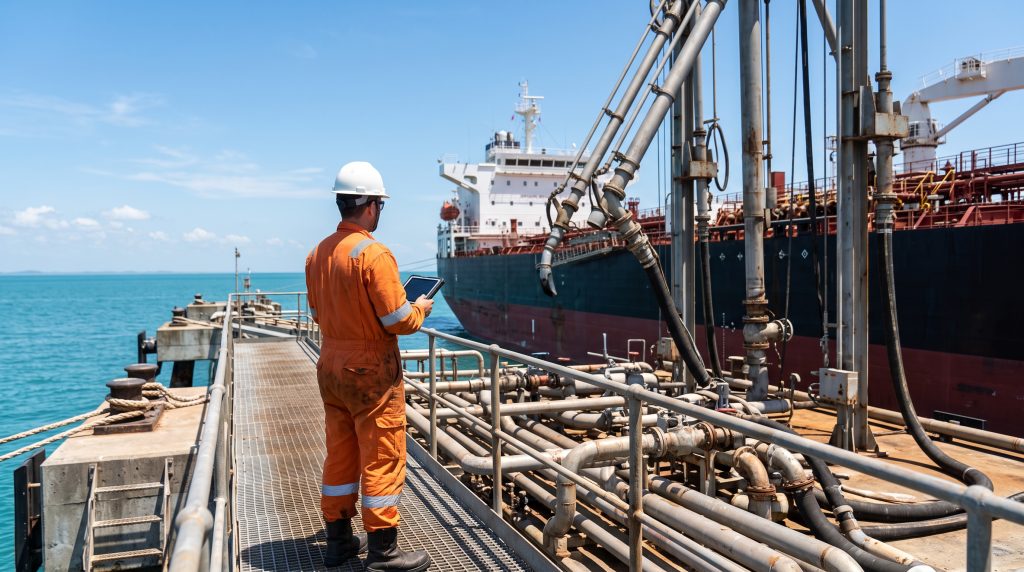
Loading Master responsibilities cover the single highest-risk moment in energy transport: the physical transfer of cargo between ship and shore. These responsibilities run from the safety checks before a vessel moors, through every valve opening during the transfer, to the final checks before the vessel departs. When the team gets it right, the cargo moves safely and on schedule. When it gets it wrong, the consequences appear in the oldest and most expensive category of maritime incident there is.
This guide sets out what a Loading Master controls, the terminal safety standards that define the role, and how terminals across Indonesia, Malaysia and the wider Southeast Asia region put those controls to work.
Key takeaways
|
In this guide |
What a Loading Master Actually Controls
“Loading Master” describes a function, not just a job title. The person who holds sign-off authority for a ship-shore cargo transfer performs it, whether a terminal, a charterer or an independent surveying firm employs them. What makes the role distinct is the scope of that authority: a Loading Master can halt a transfer unilaterally before, during or after cargo starts moving, and that authority is not symbolic.
The four areas of control
In practice, Loading Master responsibilities break down into four areas:
- Documentation and compatibility: the Loading Master confirms that the cargo, the vessel and the terminal’s systems are compatible before anyone connects a line.
- The ship/shore interface: the Loading Master runs the joint safety checklist with the vessel’s officer and keeps it live throughout the operation instead of treating it as a one-time form.
- Transfer parameters: the Loading Master approves and monitors the loading rate, the pressure and the sequence of tanks or compartments.
- Emergency authority: the Loading Master can call an emergency shutdown (ESD) at any point, without waiting for anyone else’s sign-off.
| Related training: New to the role, or formalising skills you already use day to day? EnergyEdge’s Loading Master Training Certification Course for Oil & Gas covers exactly this scope of responsibility (25–27 January 2027, Kuala Lumpur). |
The Controls, Stage by Stage
Every transfer, regardless of cargo type or terminal, moves through the same three stages. What changes between a simple fuel-oil transfer and a cryogenic LNG parcel is the margin for error, not the structure of the controls.
Stage 1 Pre-transferFirst, the Loading Master verifies the cargo documents against the vessel’s certificate of compatibility. Next, the Loading Master and the vessel’s officer complete and sign the ship/shore safety checklist together. The Loading Master also checks the mooring arrangement against OCIMF’s Mooring Equipment Guidelines, and then agrees and tests the communication method with the ship. |
Stage 2 During transferThe Loading Master re-verifies checklist items at set intervals, not just once at the start. Meanwhile, the Loading Master monitors loading rate and pressure against the agreed limits. If anything deviates, whether rate, pressure or communication, the team pauses immediately instead of leaving a note for later. |
Stage 3 Post-transferBefore disconnection, the Loading Master reconciles the final gauging and the documentation. The team then purges and drains the lines in the agreed sequence. Finally, ship and shore both sign the closing checklist before the vessel receives clearance to unmoor. |
What the Loading Master checks and who signs off
| Stage | What the Loading Master checks | Sign-off |
|---|---|---|
| Pre-transfer | Cargo compatibility, documentation, mooring, communications, ship/shore checklist | Loading Master and vessel’s responsible officer, jointly |
| During transfer | Rate, pressure, tank sequence, checklist re-verification, any deviation from plan | Loading Master, continuously, not a single sign-off |
| Post-transfer | Final gauging, documentation reconciliation, line purging, closing checklist | Loading Master and vessel’s responsible officer, jointly |
The Standards Behind the Role
ISGOTT and its sixth edition
The International Safety Guide for Oil Tankers and Terminals (ISGOTT), now in its sixth edition, is the reference point. The International Chamber of Shipping (ICS) and the Oil Companies International Marine Forum (OCIMF) publish it jointly, and the International Association of Ports and Harbors (IAPH) reviews it with them.
The sixth edition specifically revised the Ship/Shore Safety Checklist and the Bunkering Operations Checklist. The changes reflect how human factors, such as fatigue, complacency and checklist fatigue, affect whether people actually follow a control, not just sign it.
MARPOL, SOLAS and OCIMF MEG4
Three other frameworks sit alongside ISGOTT:
- MARPOL (the International Convention for the Prevention of Pollution from Ships) sets the pollution-prevention rules that a Loading Master enforces by controlling the transfer.
- SOLAS (the International Convention for the Safety of Life at Sea) sets the broader safety requirements that frame the ship/shore interface.
- OCIMF’s Mooring Equipment Guidelines (MEG4) set the technical standard that the Loading Master checks mooring arrangements against before any cargo moves.
However, none of these documents replace judgement. They define the floor, meaning what the team must check, and the Loading Master’s authority turns that floor into an actual decision at the moment it matters.
| Related training: Working specifically with LNG or other cryogenic cargoes? EnergyEdge’s LNG Marine Terminal Loading Master Certification course and LNG Terminal Operations & Safety course (5–7 April 2027, Kuala Lumpur) both build on this same ISGOTT foundation for cryogenic-specific risks. |
What Happens When a Control Is Skipped
ISGOTT’s sixth-edition revision of the checklists exists for a specific reason: a checklist that nobody genuinely re-verifies does not function as a control at all. The most common failure point is not a missing procedure. Instead, it is a procedure that has become routine enough that people sign it without checking.
A reported case from Langkawi
Enforcement action illustrates the same point from a different angle. In one reported case, Malaysia’s Maritime Enforcement Agency (MMEA) detained a tanker and a ferry in Langkawi waters because their crews could not produce any approval document for a ship-to-ship fuel transfer they had already begun.
There was no authorisation, no compatibility check and no Loading Master sign-off. That is exactly the kind of gap the pre-transfer stage exists to catch.
The lesson is not that cargo transfer is uniquely dangerous. Rather, the controls only work when every stage counts as a live check instead of a formality. For that reason, certification demonstrates structured training, not just possession of a copy of the checklist.
Southeast Asia: Indonesia and Malaysia Terminal Examples
Southeast Asia’s terminal infrastructure is expanding on both sides of the Malacca Strait at once. As a result, terminals handle more berths and more cargo types, and they need more Loading Masters qualified across multiple fuel types, not just one.
Indonesia: a multi-fuel terminal built for complexity
Pertamina, through Pertamina International Shipping, and port operator Pelindo are jointly developing the Jakarta Integrated Green Terminal (JIGT) in Kalibaru, North Jakarta. The terminal covers 64 hectares and has deep-sea berths for large vessels. It can handle LPG, LNG, gasoline, biodiesel, crude palm oil, used cooking oil and petrochemical products through a single facility, with a planned storage capacity of 6.3 million barrels.
Because one set of berths handles that many cargo types, ship/shore compatibility checks matter even more, and the Loading Master owns exactly that control.
Malaysia: the country’s first FSRU-based import terminal
Petronas Gas and Integrax (a unit of TNB Power Generation) signed a Heads of Agreement in mid-2026 to develop Malaysia’s first FSRU-based LNG import terminal jointly, in Lumut, Perak. The RGT-3 project centres on a 170,000 cbm floating storage and regasification unit with 500 MMscfd send-out capacity, which MISC will operate. It will become Malaysia’s third regasification facility, after Sungai Udang and Pengerang.
A floating terminal also adds a layer that most fixed jetties lack. The Loading Master’s pre-transfer checks now cover the FSRU-to-carrier interface itself, not just the cargo.
Singapore: the regional benchmark
Singapore remains the region’s regulatory benchmark, even though it sits outside the two main markets this series covers. The Maritime and Port Authority of Singapore tightened its bunkering rules from January 2026. Suppliers must now give a signed declaration that the fuel meets the required flashpoint standard before any transfer begins, and the flashpoint value must appear on the bunker delivery note itself.
It is a small procedural change with a clear direction: pre-transfer documentation requirements in the region are getting more specific, not less.
| Related training: Cargo increasingly includes alternative fuels alongside conventional product. EnergyEdge’s Ammonia as Cargo in Maritime Applications course (17–19 November 2026, Amsterdam) covers the safe handling and transfer procedures for ammonia cargoes, and the Offshore & Marine Operations and HSE Management course covers the wider safety management context in which Loading Masters operate. |
Loading Master Training with EnergyEdge
Certification signals one thing above all: that candidates have practised every stage above under supervision, not just read about it. EnergyEdge’s courses map directly onto the scope of the role this guide sets out.
25–27 JAN 2027 · KUALA LUMPUR Loading Master Training Certification Course for Oil & Gas The core certification covering ship/shore operations, documentation and emergency response. | SPECIALISED TRACK LNG Marine Terminal Loading Master Certification The same core scope, focused on LNG-specific risks and cryogenic transfer procedures. |
5–7 APR 2027 · KUALA LUMPUR LNG Terminal Operations & Safety Broader terminal safety management for teams working alongside Loading Masters. | 17–19 NOV 2026 · AMSTERDAM Ammonia as Cargo in Maritime Applications Safe handling and transfer procedures for ammonia as a growing alternative-fuel cargo. |
SEE COURSE PAGE FOR DATES Offshore & Marine Operations and HSE Management The wider HSE framework within which a Loading Master’s authority sits. | 22–24 SEP 2027 · KUALA LUMPUR Transportation Management in Upstream Oil & Gas Logistics and transport coordination for teams managing the wider supply chain. |
Need training for a whole team? EnergyEdge also runs in-house programmes tailored to your terminal operations and operating context. Explore the courses above, or contact EnergyEdge to discuss the right training approach for your team.
For a broader look at why the role matters across the wider energy transport chain, read the related article, Loading Masters: The Backbone of Energy Transport.
FAQs
A Loading Master holds sign-off authority for a ship-to-shore cargo transfer. First, the Loading Master confirms that the cargo, the vessel and the terminal’s systems are compatible. Then they run the joint safety checklist with the vessel’s officer, and they approve and monitor the loading rate, pressure and tank sequence. Finally, they hold emergency shutdown authority, so they can stop the operation at any point. A terminal, a charterer or an independent surveying firm can employ the role.
Yes. A Loading Master can halt a transfer unilaterally before, during or after cargo starts moving. Moreover, the role carries standing authority to call an emergency shutdown (ESD) at any point, and nobody else needs to sign off first.
Every transfer moves through pre-transfer, during-transfer and post-transfer stages. Before cargo moves, the Loading Master checks compatibility, documents, mooring and communications, and signs the joint checklist. While the cargo flows, the Loading Master re-verifies the checklist at set intervals, and any deviation triggers an immediate pause. After the transfer, the team reconciles the final gauging and documents, purges the lines and signs the closing checklist before the vessel unmoors.
ISGOTT, the International Safety Guide for Oil Tankers and Terminals, is the main reference. In addition, MARPOL sets the pollution-prevention rules, SOLAS frames the broader safety requirements at the ship/shore interface, and OCIMF’s Mooring Equipment Guidelines (MEG4) set the standard for mooring checks. However, these documents only define what the team must check. The Loading Master’s authority then turns that requirement into a decision.
The sixth edition revised the Ship/Shore Safety Checklist and the Bunkering Operations Checklist. As a result, both now account for human factors such as fatigue, complacency and checklist fatigue. The aim is to make sure people actually follow a control instead of just signing it.
When nobody genuinely re-verifies a checklist, it stops working as a control. For example, in one reported case, Malaysia’s Maritime Enforcement Agency detained a tanker and a ferry in Langkawi waters because their crews could not produce an approval document for a ship-to-ship fuel transfer they had already begun. Therefore, the pre-transfer stage exists to catch that kind of gap.
Terminal capacity is expanding in both countries. For example, Indonesia’s Jakarta Integrated Green Terminal can handle LPG, LNG, gasoline, biodiesel, palm oil, used cooking oil and petrochemicals, with 6.3 million barrels of planned storage. Similarly, Malaysia’s planned Lumut terminal will be its first FSRU-based LNG import terminal, so the pre-transfer checks must also cover the FSRU-to-carrier interface. As a result, more berths and more cargo types mean more compatibility checks and more demand for qualified Loading Masters.
EnergyEdge runs the Loading Master Training Certification Course for Oil & Gas on 25–27 January 2027 in Kuala Lumpur. Meanwhile, the LNG Marine Terminal Loading Master Certification covers LNG and cryogenic cargoes. Teams can also arrange in-house programmes, so a whole terminal can train together.