
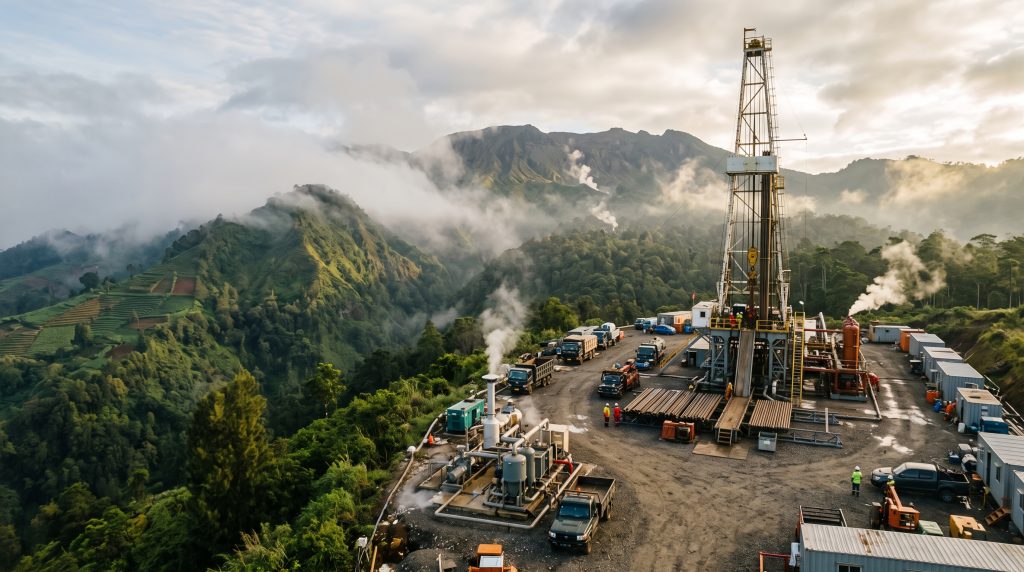
Picture a well pad high on a volcanic slope in Indonesia. The rig looks familiar to anyone from oil and gas. Yet the driller watches one gauge more closely than the rest: the temperature of the mud coming back up. A sudden rise means the well is heating fast, so hot water deep below may soon flash into steam. That detail sums up geothermal drilling in Indonesia. The tools are familiar, but the risks are different.
Geothermal drilling in Indonesia (in Bahasa Indonesia, pengeboran panas bumi) means drilling deep wells into hot, hard and fractured volcanic rock to reach the steam and hot water that power geothermal plants (PLTP). Unlike oil and gas wells, the main well control danger is hot water flashing into steam. Meanwhile, fluid losses, heat, corrosion and cement damage drive most of the cost.
- Indonesia has about 2,776 MW of geothermal capacity installed, so roughly 88% of its potential is still untapped.
- Furthermore, the national electricity plan (RUPTL) adds 5.2 GW of geothermal, so the industry needs many more wells.
- In geothermal wells, the main well control danger is a steam flash, not a gas kick.
- Lost circulation, hard rock, heat and corrosive fluids are the biggest cost drivers.
- Above about 110°C, well cement needs added silica to stay strong.
- Finally, oil and gas skills transfer well, yet teams still need geothermal-specific training.
Why does geothermal drilling in Indonesia matter now?
Indonesia sits on a long chain of volcanoes, so it holds one of the largest geothermal resources in the world. According to ESDM data reported by ANTARA, the country has about 23.2 GW of potential. However, it has only about 2,776 MW installed, so roughly 88.4% remains untapped. Even so, Indonesia already ranks second in the world for installed geothermal power, behind the United States.
Growth is now planned at scale. For example, PLN’s ten-year electricity supply plan (RUPTL) includes 5.2 GW of new geothermal capacity. As a result, developers will need many new production and injection wells. In other words, every new megawatt starts with a well that crews must drill safely, on time and within budget.
The rules matter too. Law No. 21 of 2014 on Geothermal (UU Panas Bumi) governs the sector, and the Job Creation laws later amended it. In practice, the law sets how the government grants geothermal working areas (WKP) and permits. Therefore, teams should check the current implementing regulations for each project.
A global lens: why this matters beyond Indonesia
Although this guide focuses on Indonesia, the lessons travel well. At the end of 2025, the world had 17,173 MW of geothermal power across 35 countries, according to ThinkGeoEnergy. Moreover, the physics of hot water, steam and fractured rock is the same everywhere. That is why the drilling industry’s first global geothermal well control guidelines apply far beyond any one country. So the ideas here apply across Southeast Asia and beyond.
Build a solid base first. Introduction to Geothermal Exploration and Development explains how projects move from exploration to early development, so you can join geothermal teams with confidence.
How is geothermal drilling different from oil and gas drilling?
At first glance, a geothermal rig looks like any land rig. However, the conditions downhole are very different, as the comparison below shows.
| Topic | Oil and gas well | Geothermal well |
|---|---|---|
| Main target | Oil or gas trapped in rock. | In contrast, heat carried by steam and hot water. |
| Temperature | Often moderate, while HPHT wells exceed about 150°C. | Production zones often run from 160°C to above 300°C. |
| Pressure | Often high pore pressure. | Often underpressured, so influx is less common. |
| Rock | Mostly sedimentary rock. | Instead, hard, abrasive and fractured volcanic rock. |
| Main well control danger | A gas kick from high pressure. | However, hot water flashing into steam. |
| Fluid losses | Usually manageable. | Frequent and sometimes total. |
| Cement | Standard slurries often work. | Therefore, crews use silica-stabilised slurries above about 110°C. |
What makes geothermal well control different?
In an oil and gas well, a “kick” usually means gas or oil entering the well because formation pressure beats the mud pressure. Crews then shut in the well and raise mud weight. In a geothermal well, by contrast, the main danger is different.
Deep geothermal water is far hotter than 100°C. It stays liquid only because the rock and the fluid column above it hold it under pressure. So if that pressure drops, even a little, the water can flash into steam. Because steam takes up much more space than water, the well can unload fluid very quickly. That is how a geothermal blowout can start.
For this reason, geothermal well control focuses on keeping the well cool and full. Typical practices include:
- First, keeping the hole full at all times, especially while pulling pipe.
- Also, monitoring flowline temperature, not only pit volume, because a sudden rise in heat is an early warning.
- Pumping cold water to cool the well, which often brings it back under control.
- In addition, watching for non-condensable gases such as hydrogen sulphide (H₂S) and carbon dioxide, which can rise with steam.
- Finally, using managed pressure drilling in the rarer overpressured zones.
In May 2026, the International Association of Drilling Contractors (IADC) released its first Geothermal Well Control Guidelines. The guidance adapts oil and gas well control to heat, flash risk and underpressured formations. As a result, many operators now update their procedures and training.
Learn high-temperature well control in depth. Geothermal Drilling Engineering – Master High-Temperature Drilling from Concept to Execution covers well design, well control and drilling fluids in extreme heat.
What are the main geothermal drilling risks?
Geothermal drilling is expensive. According to the US Department of Energy, drilling can account for up to 50% of geothermal exploration and development costs. Five risks drive most of that cost.
Lost circulation
Drilling fluid flows into fractures instead of returning to surface. As a result, one industry review citing the DOE put it at 3.5% to 10% of project costs.
Fix: plan for losses and plugs.
Hard, abrasive rock
Bits wear faster, so drilling rates fall. In fact, the DOE notes that doubling the daily drilling rate could cut well cost by 10–15%.
Fix: hard-rock bits and live data.
Heat on tools and fluids
High temperatures shorten the life of bits, motors and electronics. Meanwhile, drilling fluids lose their properties when they get too hot.
Fix: high-temperature equipment.
Corrosion and scaling
Geothermal fluids can be acidic or rich in minerals. Consequently, they corrode steel and leave scale inside pipe and casing.
Fix: alloys and protective design.
Subsurface uncertainty
Before drilling, nobody knows exactly how hot or permeable a reservoir is. For example, PLN’s leadership noted success rates of about 30% to 40%.
Fix: better models and stage gates.
Reduce uncertainty before you drill. Geothermal Exploration and Resource Assessment – Volcanic-Hosted Hydrothermal Systems is a hands-on workshop on exploration design, conceptual models and well targeting.
How do you build a geothermal well that lasts?
A geothermal well must contain hot, sometimes corrosive fluid for decades. So well integrity starts at the design stage, long before production begins.
First, cement must survive the heat. Above about 110°C, standard Portland cement can lose strength and let fluids through, a problem called strength retrogression. To prevent it, crews add silica flour, often around 35–40% by weight of cement.
Second, casing must handle heating and cooling. Steel expands as it heats up, so engineers design casing and cement for large thermal stresses. Third, materials must resist corrosion. Where fluids are aggressive, engineers therefore choose corrosion-resistant alloys or protective designs. Finally, the barrier approach from oil and gas still applies. In other words, every well needs clear barriers, testing and monitoring through its life, from drilling to final abandonment.
Strengthen well integrity skills. Advanced Well Integrity Management and Advanced Well Cementing and Integrity Management in Upstream Oil and Gas Operations cover barriers, cement and long-term integrity.
Is your team geothermal-ready? A five-question self-check
Answer these questions honestly. Each “no” or “not sure” points to a skill gap worth closing before your next campaign.
- Does your well control plan cover steam flashing, not only gas kicks?
- Do crews monitor flowline temperature as an early warning sign?
- Is there a lost circulation plan for fractured volcanic rock?
- Are cement slurries designed for temperatures above 110°C?
- Do project and finance staff understand subsurface uncertainty and stage gates?
If you answered “no” to questions 1 to 3, start with Geothermal Drilling Engineering. For question 4, look at the well cementing and integrity courses. For question 5, however, Decision-based Geothermal Field Development is the best fit.
Which oil and gas skills transfer to geothermal?
The good news is that many oil and gas skills transfer directly. For example, well planning, casing design, directional drilling and barrier thinking all apply. However, teams also need new knowledge of heat, steam and volcanic reservoirs. The pathway below matches each background to a practical next course.
- Drilling engineer or supervisor→Geothermal Drilling Engineering
- HPHT or deep well engineer→HPHT Well Engineering
- Well integrity engineer→Advanced Well Integrity Management
- Cementing engineer→Advanced Well Cementing and Integrity Management
- Geoscientist or reservoir engineer→Resource Assessment – Volcanic-Hosted Systems
- Project manager or investor→Decision-based Geothermal Field Development
- New to geothermal→Introduction to Geothermal Exploration and Development
Glossary
- Barrier: In short, a barrier is any part of the well, such as cement or a valve, that stops fluid from escaping.
- Flashing: Flashing happens when very hot water suddenly turns into steam because its pressure drops.
- Kick: A kick is an unplanned flow of formation fluid into the well during drilling.
- Lost circulation: Lost circulation occurs when drilling fluid flows into the rock instead of returning to surface.
- Managed pressure drilling (MPD): In other words, MPD lets crews control well pressure very precisely from the surface.
- Non-condensable gases: These gases, such as H₂S and CO₂, stay as gas even when steam cools.
- PLTP: PLTP (Pembangkit Listrik Tenaga Panas Bumi) is the Indonesian term for a geothermal power plant.
- RUPTL: The RUPTL is PLN’s ten-year electricity supply business plan for Indonesia.
- Strength retrogression: Strength retrogression means cement loses strength at temperatures above about 110°C.
- WKP: A WKP (Wilayah Kerja Panas Bumi) is a geothermal working area that the government offers to developers.
Geothermal and well engineering courses
Pick the course that matches your role, then open its page for the latest schedule and formats.
| Course | Best for | Level and length |
|---|---|---|
| Geothermal Drilling Engineering – Master High-Temperature Drilling from Concept to Execution | Drilling engineers, rig and wellsite leaders | Basic to Intermediate · 4 days |
| Introduction to Geothermal Exploration and Development | Oil and gas staff new to geothermal | Basic to Intermediate · 5 days |
| HPHT Well Engineering – Planning, Design & Operations | Well engineers working in high heat | Basic to Intermediate · 5 days |
| Geothermal Exploration & Resource Assessment – Volcanic-Hosted Hydrothermal Systems | Geoscientists, reservoir and drilling engineers | Basic to Intermediate · 3 days |
| Decision-based Geothermal Field Development | Project managers, finance and government staff | Intermediate · 5 days |
| Advanced Well Integrity Management – Securing the Well Lifecycle from Concept Selection to Final Abandonment | Well integrity, completion and HSE staff | Intermediate to Advanced · 5 days |
| Advanced Well Cementing and Integrity Management in Upstream Oil and Gas Operations | Cementing, drilling and integrity engineers | Advanced · 4 days |
Every course can also run in-house or online (VILT) for your team. See the full training calendar.
Related reading
- Top 10 In-Demand Training Courses for Indonesia’s Power Utilities and Renewable Energy Sector
- The Critical Role of Training in Energy Transition and Local Content Development
- Geothermal Footprint: Weighing the Environmental Pros and Cons
Build geothermal-ready teams
Indonesia’s geothermal pipeline keeps growing, and every project depends on safe, well-built wells. So whether you drill, design, evaluate or invest, now is a good time to build geothermal skills in your team.
Pengeboran panas bumi adalah kegiatan mengebor sumur dalam ke batuan vulkanik yang panas, keras, dan retak untuk mencapai uap dan air panas yang menggerakkan PLTP. Bahaya utamanya berbeda dari sumur migas: air panas dapat tiba-tiba berubah menjadi uap ketika tekanan turun.
01Eksplorasi
Tim geosains membangun model bawah permukaan untuk menentukan target sumur. Karena tingkat keberhasilan pengeboran sekitar 30–40%, keputusan bertahap sangat penting.
02Pengeboran
Batuan vulkanik yang keras dan retak memperlambat laju pengeboran. Selain itu, lumpur pemboran sering hilang ke dalam rekahan (kehilangan sirkulasi).
03Penyemenan
Di atas sekitar 110°C, semen biasa dapat kehilangan kekuatan. Oleh karena itu, kru menambahkan tepung silika sekitar 35–40% dari berat semen.
04Pengendalian sumur
Jika tekanan turun, air panas dapat berubah menjadi uap (flashing). Karena itu, kru menjaga sumur tetap penuh, memantau suhu di flowline, dan memompa air dingin.
Pertanyaan yang sering diajukan
Apa itu pengeboran panas bumi?
Pengeboran panas bumi adalah pembuatan sumur dalam ke reservoir panas bumi untuk memproduksi uap dan air panas bagi PLTP. Meskipun peralatannya mirip dengan pengeboran minyak dan gas, kondisinya jauh lebih panas, dan batuannya lebih keras serta retak.
Apa risiko utama pengeboran panas bumi di Indonesia?
Risiko utamanya adalah kehilangan sirkulasi, batuan yang keras dan abrasif, suhu tinggi pada peralatan dan fluida, korosi dan kerak (scaling), serta ketidakpastian bawah permukaan. Selain itu, air panas dapat berubah menjadi uap jika tekanan di dalam sumur turun.
Apakah tenaga ahli migas bisa beralih ke panas bumi?
Bisa. Keahlian seperti perencanaan sumur, desain casing, pengeboran berarah, dan integritas sumur dapat langsung diterapkan. Namun, tenaga ahli tetap perlu memahami panas, uap, dan reservoir vulkanik melalui pelatihan khusus panas bumi.
