
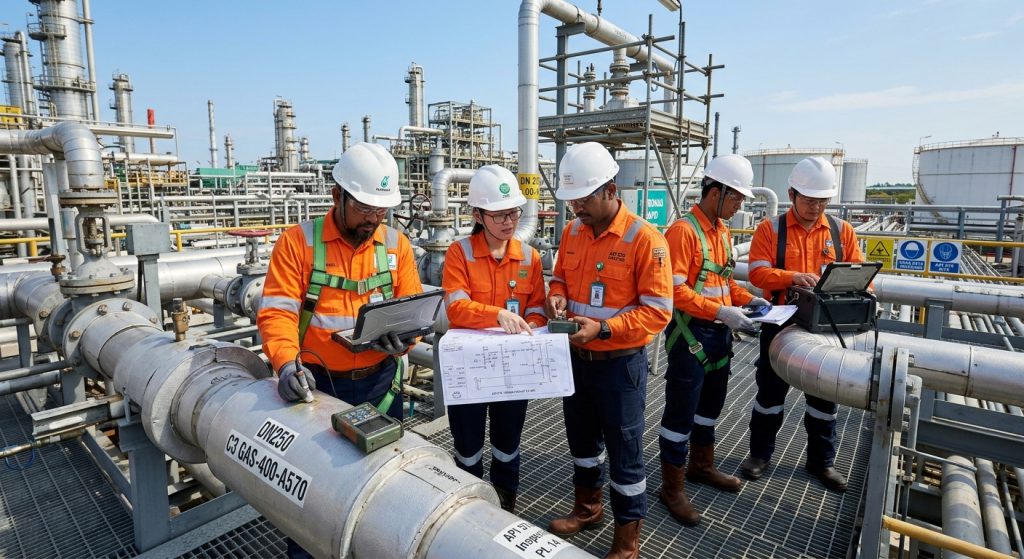
API 570 is the American Petroleum Institute’s certification for Authorized Piping Inspectors, covering in-service inspection, rating, repair and alteration of process piping. An API 570 course in Malaysia prepares inspectors, integrity engineers and QA/QC personnel to sit the API examination and to apply the code in refineries, terminals and offshore facilities. Training is available in Kuala Lumpur or online.
Key facts: API 570 at a glance
| Credential | API 570 — Authorized Piping Inspector (part of API’s Individual Certification Programs) |
| Awarded by | American Petroleum Institute (API), Washington DC — not by any training provider |
| Governing document | API 570, Piping Inspection Code: In-service Inspection, Rating, Repair, and Alteration of Piping Systems |
| Typical audience | Piping and plant inspectors, asset integrity engineers, QA/QC personnel, maintenance and turnaround engineers, NDT coordinators, inspection contractors |
| Typical prerequisite | A combination of formal education and hands-on piping experience — the higher your qualification, the fewer years required |
| Exam format | Computer-based, split into a closed-book section and an open-book section |
| Delivery in Malaysia | Classroom in Kuala Lumpur, Virtual Instructor-Led Training (VILT), or in-house at your site |
| Typical preparatory course length | 5 days classroom, or 5 half-days delivered virtually |
| Realistic total prep time | 80–150 self-study hours on top of the course, depending on your starting point |
| Outcome | Exam readiness plus practical, code-anchored inspection judgement you can use the following Monday |
| Certification cycle | Recertification is required on a recurring cycle; confirm the current interval and requirements with API |
| HRD Corp | EnergyEdge is an HRD Corp registered training provider, so Malaysian employers can typically claim against their levy |
Preparatory course: API 570: Piping Inspector Certification Preparatory Course · Virtual (VILT) delivery
Important: No training provider — including EnergyEdge — issues the API 570 certificate. Providers prepare you for the examination. The certificate comes from API after you apply, qualify and pass. Be sceptical of any course marketed as “guaranteed certification”.
Who this guide is for
If you are reading this, you are probably in one of five situations:
- You are an inspector or engineer who has been told by your employer or a client that API 570 is now expected, and you need to work out whether you qualify and how much study is realistic.
- You are an integrity or reliability lead building a competency plan for a team of five, ten or thirty people, and you need to know what sequence of training actually works.
- You are in HR or L&D at a Malaysian operator or service company, comparing providers, and you need to know what separates a serious preparatory course from a slide-reading exercise.
- You already failed the exam once and want to understand what you missed — usually it is open-book navigation speed, not technical knowledge.
- You are early-career and trying to decide between API 570, API 510, API 653 and CSWIP as your first serious credential.
The guide is written to answer all five. Skip to whichever section you need — each one stands alone.
Part 1: Eligibility for API 570
API sets eligibility through a matrix of education and experience. The principle is straightforward: the more formal engineering education you hold, the fewer years of hands-on piping experience API requires. The experience must be relevant — supervision, design, operation, maintenance or inspection of in-service piping systems — not general plant work.
Typical eligibility structure
| Educational background | Minimum relevant experience (typical) | What “relevant” usually means |
| Degree in engineering or technology | About 1 year | Design, operation, maintenance, inspection or supervision of in-service piping |
| Two-year certificate or diploma in engineering or technology | About 2 years | As above, documented and verifiable |
| High school diploma or equivalent | About 3 years | As above, typically in the process industries |
| No formal qualification | About 5 years | As above, with a longer track record substituting for education |
Verify before you apply. The table above reflects the structure API has historically used, not a quotation of the current requirements. API updates eligibility criteria, exam scheduling and the publications in scope. Always check the current API Individual Certification Programs eligibility requirements and the Publications Effectivity Sheet for your exam window before paying anything.
Supporting documents you will typically need
- Proof of education — degree certificate, diploma or transcript, often certified or notarised.
- Employer verification of experience — usually a letter on company letterhead, signed by a supervisor or HR, stating your role, dates and the nature of your piping work.
- A CV or work history mapped to the experience categories API recognises, not written as a generic job application.
- Government photo identification matching the name on your application exactly — this trips up more Malaysian candidates than any other item, because passport names, IC names and the name on a degree certificate frequently differ in spelling, order or the use of “bin”/”binti” and “a/l”/”a/p”.
- Payment details for the application and examination fees.
Six eligibility mistakes Malaysian candidates make
- Counting fabrication or construction QC as in-service inspection. New-build QA/QC work under B31.3 is valuable, but API 570 is about in-service piping. If most of your experience is on greenfield projects, expect to justify it carefully.
- Leaving the experience letter vague. “Mr X worked as an engineer from 2019 to 2024” is not enough. The letter should name piping inspection duties explicitly.
- Applying before the education documents are ready. Certified copies from a Malaysian or overseas university can take weeks. Start this before you book the course, not after.
- Name mismatches across documents. Fix these first. An identification mismatch at the test centre can cost you the entire exam fee.
- Assuming an employer will handle it. Many do. Many also assume you have done it. Confirm in writing who is submitting the application.
- Booking a course for a date that does not line up with the exam window. Training three months before you can sit the exam wastes most of the retention benefit. Work backwards from the exam date.
A note on Malaysian statutory requirements
API 570 is an international, voluntary, employer-recognised credential. It is not a Malaysian statutory licence, and holding it does not by itself make you a competent person under Malaysian occupational safety and health legislation, where DOSH sets its own competency framework for pressure equipment.
In practice, the two operate side by side. Malaysian operators and their contractors use API 570 as the benchmark for piping inspection competency in contracts, bid qualification and internal integrity management systems, while statutory duties continue to be discharged through the DOSH framework. If your role has a statutory dimension, confirm what your regulator and your client each require — they are separate questions with separate answers.
Part 2: How the API 570 examination actually works
Understanding the exam’s mechanics matters as much as knowing the technical content. Most candidates who fail do so because of how they used their time, not because of what they did not know.
The two-part structure
The examination is delivered by computer at approved test centres and is split into two distinct sections:
The closed-book section tests what you carry in your head. No references. This is where general inspection knowledge, damage mechanism recognition, welding and NDE fundamentals, and the logic of the piping code live. Questions are short and the pace is quick.
The open-book section tests whether you can find and apply information under time pressure. You have access to the specified publications. Questions typically require you to locate a clause, read a table, or run a calculation and select the right answer. The technical difficulty is often lower than the closed-book section — the difficulty is speed.
The single most important document: the Effectivity Sheet
API publishes a Publications Effectivity Sheet for each exam window. It lists exactly which editions and addenda of which documents are in scope. This matters because:
- Buying the wrong edition of ASME B31.3 means your tabs, page numbers and clause references will not match the exam.
- Documents occasionally drop off or join the list between windows.
- Some publications are in scope for the closed-book section only, meaning you must know them without being able to look them up.
Download the effectivity sheet for your specific exam window before you buy a single code book. If a training provider cannot tell you which effectivity sheet their material is aligned to, that is a meaningful warning sign.
What you can bring
Rules on annotations, tabs and highlighting are set by API and enforced at the test centre. Typically, tabs and highlighting are permitted while written notes in the margins are not — but this is exactly the kind of rule that changes, and the consequences of getting it wrong are severe. Confirm the current policy with API directly, not with a forum post from 2019.
Realistic difficulty
API 570 is a demanding exam but not an exotic one. Candidates who work in piping inspection daily and put in genuine preparation pass at reasonable rates. Candidates who treat the five-day course as the whole preparation, and who have never opened ASME Section IX before, generally do not.
The two hardest transitions are usually:
- From “I know how this plant works” to “I know what the code requires.” Experienced inspectors often have excellent practical judgement built on company procedures that are more conservative — or occasionally less conservative — than the code. The exam tests the code.
- From reading to retrieving. Being able to explain corrosion rate calculation is different from finding the right table in ninety seconds under pressure.
Part 3: The API 570 Body of Knowledge, section by section
API publishes a Body of Knowledge (BoK) that defines what the exam covers. The sections below organise that material the way inspectors actually use it, with the common errors that cost marks in each area.
Every section ends with a “common mistakes” list. If you read nothing else in this guide, read those.
3.1 Codes and standards you must know
API 570 does not stand alone. It sits at the centre of a small library, and the exam tests your ability to move between the documents.
The core set typically in scope:
- API 570 — Piping Inspection Code: In-service Inspection, Rating, Repair, and Alteration of Piping Systems. The primary document. Inspector responsibilities, piping classification, inspection intervals, thickness monitoring, repairs, alterations, rerating, records.
- API RP 571 — Damage Mechanisms Affecting Fixed Equipment in the Refining Industry. The reference for recognising why piping degrades and what it looks like.
- API RP 574 — Inspection Practices for Piping System Components. Practical inspection technique: valves, flanges, fittings, bolting, supports, and how to actually take readings.
- API RP 577 — Welding Processes, Inspection, and Metallurgy. Welding processes, discontinuities, metallurgy, and what an inspector should look for.
- API RP 578 — Guidelines for a Material Verification Program (MVP) for New and Existing Assets. Positive material identification and why the wrong alloy in the wrong service is a fatality waiting to happen.
- ASME B16.5 — Pipe Flanges and Flanged Fittings. Pressure–temperature ratings, flange classes, materials groups.
- ASME B31.3 — Process Piping. Design conditions, pressure design of components, materials, fabrication, examination, testing.
- ASME BPVC Section V — Nondestructive Examination. The methods themselves: RT, UT, PT, MT, VT.
- ASME BPVC Section IX — Welding, Brazing, and Fusing Qualifications. WPS, PQR, welder qualification, essential variables.
- ASME PCC-2 — Repair of Pressure Equipment and Piping. Repair techniques including sleeves, clamps and composite repairs.
Some exam windows also include API RP 576 (Inspection of Pressure-Relieving Devices). Check your effectivity sheet.
How to hold this in your head:
Think of the documents in four groups, and the exam becomes far less intimidating:
| Group | Documents | The question it answers |
| What must I do? | API 570 | Intervals, responsibilities, what triggers action |
| Why is it degrading? | API 571, API 578 | Damage mechanisms, alloy verification |
| How do I look at it? | API 574, ASME Section V | Inspection practice, NDE methods |
| How do I fix or rate it? | ASME B31.3, B16.5, Section IX, PCC-2 | Design calculations, ratings, welding, repairs |
Nearly every open-book question can be routed to one of these four groups in a few seconds. That routing decision is the single biggest determinant of your open-book speed.
Common mistakes
- Buying the wrong edition because the effectivity sheet was not checked first.
- Treating ASME Section IX as a welding engineer’s document and skipping it. It is heavily examined, and the logic of essential versus non-essential variables is entirely learnable in a weekend.
- Assuming B16.5 questions are only about flange ratings. Material group determination, temperature interpolation and bolting are all fair game.
- Not distinguishing between a Code (mandatory when adopted, e.g. API 570 itself) and a Recommended Practice (guidance, e.g. API 571, 574, 577, 578). The exam expects you to know which is which.
- Ignoring PCC-2 until the last week. Repair questions carry real weight.
If your foundation in the ASME piping code is thin, structured design-side training closes that gap quickly — the ASME B31.3 Process Piping Systems in Industrial Plants course covers the design and calculation logic the API exam then asks you to apply, and there is an ASME B31 e-learning module if you need to work at your own pace around shift patterns.
3.2 Inspection planning and intervals
This is the heart of API 570 and the section where the code’s own logic is most heavily tested.
Concepts to master:
- Piping classification. API 570 groups piping into classes based on the consequence of a loss of containment — flammability, toxicity, location relative to people, and similar factors. Higher-consequence piping gets more frequent inspection. Know the logic of what pushes a line into a higher class, not just the class numbers.
- Piping circuits and condition monitoring locations (CMLs). A circuit is a section of piping with a common expected corrosion rate and environment. CMLs are the specific points you monitor within it. Getting circuitisation wrong is the most common real-world integrity failure in the entire discipline.
- Interval determination. The governing principle: the next inspection is due at the lesser of half the calculated remaining life or the maximum interval permitted by the code for that piping class. Understand why “half remaining life” exists — it builds in the opportunity to intervene before the line reaches minimum thickness.
- Types of inspection. External visual, internal visual where practical, thickness measurement, CUI inspection, injection point inspection, and inspection of deadlegs and small-bore connections. Each has its own drivers.
- Injection points, mix points and deadlegs. These get special treatment because localised corrosion rates can be an order of magnitude above the rest of the circuit. Know the extent of the circuit around an injection point and why the interval is shortened.
- Corrosion under insulation (CUI). Driven by temperature range, insulation condition, coating condition and environment. Malaysia’s climate — permanently high humidity, heavy rainfall, coastal chloride exposure — makes CUI a first-order risk here, not a footnote.
- Risk-based inspection (RBI). API 570 permits RBI to set intervals in place of the default schedule, provided the RBI assessment meets the requirements of API RP 580 and is properly documented and reviewed.
Common mistakes
- Confusing the interval (maximum time between inspections) with the due date (which is set by half remaining life when that is shorter).
- Forgetting that both a thickness measurement interval and a visual external interval apply, and they are not the same number.
- Applying a plant’s internal procedure rather than the code. Your company may inspect Class 2 lines every three years. The exam does not care.
- Treating CUI as applying only to insulated lines in a narrow temperature band and forgetting cyclic service, intermittent service and lines that operate below ambient.
- Missing that an RBI-driven interval extension carries documentation, competency and review requirements — it is not a free pass.
- Not recognising that a deadleg’s corrosion rate can differ completely from the parent circuit, so it needs its own CMLs.
For teams moving from calendar-based to risk-based planning, the Asset Integrity and Life Extension course — mastering risk-based inspection and fitness-for-service methodologies is the natural companion to API 570: 570 tells you what the default requires, RBI tells you when and how you are permitted to deviate.
3.3 Thickness measurement, corrosion rates and remaining life
This is where the calculation questions live. There are not many distinct calculation types, and they are all learnable — but you must be able to run them cleanly, at speed, with correct units.
The core calculations:
Short-term corrosion rate
Short-term rate = (t_previous − t_actual) ÷ (years between t_previous and t_actual)
Long-term corrosion rate
Long-term rate = (t_initial − t_actual) ÷ (years between t_initial and t_actual)
Remaining life
Remaining life (years) = (t_actual − t_required) ÷ corrosion rate
Next inspection due date
Due = lesser of (½ × remaining life) or (maximum interval for the piping class)
Required thickness comes from the pressure design equations in ASME B31.3, and separately from structural minimum thickness considerations. Both matter: a small-bore line can satisfy pressure design at a wall thickness that is structurally unsound.
Concepts to master:
- Which corrosion rate governs. API 570 requires judgement here. When short-term and long-term rates differ significantly, you must decide which better represents current conditions — and be able to justify it. Something has usually changed in the process.
- Statistical treatment of readings. When and how you may use averaged or statistically analysed thickness data instead of the single lowest reading.
- Measurement accuracy and its limits. Repeatability, transducer effects, temperature correction, surface condition, coating thickness. A “corrosion rate” derived from two readings taken by different technicians with different instruments on slightly different spots is not a corrosion rate.
- Nominal versus actual initial thickness. Pipe is supplied with a manufacturing tolerance. Using nominal thickness as your starting point when actual measured thickness was lower produces a corrosion rate that is wrong, usually optimistically.
- MAWP determination for a corroded component, and what it means when calculated MAWP falls below operating pressure.
- Damage mechanisms as the reason behind the numbers: general thinning, localised corrosion, erosion and erosion-corrosion, CO₂ corrosion, sulfidation, naphthenic acid corrosion, high-temperature hydrogen attack, chloride stress corrosion cracking, wet H₂S damage (HIC, SOHIC, SSC), caustic and amine cracking, carbonate cracking, thermal and mechanical fatigue, creep.
Common mistakes
- Unit errors. Mixing inches and millimetres, or mils per year with millimetres per year, is the single most common cause of lost calculation marks. Decide on one unit system per question and convert everything at the start.
- Using nominal wall thickness where the question supplies an actual initial measurement.
- Forgetting that remaining life is measured from actual to required, not from actual to zero.
- Calculating half remaining life and then failing to compare it to the code maximum interval.
- Rounding aggressively mid-calculation and drifting into the wrong multiple-choice option. Carry the decimals.
- Reporting a next inspection date instead of an interval, or vice versa, when the question asked for the other.
- Applying a general thinning mindset to a localised mechanism. Averaging readings across a pitted area hides exactly the damage you are looking for.
Because so much of this section depends on recognising why the metal is disappearing, damage mechanism knowledge pays back disproportionately. The API 571 Materials and Corrosion Damage Mechanisms course is the most useful single companion to API 570 preparation, and it remains useful long after the exam — it turns inspectors who record damage into inspectors who predict it.
3.4 Welding, NDE and materials verification
Piping inspectors are not welding engineers, but the API 570 examination expects a working command of welding documentation and non-destructive examination.
Concepts to master:
- The document chain. A WPS (Welding Procedure Specification) tells the welder what to do. A PQR (Procedure Qualification Record) is the evidence that the procedure was tested and produced acceptable results. A WPQ (Welder Performance Qualification) shows an individual welder can execute it. Know what each contains and who signs it.
- Essential, non-essential and supplementary essential variables. Change an essential variable and the procedure must be requalified. Change a non-essential variable and only the WPS needs revision. Supplementary essential variables come into play when notch toughness is required. This distinction is examined heavily and is pure ASME Section IX.
- P-numbers, F-numbers and A-numbers. Base metal grouping, filler metal grouping, and weld deposit chemistry respectively. Know which number applies to which thing.
- Preheat and post-weld heat treatment. When PWHT is required, why, and what alternatives the code permits — including controlled-deposition and temper-bead techniques that API 570 allows in place of PWHT under defined conditions.
- NDE method selection. Visual, penetrant, magnetic particle, radiographic, ultrasonic. Know what each detects, what it cannot detect, and the surface versus volumetric distinction. Magnetic particle will not work on austenitic stainless steel; penetrant will not find subsurface flaws; radiography is poor at detecting tight planar defects oriented unfavourably to the beam.
- Weld discontinuities and defects. Porosity, slag inclusion, lack of fusion, incomplete penetration, undercut, cracks, arc strikes. Know which are rejectable, and remember that a discontinuity only becomes a defect when it exceeds acceptance criteria.
- Positive material identification (PMI). API 578’s logic: the risk of a low-alloy or carbon steel component finding its way into an alloy line, and how a material verification program controls it. The Flixborough-style consequences of alloy mix-ups are why this is in the body of knowledge.
Common mistakes
- Memorising variable lists instead of understanding the principle. If a change could plausibly affect the mechanical properties or soundness of the weld, it is probably essential.
- Confusing the PQR (evidence, historical, not revised) with the WPS (instruction, current, can be revised).
- Assuming radiography is always the superior method. For planar defects like lack of side-wall fusion, ultrasonic testing is generally more reliable.
- Forgetting that hardness testing is often required after controlled-deposition welding used in lieu of PWHT.
- Treating every discontinuity as a defect.
- Overlooking that API 570 places specific responsibilities on the inspector regarding review of welding procedures and welder qualifications before repair work proceeds.
3.5 Repairs, alterations, rerating and documentation
This section separates candidates who have read API 570 from those who have merely worked around piping.
The three definitions you must know cold:
- Repair — work necessary to restore piping to a condition suitable for safe operation at the design conditions. Restoring what was there.
- Alteration — a physical change to a component that takes it outside its existing design, or any change that affects the pressure-containing capability beyond the scope of a repair. Changing what was there.
- Rerating — a change in either the design temperature, the MAWP, or the minimum design metal temperature. Changing what it is allowed to do.
The exam will give you a scenario and ask which of the three it is. Get the definitions wrong and you get the whole question wrong, regardless of your technical knowledge.
Concepts to master:
- Approval authority. Repairs are generally approved by the inspector. Alterations and rerating typically require engineering involvement in addition. Know who authorises what.
- Temporary repairs. Full-encirclement welded split sleeves, leak clamps, composite wraps. Know that temporary repairs have time limits, must be documented, must be re-evaluated, and must eventually be replaced by a permanent repair — and that “temporary” repairs which have been in service for eight years are one of the industry’s most persistent bad habits.
- Permanent repairs. Insert plates, replacement sections, full-encirclement sleeves designed as permanent.
- Welded lap patches — the conditions under which they are and are not acceptable.
- On-stream welding. Welding on piping in service is permitted under controlled conditions. Know the hazards: burn-through, hydrogen cracking, and flowing-medium heat sink effects.
- Pressure testing after repair. When a test is required, when in-service leak testing or NDE is acceptable in its place.
- Rerating requirements. Calculations to the applicable code, verification that the piping is suitable, records, and updating the documentation and nameplate/marking where applicable.
- Records and documentation. API 570 has explicit requirements for what must be recorded and retained. Inspection records, repair records, thickness data, calculations, and the management-of-change trail.
Common mistakes
- Classifying a change in metallurgy as a simple repair. Changing material generally makes it an alteration.
- Assuming every rerate requires a pressure test. It does not always — but you need to know the conditions.
- Forgetting that adding a branch connection is an alteration, not a repair.
- Losing track of who approves what. This is examined directly.
- Underestimating the documentation questions. They look like soft questions and are easy marks — but only if you have read the records section rather than skimming it.
- Not realising that a temporary repair left in place beyond its assessed life is a code non-compliance, not merely poor housekeeping.
Repair-heavy work is concentrated around shutdowns, which is why inspection competence and turnaround competence reinforce each other. Teams that run large scopes often pair API 570 with Advanced Turnaround, Shutdown and Outage Management or Effective Plant Turnaround Management, so that inspection findings translate into properly planned work rather than late scope growth.
3.6 Pressure testing
A smaller section, but reliably examined and easy to score well on.
Concepts to master:
- Hydrostatic testing. The default. Under ASME B31.3 the test pressure is based on 1.5 times design pressure, adjusted by the ratio of allowable stress at test temperature to allowable stress at design temperature. Know why that ratio exists.
- Pneumatic testing. Permitted where hydrostatic testing is impracticable, at a lower multiple of design pressure, with substantially greater safety precautions because of the stored energy in compressed gas.
- Initial service leak testing. Permitted in defined circumstances for certain fluid services.
- Test temperature and brittle fracture. Testing with cold water on a thick-walled carbon steel line can put the material below its transition temperature under high stress. Minimum metal temperature during test is a real hazard, not a theoretical one.
- Practical test requirements. Venting high points, filling from low points, calibrated gauges with the reading in the appropriate part of the range, hold times, isolation of components not rated for test pressure, and verification that supports and structures can carry the weight of test water.
- What a pressure test does and does not prove. It demonstrates pressure-containing integrity at that moment. It does not prove the absence of cracks, it does not measure wall thickness, and it can propagate existing damage.
Common mistakes
- Omitting the stress ratio correction and using a flat 1.5 × design pressure.
- Forgetting to isolate or remove components — relief valves, instruments, expansion joints, certain valves — that cannot take test pressure.
- Ignoring the weight of test water on piping supports designed for gas service.
- Treating pneumatic testing as simply “the same test with air”. The exclusion zone and safety requirements are fundamentally different.
- Not accounting for temperature-driven pressure drift during the hold period and reporting a false leak.
- Assuming a successful pressure test resets the inspection interval. It does not.
3.7 Inspector responsibilities, ethics and management systems
Often underprepared, always examined.
Concepts to master:
- The scope and coverage of API 570 — what piping it applies to, and importantly, what it excludes. Exclusion questions are common.
- The distinct roles of the owner/user, the authorized piping inspector, the piping engineer, the repair organisation and the examiner. Know the boundary between the inspector (who evaluates and accepts) and the examiner (who performs NDE).
- Inspector qualification, certification and the ongoing obligations that come with certification.
- The owner/user’s responsibility for the overall inspection program, and where the inspector’s authority begins and ends.
- Integrity operating windows and management of change, and why an inspector needs visibility of process changes.
Common mistakes
- Assuming API 570 applies to everything with a pipe in it. The exclusions list is specific and testable.
- Blurring inspector and examiner roles.
- Not knowing where the owner/user’s responsibility sits versus the inspector’s.
- Skipping the scope section entirely because it looks like preamble. It is not.
Part 4: The API 570 exam preparation plan
Below are three plans — four weeks, six weeks and eight weeks. Pick based on how much of the body of knowledge is already familiar, not on how much time you wish you had.
Choose the four-week plan if: you work in piping inspection daily, have used ASME B31.3 before, and are essentially converting existing knowledge into exam performance.
Choose the six-week plan if: you are an integrity or maintenance engineer with solid plant experience but limited hands-on code work. This is the right plan for most candidates.
Choose the eight-week plan if: you are moving into inspection from another discipline, English is a second language for technical reading, or you failed a previous attempt.
All three assume the five-day API 570 preparatory course sits inside the plan rather than replacing it. The course front-loads the structure and the hardest calculations; the plan converts that into recall and speed.
A note on the memorise/understand distinction used throughout: memorise means it must be available without looking it up, because it is closed-book or because looking it up costs time you do not have. Understand means you need the concept firmly enough to find and apply the detail quickly.
The four-week plan (experienced inspectors)
Week 1 — Code architecture and inspection planning
Topics: API 570 end to end. Scope and exclusions. Roles and responsibilities. Piping classification. Circuits and CMLs. Inspection types and intervals.
Practice tasks:
- Read API 570 cover to cover once, without stopping to take notes. Speed matters more than depth on this first pass.
- Tab your API 570 copy: scope, definitions, classification, intervals, thickness, repairs, rerating, records.
- Take one real circuit from your own plant and re-derive its classification and interval from the code alone. Compare with what your plant actually does and account for every difference.
Memorise: the definitions of repair, alteration and rerating. The interval decision rule (lesser of half remaining life or class maximum). Who approves what.
Understand: the logic of consequence-based classification. Why injection points and deadlegs are treated separately.
Week 2 — Calculations and thickness
Topics: Corrosion rate, remaining life, MAWP, required thickness. B31.3 pressure design. Statistical treatment of readings.
Practice tasks:
- Work 40 calculation problems. Not ten — forty. Volume is what builds speed.
- Do half in metric and half in imperial units, deliberately.
- Build a one-page formula sheet in your own handwriting, then rebuild it from memory three times across the week.
- Time yourself: target under 90 seconds per straightforward calculation question.
Memorise: short-term and long-term corrosion rate formulas. Remaining life formula. The interval rule. Unit conversions you will need (mm ↔ in, mpy ↔ mm/yr).
Understand: where the B31.3 pressure design equation lives and how to reach it in under 30 seconds. When to use short-term versus long-term rate.
Week 3 — Welding, NDE and repairs
Topics: ASME Section IX. ASME Section V. API 577. Repairs, alterations, on-stream welding, PCC-2 methods.
Practice tasks:
- Tab Section IX at the variable tables for the processes you are likely to see. This single act saves more open-book time than anything else you will do.
- Practise ten “is this variable essential or non-essential” questions until the reasoning is automatic.
- Work through five repair scenarios and classify each as repair, alteration or rerate. Write one sentence justifying each.
- Review NDE method selection: for each of six defect types, name the best and worst method.
Memorise: WPS/PQR/WPQ roles. P/F/A number meanings. Surface versus volumetric NDE methods. The repair/alteration/rerate definitions again — they are worth two passes.
Understand: the principle behind essential variables. When PWHT alternatives are permitted.
Week 4 — Simulation and consolidation
Topics: Full-length practice under exam conditions. Weak-area repair.
Practice tasks:
- Two full-length timed mock exams, at least three days apart, in one sitting each, with your actual tabbed books.
- After each, categorise every wrong answer as: knowledge gap, navigation failure, calculation error, or misread question. Fix the largest category first.
- Final review of pressure testing and records — the two sections most often neglected.
- Day before: no new material. Confirm test centre location, identification documents, and permitted materials.
Memorise: nothing new. Consolidate only.
Understand: your own failure pattern. Most candidates have one dominant error type and can lift their score several points by addressing it alone.
The six-week plan (most candidates)
Week 1 — Foundations and orientation
Topics: What API 570 is and where it sits. Scope and exclusions. Roles. Definitions. Building your reference library.
Practice tasks:
- Download the correct Publications Effectivity Sheet. Verify every document you own against it.
- Read API 570 once for orientation, marking anything you do not understand rather than stopping.
- Build a glossary of 40 terms in your own words.
Memorise: the definitions section. Repair/alteration/rerating. Understand: how the documents relate to each other.
Week 2 — Damage mechanisms and materials
Topics: API 571 damage mechanisms. Materials of construction. API 578 and PMI.
Practice tasks:
- Build a table of 20 damage mechanisms with columns: appearance, susceptible materials, driving conditions, inspection method, mitigation.
- For every mechanism, write one plant example. If you cannot name one, you have not understood it.
- Walk your own unit (or review its corrosion review documents) and identify which mechanisms are credible where.
Memorise: the appearance and location signature of the ten most common mechanisms — this is closed-book territory. Understand: why environment plus material plus temperature determines mechanism.
Week 3 — Inspection planning and intervals
Topics: Classification. Circuits and CMLs. Interval determination. CUI. Injection points. Deadlegs. Introduction to RBI.
Practice tasks:
- Circuitise a real P&ID from your plant. Defend every boundary you drew.
- Derive intervals for five lines of different classes.
- List every CUI-susceptible line in one unit and rank them.
Memorise: the interval decision rule. What drives classification upward. Understand: why half remaining life exists. What RBI permits and what it demands in return.
Week 4 — Calculations
Topics: Corrosion rates, remaining life, required thickness, MAWP, B31.3 pressure design.
Practice tasks:
- 50 calculation problems, mixed units.
- Rebuild your formula sheet from memory twice.
- Deliberately work five problems where short-term and long-term rates diverge, and justify which governs.
Memorise: all core formulas, unit conversions. Understand: the difference between pressure-design minimum thickness and structural minimum thickness.
Week 5 — Welding, NDE, repairs and testing
Topics: Section IX, Section V, API 577, repairs and alterations, PCC-2, pressure testing.
Practice tasks:
- Tab Section IX and Section V thoroughly. Practise finding five specified items in under 60 seconds each.
- Twenty essential-variable questions.
- Ten repair classification scenarios.
- Work three pressure test calculations including the stress ratio correction.
Memorise: NDE method capabilities and limitations. Document chain. Test pressure basis. Understand: when each repair method is appropriate.
Week 6 — Simulation and consolidation
Topics: Full mocks, records and documentation, weak-area repair.
Practice tasks:
- Three full-length timed mocks.
- Error categorisation after each.
- Full review of the records and documentation requirements — the most commonly skipped high-yield section.
- Final logistics check.
Memorise: nothing new after day four of this week. Understand: your pacing. You should know, from the mocks, roughly how many minutes per question you can afford in each section.
The eight-week plan (career changers and re-sitters)
Weeks 1–6 follow the six-week plan above, at a gentler pace, with these two additions inserted:
Additional Week (after Week 2) — Piping fundamentals
Topics: Pipe sizing and schedules. Fittings, flanges, gaskets, bolting. Valve types. Supports. Reading isometrics and P&IDs. ASME B16.5 ratings.
Practice tasks:
- Work through 15 flange rating lookups in B16.5, including temperature interpolation.
- Identify every component on one isometric from your plant.
- Learn NPS/schedule/wall thickness relationships for the sizes you actually see.
Memorise: flange class basics, common material groups. Understand: why a flange rating falls with temperature.
Additional Week (after Week 5) — Open-book navigation drill
This week has one purpose: speed.
Practice tasks:
- Fifty timed “find this clause” drills across all documents. Target under 45 seconds each.
- Re-tab anything that slowed you down. Your tabbing scheme should reflect how you search, not someone else’s template.
- Two half-length timed papers focused only on open-book questions.
Memorise: your own tab layout, to the point where you reach for the right tab without reading it. Understand: that open-book failure is almost always a navigation failure, not a knowledge failure.
Weeks 7–8 follow Weeks 5–6 of the six-week plan, with an additional full mock.
The minimum viable prep checklist
If you have limited time and need to know whether you are ready, this is the floor. Not the target — the floor.
Documents and logistics
- [ ] Correct Publications Effectivity Sheet downloaded and every reference document verified against it
- [ ] API application submitted and eligibility confirmed in writing
- [ ] Identification documents checked for exact name match
- [ ] Test centre location and reporting time confirmed
- [ ] Current API policy on tabs, highlighting and annotations confirmed
Knowledge
- [ ] Read API 570 end to end at least twice
- [ ] Can define repair, alteration and rerating without hesitation
- [ ] Can state the inspection interval decision rule from memory
- [ ] Can name the ten most common damage mechanisms and their signatures
- [ ] Know which NDE method finds which defect type, and which do not
- [ ] Understand the WPS/PQR/WPQ chain and essential variable logic
Calculation
- [ ] Can run short-term and long-term corrosion rate calculations in under 90 seconds
- [ ] Can calculate remaining life and next inspection date correctly, in both unit systems
- [ ] Can locate and apply the B31.3 pressure design equation without hunting
- [ ] Have completed at least 40 practice calculations
Navigation
- [ ] All documents tabbed to your own scheme
- [ ] Can locate any specified clause in under 60 seconds
- [ ] Have completed at least two full-length timed mock exams
- [ ] Have categorised your errors and addressed the largest category
The honest test: if you cannot tick the navigation section, you are not ready, regardless of how well you know the technical content. Rescheduling costs a fee. Failing costs a fee plus a waiting period plus the confidence hit.
Quick reference: the calculations you must be able to run
| What you are finding | Relationship | Watch out for |
| Short-term corrosion rate | (previous thickness − current thickness) ÷ years between those two readings | Use the previous reading, not the original |
| Long-term corrosion rate | (initial thickness − current thickness) ÷ years in service | Use actual initial thickness where given, not nominal |
| Remaining life | (current thickness − required thickness) ÷ governing corrosion rate | Required thickness, not zero |
| Next inspection due | Lesser of half the remaining life, or the class maximum interval | Always compare both; never assume one governs |
| Required thickness (pressure) | ASME B31.3 pressure design equation for the component | Include corrosion, threading and mechanical allowances as applicable |
| Required thickness (structural) | Minimum structural thickness for the size and material | Frequently governs on small-bore lines |
| MAWP of corroded component | Rearranged pressure design equation using actual measured thickness | Check whether the question wants MAWP now or at next inspection |
| Hydrostatic test pressure | 1.5 × design pressure, adjusted by the allowable stress ratio (test temperature to design temperature) | The stress ratio is where marks are lost |
Build this table yourself, by hand, from the code. Copying someone else’s version teaches you nothing; deriving it teaches you where every term lives.
Part 5: API 570 in the Malaysian market
Who typically needs API 570 in Malaysia?
Malaysia has an unusually dense concentration of process piping for a country of its size — an integrated national oil company, a large refining and petrochemical base, extensive offshore infrastructure in three regions, and a growing tank terminal and bunkering sector. That produces steady demand for certified piping inspectors across several distinct employer types.
Operators and asset owners. The PETRONAS ecosystem — upstream operations offshore Peninsular Malaysia, Sarawak and Sabah, the downstream complexes and the integrated developments in Johor — represents the largest single source of demand. Refineries and petrochemical plants at Melaka, Kertih, Gebeng, Pengerang, Port Dickson and Bintulu all run inspection functions that use API credentials as a competency benchmark.
Inspection and integrity service providers. Third-party inspection companies, NDT contractors and integrity consultancies serving Malaysian and regional clients. For these firms, certified inspector headcount is often a direct commercial asset — it appears in prequalification submissions and technical bid evaluations.
Tank terminals and midstream. The terminal cluster around Pasir Gudang, Tanjung Langsat and Tanjung Pelepas, plus Labuan and the independent storage operators, all run substantial piping systems with demanding inspection regimes.
Offshore and FPSO operations. Topsides piping on production platforms and floating facilities, where access is constrained, CUI risk is elevated by the marine environment, and inspection windows are limited by logistics.
Power generation and utilities. Conventional thermal plants, cogeneration facilities and industrial utility systems run steam and condensate piping where inspection competency matters, even though ASME B31.1 rather than B31.3 often governs the design side.
Adjacent process industries. Oleochemicals, palm oil refining, specialty chemicals, industrial gases and semiconductor fabrication utilities all operate piping systems where the API framework has been adopted as good practice.
EPC and fabrication. Contractors who need people who can read the in-service code, because clients increasingly expect handover documentation that supports future inspection planning rather than just construction sign-off.
What makes Malaysian piping different
Three environmental and operational factors shape inspection practice here more than they do in temperate regions:
Corrosion under insulation is a first-order risk. Year-round high humidity, heavy rainfall, and coastal chloride exposure at nearly every major facility mean CUI is not a niche concern. Insulation systems that perform adequately in dry climates fail here. Any Malaysian inspector who cannot systematically identify CUI-susceptible circuits is missing the dominant damage mechanism in their plant.
External chloride stress corrosion cracking of austenitic stainless steel. Marine atmosphere plus insulation plus the right temperature range produces external chloride SCC with depressing regularity. It is a classic API 571 mechanism and it is genuinely common on the Malaysian coast.
Ageing assets alongside new capacity. Malaysia operates plants commissioned across five decades. Inspectors frequently move between a facility where original construction records are incomplete and a facility commissioned in the last few years with complete digital records. The inspection approach differs substantially, and API 570 has provisions for both.
HRD Corp and training funding
For Malaysian-registered employers contributing to the Human Resource Development Corporation levy, technical training is typically claimable, which changes the economics of certification considerably. EnergyEdge is an HRD Corp registered training provider.
Practical points:
- Claims generally need to be submitted before the training takes place, not after. Build the lead time into your planning.
- The claim covers the training. API application and examination fees are a separate matter and are usually handled directly with API.
- For teams of five or more, an in-house delivery is often more cost-effective than sending people to a public course, and the scheduling is easier to align with a shutdown calendar. EnergyEdge handles this through in-house and customised training.
In-person versus online in Malaysia: how to choose
Both formats work. They work for different people.
| Consideration | Classroom (Kuala Lumpur) | Virtual (VILT) |
| Best for | Candidates who need immersion and few distractions | Candidates on rotation, offshore schedules, or outside the Klang Valley |
| Schedule | Five consecutive full days | Typically five half-days, leaving half the day free |
| Travel and accommodation | Required if you are outside KL — a real cost for East Malaysia and Terengganu-based staff | None |
| Peer learning | Strong. The corridor conversations with inspectors from other operators are often worth as much as the syllabus | Present but reduced |
| Hands-on code navigation practice | Easier — the instructor can see you searching and correct your method in real time | Workable, but requires more deliberate structure |
| Focus | High. You are out of the office | Depends entirely on your discipline about ignoring work email |
| Cost | Higher when travel is included | Lower total cost |
| Team delivery | Excellent for building shared standards across an inspection group | Good, particularly for geographically split teams |
Choose classroom if: you learn better with immersion, you are based in or near the Klang Valley, your employer is funding travel, or you are part of a team where shared standards matter as much as individual certification.
Choose virtual if: you are on a rotation that makes five consecutive days impossible, you are based in Sabah, Sarawak or the East Coast and travel would double the cost, or you prefer to spread learning across more elapsed time with study in between.
Choose in-house if: you have five or more candidates. Beyond that headcount it is usually cheaper, and you get the significant advantage of using your own P&IDs, your own damage mechanisms and your own inspection history as the worked examples. That transfer to actual practice is substantially better than any generic case study.
EnergyEdge delivers the API 570 preparatory course as classroom training, as virtual instructor-led training, and in-house at client sites. More on the VILT format here.
What to ask a training provider in Malaysia: a checklist
Use this before you commit budget. A serious provider will answer all of these without hesitation.
About alignment to the exam
- [ ] Which Publications Effectivity Sheet is your course material aligned to?
- [ ] Does the course map explicitly to the current API body of knowledge, section by section?
- [ ] How much course time is spent on open-book navigation practice, as opposed to lecture?
- [ ] How many practice questions will I work during the course, and are they timed?
- [ ] Do you provide the reference documents, or am I expected to buy them?
About the trainer
- [ ] What is the instructor’s actual field background in piping inspection — not their teaching background?
- [ ] Have they held API certification themselves?
- [ ] Have they worked in this region, or at least in comparable process facilities?
- [ ] Will the named trainer actually deliver, or is substitution possible?
About what happens after the course
- [ ] What support is available between the course and the exam?
- [ ] Is there any post-training coaching option?
- [ ] Can I contact the instructor with a question three weeks later?
About the commercial terms
- [ ] Is this HRD Corp claimable, and will you support the claim submission?
- [ ] What is included: materials, meals, certificate of attendance, CPD hours?
- [ ] What are the terms if I need to transfer to a later date?
- [ ] For in-house delivery, what does the pricing cover and what is extra?
The questions that reveal the most
- [ ] “What is your honest view of the pass rate for candidates with my background?” A provider willing to tell you that you need more preparation than you think is worth more than one that tells you what you want to hear.
- [ ] “What do candidates most commonly fail on?” If the answer is not something close to open-book navigation speed and calculation discipline, they may not have tracked their candidates closely.
Red flags
- Any claim that the course itself confers API certification.
- Any guarantee of a pass.
- Inability to name the effectivity sheet.
- Course material that is visibly several editions out of date.
- No time allocated to timed practice.
Part 6: Building a piping integrity career beyond the certificate
API 570 is a strong credential, but on its own it is a snapshot of code knowledge. The inspectors and integrity engineers who progress fastest treat it as one component of a broader competency set.
A sensible progression for an individual, or a development pathway for a team:
1. Establish the inspection foundation. Start with the API 570 Piping Inspector Certification Preparatory Course. This anchors the code framework and gives you the language the rest of the discipline is built on.
2. Understand the design side. Inspection judgement improves enormously once you understand why the wall thickness is what it is. The ASME B31.3 Process Piping Systems in Industrial Plants course covers pressure design, materials, stress fundamentals and support selection. The ASME B31 e-learning module offers the same territory at your own pace.
3. Master degradation. The API 571 Materials and Corrosion Damage Mechanisms course is the difference between recording damage and predicting it. For Malaysian facilities specifically, the CUI and chloride SCC content earns its keep immediately.
4. Move to risk-based decision-making. Asset Integrity and Life Extension — Mastering Risk-Based Inspection and Fitness-for-Service Methodologies takes you from “the code says inspect every N years” to defensible, risk-informed inspection planning and remaining-life assessment.
5. Connect inspection to execution. Findings only create value when they turn into well-planned work. Advanced Turnaround, Shutdown and Outage Management and Effective Plant Turnaround Management close that loop.
6. Broaden into reliability and asset management. For those moving toward integrity leadership: Maintenance and Reliability Best Practices aligned with SMRP and the CMRP certification, the Certified Reliability Engineer (CRE) preparatory course, the IAM Certificate in Asset Management, and the Certified Asset Management Assessor (CAMA) preparatory course.
7. Strengthen the process safety context. Piping failures are process safety events. Process Safety Management and Engineering Applications and HAZOP and HAZOP Team Leader training put inspection findings into the risk framework that management actually uses.
8. Learn to communicate the finding. An inspection report that nobody acts on has created zero value. Technical Report Writing and Presentation Skills in the AI Era is more useful to a mid-career inspector than most people expect.
Related resources: the Equipment, Facilities and Maintenance training portfolio, the Equipment, Facilities and Maintenance training roadmap, the full Certificate and Examination Preparatory Courses catalogue, and one-to-one coaching for energy professionals if you want targeted support between the course and the exam.
For a broader treatment of why piping integrity competency matters commercially, see our companion article: API 570 for the Energy Industry — a practitioner’s guide to piping integrity, competency and career-critical compliance.
Get started
Public course, Kuala Lumpur or virtual: API 570: Piping Inspector Certification Preparatory Course
Register your interest for the next intake: Join the waitlist
Training a team of five or more: Request an in-house proposal
Questions about dates, fees or HRD Corp claims: Quick enquiry · View the full training calendar
EnergyEdge is an HRD Corp registered training provider with offices in Singapore, Kuala Lumpur and Jakarta, delivering CPD-accredited technical training to the energy industry across Southeast Asia.
This guide is provided for general information. API eligibility criteria, examination structure, publication effectivity and certification requirements are set by the American Petroleum Institute and are subject to change. Always verify current requirements directly with API before making application or purchase decisions. Malaysian statutory requirements for pressure equipment competency are administered separately by DOSH.
Frequently Asked Questions
API 570 is the American Petroleum Institute’s Piping Inspection Code, covering in-service inspection, rating, repair and alteration of process piping systems. It is also the name of the associated certification for Authorized Piping Inspectors. The credential demonstrates that the holder can apply the code to determine inspection intervals, assess remaining life and evaluate repairs.
It is demanding but not exotic. The technical content is within reach of anyone working in piping inspection or integrity. The difficulty is concentrated in two places: the volume of reference material, and the speed required to navigate it in the open-book section. Most candidates who fail were technically capable but ran out of time.
Plan on 80 to 150 hours of study on top of a five-day preparatory course, spread across four to eight weeks. Working inspectors at the lower end, career changers at the upper end. Compressing this into two weeks rarely works, because the open-book navigation skill needs repetition rather than intensity.
API sets eligibility through an education-and-experience matrix: an engineering degree requires the least additional experience, and candidates without formal qualifications require the most. The experience must involve in-service piping — design, operation, maintenance, inspection or supervision. Confirm the current requirements directly with API before applying.
They cover different equipment. API 570 is the piping inspection code, covering process piping systems. API 510 is the pressure vessel inspection code, covering pressure vessels. The underlying logic is similar — corrosion rates, remaining life, intervals, repairs, alterations, rerating — and both draw on ASME Section IX and API 571. Many inspectors hold both. If you are choosing which to do first, choose the one that matches the equipment you actually inspect. A third related credential, API 653, covers aboveground storage tanks.
Not legally in Malaysia, since API 570 is a voluntary international credential rather than a statutory licence. Practically, it is increasingly expected. Operators and clients use it in contractor prequalification and internal competency frameworks, and for service companies, certified inspector headcount is a commercial asset. It also forces a level of code rigour that day-to-day work does not always demand.
Yes, widely — as an industry credential. It is used by operators, EPC contractors and inspection service providers throughout the Malaysian oil, gas and petrochemical sector as a competency benchmark. It sits alongside, rather than replaces, the Malaysian statutory framework administered by DOSH. Check what your specific role requires under both.
Typically: proof of education (certificate or transcript), a signed employer letter verifying the nature and dates of your piping experience, a CV mapped to API’s experience categories, government photo identification with an exact name match across all documents, and payment details. Start gathering these weeks before you intend to apply — certified education documents in particular can be slow.
For a small number of candidates with extensive current code experience, sometimes. For most, no. A good five-day course gives you structure, the hardest calculations, navigation technique and an accurate picture of where you stand. It does not substitute for the individual study hours needed to build recall and retrieval speed. Treat the course as the framework and your own study as the content.
The exact list is set by the Publications Effectivity Sheet for your exam window. It typically includes API 570 itself, API RP 571, 574, 577 and 578, ASME B16.5, ASME B31.3, and ASME BPVC Sections V and IX, with ASME PCC-2 also commonly in scope. Download the effectivity sheet for your window before buying anything — editions matter.
Costs fall into three separate buckets: the API application and examination fee paid to API, the reference documents if your employer does not already hold them, and the preparatory course. Only the third is typically HRD Corp claimable for Malaysian employers. Budget for all three from the start — candidates frequently overlook the cost of the code books, which is not trivial.
API operates a recurring recertification cycle for its Individual Certification Programs, with requirements that differ depending on how long you have held the credential. Because these requirements are periodically revised, confirm the current cycle and criteria directly with API rather than relying on secondhand information.
API examinations are delivered through computer-based testing at approved centres, with locations available in the region. Availability, scheduling windows and centre locations change, so confirm current options through API’s official scheduling process when you apply.
You can retake the examination, subject to API’s rules on waiting periods and fees. If you fail, resist the urge to simply re-read everything. Identify whether your failure was knowledge, navigation, calculation or comprehension, and rebuild around that. Most second attempts succeed when the candidate diagnoses honestly and most fail again when they just study harder in the same way.
