
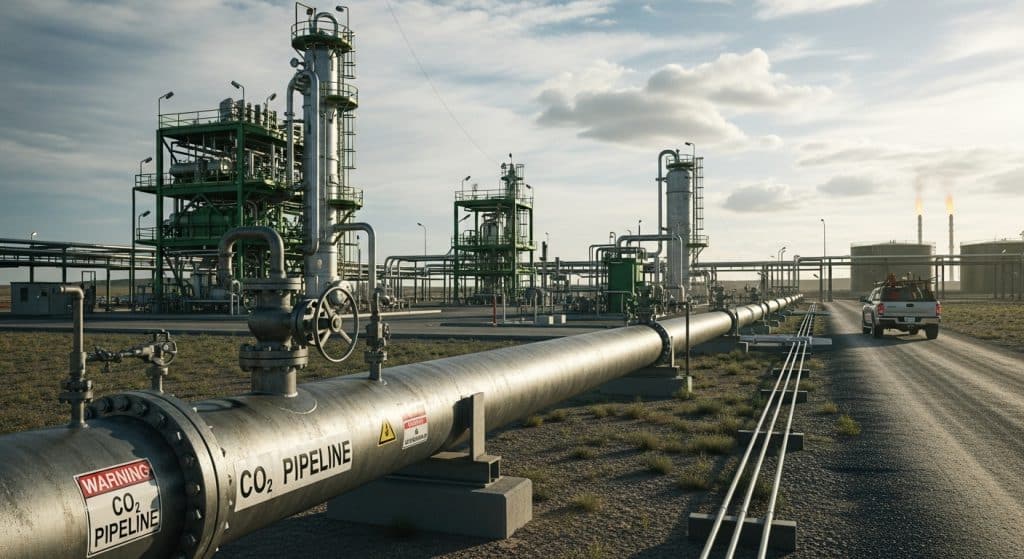
Industrial reality now defines much of Asia’s decarbonisation challenge. Renewable power, electrification and efficiency remain central to the energy transition, yet they do not fully address emissions from sectors where production itself generates carbon dioxide. Cement, steel, chemicals, refining and gas processing still underpin Asian economies, and many of those activities cannot eliminate emissions through renewable electricity alone.
That constraint gives carbon capture and storage a practical role in Asia’s net-zero strategies. The case is neither ideological nor universal. It rests on a simple fact: when emissions are concentrated, difficult to avoid and tied to long-life industrial assets, capture and permanent storage may offer one of the few credible routes to deep abatement.
The debate has therefore shifted. Senior decision-makers no longer need to ask whether CCS has any role in Asia. They need to judge where that role is strongest, how the market can scale, and which constraints could still keep deployment below the level required.
Industrial Emissions Still Lack a Complete Solution
Industrial growth, urbanisation, export manufacturing and rising demand for basic materials continue to shape Asia’s emissions profile. Even where grids add more renewables, a large share of industrial emissions remains stubbornly hard to remove. Cement plants release CO2 through calcination. Conventional steelmaking still relies on carbon-intensive routes. Refining, chemicals and gas processing often generate carbon dioxide through feedstock conversion and process design, not simply through purchased energy.
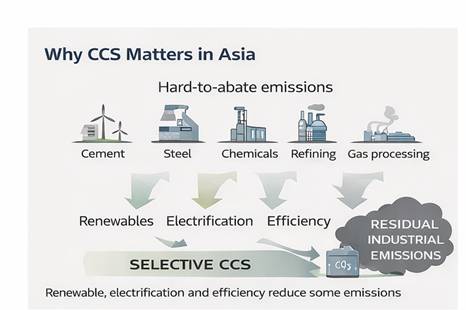
Why CCS matters in Asia: Hard-to-abate sectors such as cement, steel, chemicals, refining and gas processing still produce residual emissions that renewables, electrification and efficiency cannot fully eliminate.
This distinction matters because decarbonised power only solves part of the problem. Clean electricity can lower indirect emissions, and electrification can replace some combustion. Neither measure, however, removes emissions that arise from industrial chemistry or from assets that operators cannot reconfigure quickly without major cost and disruption.
Executives therefore face a more operational question than a conceptual one. In several sectors, long-term decarbonisation now depends on whether businesses can capture, transport and store carbon dioxide with the same discipline they apply to any other core industrial system. Emissions management, in other words, is becoming an infrastructure challenge rather than a reporting exercise.
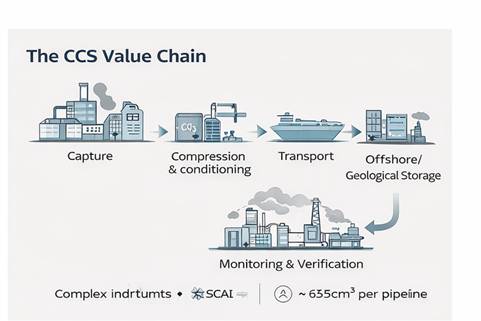
The CCS value chain: Carbon capture and storage depend on an integrated system spanning capture, conditioning, transport, geological storage, and long-term monitoring and verification.
Why CCS Now Has Strategic Relevance in Asia
Carbon capture and storage fits Asia’s industrial structure because it addresses the emissions that other decarbonisation tools leave behind. That does not make it a universal answer, and it should not displace renewables, efficiency or fuel switching where those options work better. Its value lies elsewhere. It offers a targeted route for concentrated emissions from sectors that remain commercially important and technically difficult to decarbonise.
The strongest early use cases tend to share a common profile. They involve large point-source emissions, limited near-term alternatives, long asset lives and access to either subsurface storage or transport corridors that can link emitters to storage locations. Industrial clusters, refining and chemicals complexes, gas processing facilities and selected materials sectors therefore stand out more than dispersed or lower-intensity emitters.
Cost reinforces that selectivity. Capture remains expensive, so projects with favourable stream characteristics and shared infrastructure will move first. Asia is unlikely to build a broad, uniform CCS market in one step. A more realistic path starts with targeted clusters and expands only where operators, investors and regulators can lower execution risk through scale and coordination.
Regional Collaboration Will Shape the Market
Asia’s geography gives CCS a distinctly regional character. Some economies host large industrial clusters but lack suitable storage geology. Others hold promising storage formations but do not generate the same volume of industrial emissions. That mismatch pushes governments and industry towards cross-border transport and offshore storage.
For several countries, this is not a secondary option. It may prove the only realistic route to large-scale deployment. Industrial centres with constrained geology will need access to external storage, while storage jurisdictions will need commercial and legal frameworks that allow them to receive and manage third-party CO2 securely over long periods.
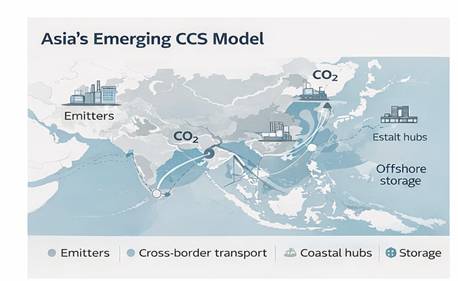
Asia’s emerging CCS model: A regional network linking industrial emitters to coastal hubs, cross-border transport routes and offshore storage will be critical where domestic storage options are limited.
Cross-border systems also change the policy task. Commercial contracts alone cannot resolve questions around custody transfer, CO2 specifications, customs treatment, liability allocation, monitoring obligations and long-term stewardship. Governments will need to align those rules if they want projects to reach bankable scale. Without that alignment, even technically sound projects may struggle to move beyond memoranda and feasibility work.
Regional collaboration therefore matters for more than diplomacy. It shapes market design. Shared infrastructure can spread cost across multiple emitters and make CCS accessible beyond the very largest facilities. At the same time, that model creates interdependence across the chain. A delay in shipping readiness, storage appraisal or regulatory approval in one jurisdiction can disrupt users across the wider network.
Offshore Storage and Shipping Will Become Strategic Assets
Offshore storage is likely to anchor much of Asia’s CCS build-out. Many of the region’s largest emitters sit in coastal industrial zones, while a significant share of prospective storage resources lies offshore. That combination makes marine-based value chains commercially and logistically attractive.
Shipping will therefore move from support function to strategic asset. In some regions, pipeline corridors may dominate early deployment. Asia, by contrast, is more likely to rely heavily on maritime transport because emitters and storage basins often sit far apart across archipelagic and coastal geographies.
That shift broadens the CCS supply chain considerably. Developers will need more than capture technology and subsurface capability. They will also need liquefaction and conditioning systems, port interfaces, temporary storage, receiving terminals, marine safety standards and reliable injection systems offshore. Every link in that chain affects project economics and operational performance.
Hub design becomes critical in that context. Projects that aggregate volumes from multiple emitters should achieve stronger transport economics than projects tied to a single source. Reliability matters just as much as capture efficiency. A well-performing capture plant creates limited value if downstream transport or injection capacity remains uncertain.
Economics Still Impose The Hardest Discipline
The strategic case for CCS does not remove the commercial test. Costs still determine the order of deployment, and the economics vary widely by sector and site. CO2 concentration, plant design, energy penalty, compression requirements, transport distance and storage characteristics all shape the final cost position.
Higher-concentration streams are therefore likely to move first. Facilities with easier capture profiles, established infrastructure access and a credible route to storage will attract capital ahead of more complex sources. That pattern does not weaken the case for CCS. It simply reflects how industrial markets allocate risk and capital in practice.
Policy will matter because pricing alone may not close the gap. Carbon prices can improve the business case, but many projects will still require clearer long-term revenue logic. Regulated transport and storage frameworks, industrial decarbonisation support, long-tenor contracts and public backing for shared infrastructure may all play a role, depending on the jurisdiction.
Capital discipline will matter just as much. Move too slowly and industrial emissions remain locked in without a credible abatement route. Move too quickly and the market risks underutilised infrastructure, weak tariff structures and poor returns. The most resilient projects will likely start with anchor volumes, phase expansion carefully and preserve room for third-party access as demand grows.
Regulation Will Determine Whether Projects Scale
Regulators now hold one of the decisive levers in Asia’s CCS market. Climate targets alone will not deliver projects at scale. Investors and operators need clear rules for storage licensing, transport, injection, monitoring, site closure and post-closure responsibility.
Several issues will shape project viability. Storage developers need confidence that authorities will license and oversee sites under stable, technically credible frameworks. Transport operators need clarity on how rules apply to shipping, intermediate storage and transboundary movement. Emitters and financiers need robust systems for measurement, monitoring and verification so they can rely on the claimed abatement outcome.
Public trust also matters. Communities, counterparties and investors will expect transparent governance and credible monitoring over the life of the storage asset. Projects linked to continued hydrocarbon production may face closer scrutiny unless operators can demonstrate clear abatement integrity and long-term containment. Technical performance alone will not settle that question; governance quality will influence it just as strongly.
Regulation therefore needs operational detail, not broad intent. Markets will progress faster where laws and permitting frameworks answer real project questions on liability, stewardship, access, specifications and compliance.
Capability May Prove As Important As Capital
Asia starts with a useful industrial base. The region already has deep experience in oil and gas, offshore operations, process industries, wells, pipelines and major project delivery. Those capabilities create a strong starting point for CCS, but they do not eliminate the need for new skills and new forms of organisational coordination.
Large-scale deployment introduces technical interfaces that many organisations have not yet managed at full-chain level. Capture technology, CO2 conditioning, corrosion control, shipping systems, storage appraisal, monitoring, permitting and long-term risk management all need to work together. Problems are most likely to emerge at those interfaces rather than within a single discipline.
Generic energy transition training can raise awareness, but it will not close the delivery gap on its own. Project teams need applied CCS training that reflects operating conditions, safety systems, measurement requirements and accountability across the full value chain. A carbon management course may strengthen understanding of emissions accounting, compliance and policy, but major projects also require commercial, subsurface and operational depth.
Leadership teams should treat capability as a strategic issue rather than an HR side topic. Commercial functions need to understand liability allocation and tariff structures. Operations teams need to manage new process interfaces and integrity risks. Legal and regulatory teams need to navigate transboundary frameworks and long-term stewardship rules. Technical teams need to move beyond concept studies and manage injection performance, containment assurance and measurable abatement outcomes.
The organisations that build those capabilities early will lower execution risk materially. Those that rely only on general energy transition training or ad hoc learning may discover that project ambition has outpaced delivery readiness.
A Practical Path, Not A Universal Solution
CCS has a credible place in Asia’s net-zero pathway when companies and governments apply it selectively and pragmatically. It should not be the first lever in every sector, and it should not displace simpler abatement options where those options are technically and economically stronger. Yet several industries still need a realistic route to manage emissions that remain embedded in process chemistry, product demand and existing asset bases.
That reality points to a cluster-led, infrastructure-based model. Industrial hubs, offshore storage, shared transport systems and cross-border coordination are likely to shape the strongest opportunities. The pace of deployment will depend less on headline ambition than on storage confidence, project economics, legal clarity, shipping readiness and the strength of execution capability across the chain.
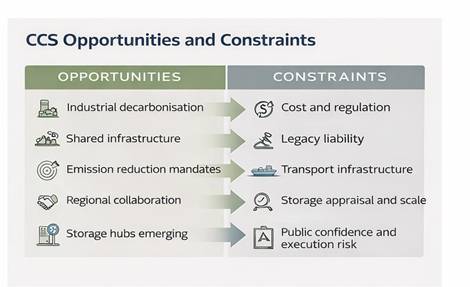
CCS opportunities and constraints in Asia: Industrial decarbonisation, shared infrastructure and regional collaboration support growth, but cost, regulation, transport readiness, storage scale and public confidence remain major barriers.
Conclusion
Asia will not reach net zero through renewable deployment alone. Several industrial sectors still require a practical method for dealing with residual carbon dioxide that power-sector decarbonisation cannot remove. Carbon capture and storage therefore has a defined, if selective, role in the region’s transition.
The market will not scale everywhere at the same pace, and not every project will justify the capital required. Even so, the strategic direction is increasingly clear. A disciplined combination of renewables, electrification, efficiency and selective carbon capture and storage offers the most realistic route for hard-to-abate industries.
Execution will decide the outcome. Regional collaboration, offshore storage, transport infrastructure, regulatory clarity and workforce capability will determine whether CCS remains a limited concept or becomes a durable part of Asia’s industrial transition.
Frequently Asked Questions
Carbon Capture and Storage is a process that captures CO2 from industrial sites or power facilities, transports it, and stores it deep underground. It is most relevant where emissions are hard to remove through renewables, electrification or efficiency alone.
CCS matters because some emissions come from industrial processes, not just energy use. In sectors such as cement, steel and chemicals, it can reduce emissions that other decarbonisation measures cannot fully eliminate.
The strongest candidates are industries with large, concentrated emissions. These include cement, steel, refining, chemicals, fertilisers, hydrogen production and gas processing. Projects become more viable when several emitters can share transport and storage infrastructure.
Carbon capture prevents CO2 from entering the atmosphere at the point of emission. Carbon removal takes CO2 out of the atmosphere after it has already been released. Both support climate goals, but they serve different purposes.
The main challenges are cost, energy use, infrastructure, regulation and long-term liability. Projects also depend on reliable transport and storage options, which means technical feasibility alone is not enough to guarantee commercial success.
Storage can be safe when operators choose suitable geology, maintain well integrity and apply robust monitoring. It relies on careful site selection, engineering controls and regulatory oversight rather than assumption or short-term performance alone.
Asia is a major industrial region with large hard-to-abate emissions and growing demand for materials and energy. That makes it a key market for CCS, especially where cross-border transport, offshore storage and industrial hubs can support scale.
The outlook is strongest in industrial clusters with clear storage access, supportive regulation and shared infrastructure. Growth will likely depend on cost reduction, project execution, regional cooperation and the skills needed to manage full CCS value chains.
