
Why Data Centres Are Reshaping Southeast Asia’s Power Demand
Southeast Asia is entering a new phase of energy planning. Rapid digitalisation, AI adoption, and cloud expansion are pushing electricity demand higher, especially in data-centre-heavy markets such as Singapore and southern Malaysia. The International Energy Agency says electricity demand from data centres in Southeast Asia is expected to more than double by 2030. That matters because data centres require not just large volumes of electricity, but also high reliability, stability, and increasingly lower-carbon supply.
This is one reason nuclear energy is re-entering policy discussions across the region. For data centres, the attraction is clear: nuclear can provide firm, dispatchable, low-carbon electricity for facilities that operate continuously and cannot tolerate prolonged interruptions. But in Southeast Asia, the real issue is not simply whether nuclear technology is available. It is whether countries can build the regulatory, commercial, grid, safety, and human-capital capabilities needed to assess and deploy it responsibly. That is why the IEA, together with the IAEA, launched the Southeast Asia Nuclear Dialogue Series for government officials, industry leaders, and private-sector decision-makers shaping the region’s energy future.
Regional Nuclear Pathways for Powering Southeast Asia’s Data Centre Growth
Singapore Builds Advanced Nuclear and SMR Capability
Singapore’s recent actions show how this conversation is evolving. The Energy Market Authority appointed Mott MacDonald Singapore to evaluate the safety performance and technical feasibility of advanced nuclear technologies, including small modular reactors. In March 2026, EMA also signed an MoU with Korea Hydro & Nuclear Power on civil nuclear energy capability building in SMRs, covering cooperation on technical knowledge and human-resource development. These are not deployment decisions, but they are important capability-building steps for a country that is also a major regional digital infrastructure hub.
Malaysia Focuses on Policy Structure and Readiness Assessment
Elsewhere in Southeast Asia, several governments are moving in the same direction, although at different speeds and from different starting points. In Malaysia, the government’s National Nuclear Technology Policy (DTNN) 2030, launched by MOSTI in 2023, set out a national framework to mainstream the peaceful use of nuclear technology. More recently, PETRA said the government is undertaking a structured assessment of nuclear energy as a future source of clean, stable, and competitive electricity, and assigned MyPOWER Corporation, acting as the Nuclear Energy Programme Implementing Organization, to coordinate preparations using the IAEA Milestones Approach. PETRA also stated that no decision has yet been made on implementation, reactor technology, or capacity, which shows that Malaysia is still in an evaluation and readiness-building stage rather than full project commitment.
Indonesia Moves Nuclear from Strategy to Implementation Planning
In Indonesia, the government’s nuclear initiative is becoming more explicit. Indonesia’s Ministry of Energy and Mineral Resources said in December 2025 that nuclear is an essential part of the country’s energy-transition strategy, with a national target of 35 GW of nuclear capacity by 2060 under the RUKN. The same ministry said early implementation is planned within the 2025–2034 PLN planning period, with an initial 500 MW targeted for operation in 2032 and 2033, split between Sumatra and Kalimantan. Alongside this, Indonesia’s energy human-capital arm, BPSDM ESDM, worked with BRIN in 2025 on a webinar focused on nuclear energy’s role in achieving net zero, including technology trends, human-resource needs, and implementation challenges. That combination of policy signalling and workforce preparation suggests Indonesia is trying to move nuclear from a long-discussed option toward a more structured national programme.
Vietnam Advances Towards Concrete Project Development
In Vietnam, the government has moved even further. The Ministry of Industry and Trade’s implementation plan for the revised Power Development Plan VIII states that Ninh Thuan 1 and 2 are planned as nuclear power plants, each with expected capacity of 2,000 to 3,200 MW and intended operation in the 2030–2035 period. Then, on 23 March 2026, Vietnam and Russia signed an intergovernmental agreement on cooperation to construct Ninh Thuan 1, which MOIT described as part of Vietnam’s long-term strategy to diversify energy sources, reduce dependence on fossil fuels, and promote clean, sustainable, and safe energy. This makes Vietnam one of the clearest examples in Southeast Asia of a government moving from planning language into concrete state-to-state project development.
The Philippines Strengthens Its Legal and Regulatory Foundations
In the Philippines, the nuclear pathway is being built through law, regulation, and programme development. The IAEA reported in December 2024 that the Philippines had made significant progress on nuclear infrastructure, adopted a national position for a nuclear energy programme, expanded its Nuclear Energy Programme Implementing Organization to 24 organisations, and announced a roadmap targeting commercially operational nuclear plants by 2032 with at least 1,200 MW initially, rising to 4,800 MW by 2050. In September 2025, President Ferdinand Marcos Jr. signed the Philippine National Nuclear Energy Safety Act, creating PhilATOM as an independent nuclear regulatory authority. Then in October 2025, the Department of Energy issued a framework for integrating nuclear energy into the country’s generation mix and for the country’s first commercially developed and operated “Pioneer NPP.” Together, these moves show a government trying to establish the institutional foundations needed before large-scale deployment.
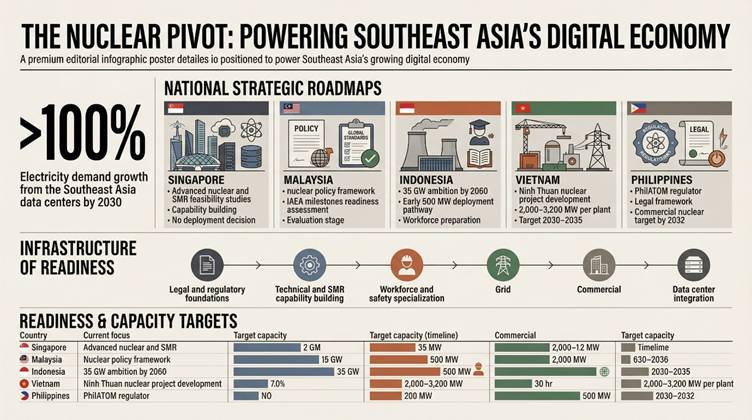
Regional nuclear pathways for powering Southeast Asia’s data centre growth
What It Takes to Make Nuclear Viable for Data Centres
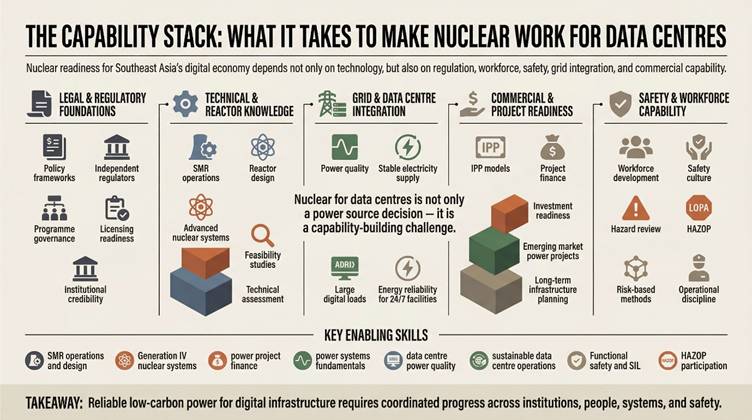
The regulatory, technical, grid, commercial, and safety capabilities needed to make nuclear viable for digital infrastructure
Building Technical and Reactor Knowledge
For Southeast Asia’s regulators and utilities, these examples point to the same conclusion: nuclear energy for data centres is not only a technology question. It is also a policy, market, and capability question. This is where EnergyEdge’s training portfolio becomes directly relevant. Its Principles of Nuclear Power Plant Operations and Design for Small Modular Reactors (SMR) course is well suited for staff who need grounding in SMR technology, reactor operations, design principles, advanced safety features, and potential applications. Its Generation-IV Nuclear Reactors – Advantages and Challenges of Innovative Nuclear Systems course adds value for decision-makers evaluating longer-term reactor pathways, including sustainability, safety, economics, and proliferation resistance. For commercial teams, IPPs & Power Project Finance is especially relevant because EnergyEdge describes it as focused on power-project challenges in emerging markets and grounded in real case studies rather than theory alone.
Preparing Power Systems and Data Centre Operations
For the data-centre side of the equation, EnergyEdge also has courses that fit the operational realities of large digital loads. Power Quality in Data Centres: Flexible AC Transmission Systems (FACTS) and Grid Forming Inverters Technologies addresses network stability, inverter-based systems, islanded operation, and the effects of large loads on harmonics, flicker, voltage stability, and frequency stability. Sustainable Data Centre Operations: From Liquid Cooling to Heat Reuse is particularly relevant because EnergyEdge says it focuses on liquid cooling for AI workloads, decarbonisation practices, and heat reuse technologies. This is an important complement to the nuclear discussion: even if data centres gain access to firm low-carbon power, their efficiency, thermal design, and energy-optimisation practices still determine how sustainable and competitive they will be. For non-specialist managers and regulatory staff, Introduction to Power Systems helps build foundational literacy in transmission, substations, protection, reactive power control, and broader power-system operation.
Strengthening Safety Culture and Workforce Capability
Safety capability is equally important. Nuclear projects require disciplined approaches to hazard identification, layered protection, functional safety, and review culture. EnergyEdge’s Layer of Protection Analysis (LOPA) – Including SIL Determination and Risk-Based Functional Safety Methods course is aligned with IEC 61511:2016 and is designed to help participants apply risk-based functional safety methods. Its HAZOP Participants course is intended to familiarise staff with the role of HAZOP within the broader process-safety framework and improve their effectiveness in review teams. These courses are not substitutes for nuclear-specific licensing or national regulatory qualification, but they are highly relevant for helping regulators, utilities, and project teams strengthen the safety mindset that any future nuclear programme will require.
The Bigger Lesson for Southeast Asia’s Digital Economy
The bigger lesson for Southeast Asia is that nuclear energy may become part of the long-term solution for powering data centres, but only if countries can build credible institutions around it. Malaysia is building policy structure and programme governance. Indonesia is translating nuclear from strategy into planning targets and workforce discussion. Vietnam is moving into concrete project development. The Philippines is putting legal and regulatory foundations in place. In that regional context, EnergyEdge’s course portfolio is useful not only because it covers reactor technology, but because it also addresses the commercial, grid, operational, and safety capabilities that regulators and utilities will need if nuclear is to become a viable source of power for Southeast Asia’s growing digital economy.
Frequently Asked Questions
Nuclear energy for data centres in Southeast Asia is gaining attention because electricity demand is rising fast. AI, cloud growth, and digitalisation are driving that demand. Data centres also need stable and reliable power. Many operators now want lower-carbon energy too.
Data centres run all day and all night. They cannot tolerate long outages or unstable supply. They need constant electricity to support cloud services, AI workloads, and digital operations. That makes energy reliability a major issue.
Nuclear power can provide firm and dispatchable electricity. It can also support lower-carbon energy goals. That combination makes it attractive for critical infrastructure. For many policymakers, reliability is the main advantage.
Singapore, Malaysia, Indonesia, Vietnam, and the Philippines are all moving forward in different ways. Some are studying feasibility. Some are building regulation and policy frameworks. Others are moving towards project development.
Not fully. Most countries are still building the foundations first. They need stronger regulation, better safety systems, and more technical capability. They also need stronger workforce and grid readiness.
Nuclear projects need strong oversight and clear rules. They also need credible institutions and disciplined safety processes. Without those foundations, deployment becomes much harder. Public trust also depends on them.