
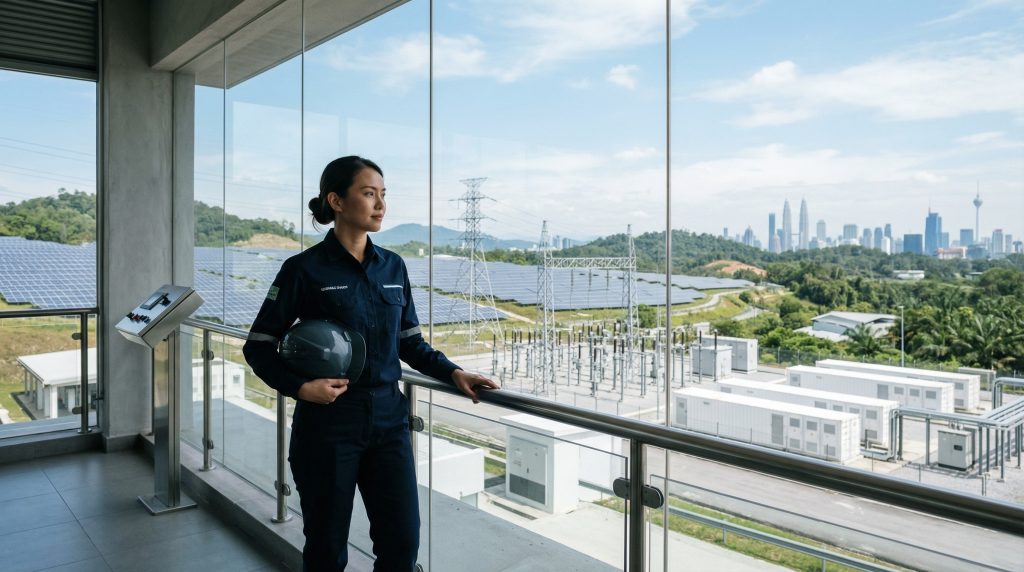
Why Renewable Energy Skills Development in Malaysia Matters Now
Renewable Energy Skills Development in Malaysia is becoming a strategic priority as the country moves from policy ambition to project execution. Malaysia is expanding solar, storage, grid integration and hybrid energy systems at a faster pace, and that shifts the real question facing the market. The issue is no longer only whether renewable energy will grow. The bigger question is whether the industry has the capability to build, connect, operate and optimise these assets reliably at scale.
Malaysia’s direction of travel is already clear. The Malaysia Renewable Energy Roadmap supports the national target of 31% renewable energy installed capacity, while the broader transition agenda has pushed ambition further, with 40% by 2035 and 70% by 2050 shaping the longer-term outlook. More than policy signals, these figures raise the bar for delivery across the sector.
As a result, the discussion now goes beyond technology alone. The transition depends not just on new capacity, but on whether operators, developers, utilities, infrastructure owners and industrial energy users have the people who can make increasingly complex systems work in real operating conditions. In practical terms, the pace of the transition will depend as much on capability as it does on capital.
This shift is also visible in the way the market looks for knowledge. A search for a renewable energy course in Malaysia today is rarely just about broad awareness. More often, it reflects demand for practical capability in solar PV systems, battery energy storage systems, floating photovoltaic systems, pumped hydro energy storage, and renewable energy corporate power purchase agreements. These are no longer side topics. They are becoming part of the core capability agenda in Malaysia’s next phase of energy transition.
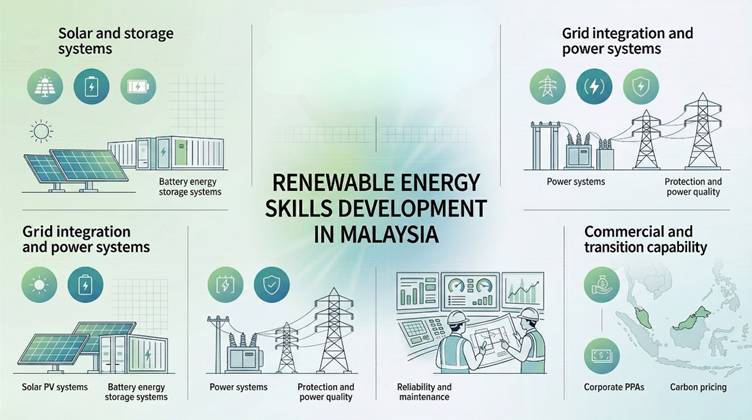
Key capability areas shaping renewable energy skills development in Malaysia.
Why Renewable Energy Skills Development in Malaysia Is Moving to the Centre of Execution
Malaysia’s renewable agenda has entered a more delivery-focused phase. Policy has created momentum, but momentum alone does not commission plants, manage interconnection challenges or sustain long-term asset performance. Delivery requires people, and not just more people, but people with the right depth of technical, operational and commercial understanding.
The Energy Commission’s ST-ECE initiative, which has highlighted the need to support 62,000 competent persons by 2050, is one sign of how seriously technical readiness is now being treated. That number points to something larger. Workforce capability is no longer a peripheral issue. It is moving closer to the centre of project delivery, system reliability and operating risk.
Skills are now an execution issue
In practical terms, the market needs more than a general understanding of sustainability or decarbonisation. It needs engineers, commissioning teams, grid specialists, protection engineers, asset managers and decision-makers who understand how renewable projects behave under real operating conditions. They need to know how design choices affect reliability. They also need to understand how interconnection decisions influence performance, bankability and long-term asset value.
For many organisations, Renewable Energy Skills Development in Malaysia is no longer a long-term HR issue. It now sits much closer to execution risk. Weak capability can delay schedules, create avoidable design issues, increase rework and affect plant performance long after construction ends.
Across the sector, that urgency is becoming harder to ignore. The challenge is not just to train more people. Industry now needs more role-specific capability across the project lifecycle, from feasibility and design through commissioning, operation and optimisation.
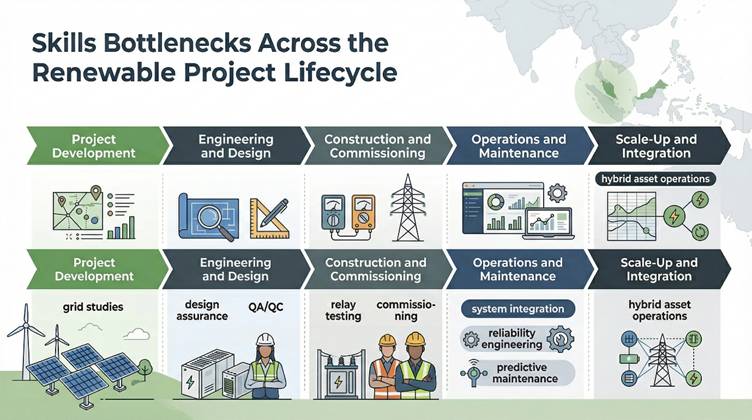
Skills bottlenecks can emerge at every stage of the renewable project lifecycle, from development and design to operations and system integration.
Solar Growth Is Raising the Skills Requirement
Solar remains the most visible part of Malaysia’s renewable growth, but it no longer tells the whole story. The market is evolving, and the skills requirement is evolving with it.
In January 2025, the Energy Commission launched LSS PETRA 5+, targeting 2,000MWac of large-scale solar capacity in Peninsular Malaysia. Importantly, the programme also includes 500MWac for floating or water-based solar, with plants expected to begin operating in 2027. That single programme says a great deal about where the market is heading. Malaysia is not only scaling solar. It is also moving into more sophisticated deployment models that demand stronger technical and operational capability.
A useful solar energy course or renewable energy course in Malaysia should reflect that shift. It should not stop at introductory technology overviews or broad sustainability messaging. Instead, it should help professionals understand yield assessment, design review, grid integration, commissioning discipline, performance monitoring and lifecycle optimisation.
Floating solar needs different capability
Floating photovoltaic systems add another layer of complexity. Floating solar is not simply ground-mounted PV placed on water. Developers and operators need to account for site-specific conditions, reservoir interfaces, mooring and anchoring systems, long-term maintenance demands and performance behaviour over time.
As floating or water-based solar grows in Malaysia, those skills will become increasingly relevant across project development and operations. At EnergyEdge, this shift is reflected in the types of topics that increasingly matter to industry practitioners. Interest is moving beyond simple technology awareness and towards more applied capability in solar PV systems, floating photovoltaic systems, utility-scale hybrid plants, battery energy storage systems and the commercial structures that support project viability.
Renewable Energy Skills Development in Malaysia Must Now Cover More Than Solar
Malaysia’s renewable story should not be framed as solar alone. Solar may be the most visible growth area, but the market is clearly moving towards a broader mix of technologies, interfaces and operating models.
Kenyir shows the shift towards integrated systems
Terengganu offers a strong example of that shift. The Kenyir Hybrid Hydro Floating Solar project and the linked Green Hydrogen Hub in Kerteh show how Malaysia’s transition is becoming more interconnected. PETRA has described the Kenyir development as a 2,500MW floating solar project in a hybrid hydro setting. That makes it one of the clearest examples of how renewable growth in Malaysia is moving beyond stand-alone assets and towards integrated energy systems.
Named developments such as Kenyir make the transition more tangible. They show that Malaysia’s next phase of renewable growth will depend not only on adding capacity, but on making different technologies work together across generation, storage and industrial demand. That also makes the workforce challenge more complex. The market increasingly needs people who can understand interfaces, not just individual technologies in isolation.
Why hydro and pumped hydro matter
Hydro also deserves a stronger place in the conversation. It already has an established role in Malaysia’s power mix, and the Kenyir example shows that hydro-linked renewable development remains relevant in the current phase of the transition. Beyond conventional hydro, pumped hydro energy storage deserves more attention as part of the country’s longer-term flexibility and storage agenda.
Public reporting has identified proof-of-concept studies for pumped hydro energy storage between the Bakun and Murum hydroelectric plants, as well as in the Padawan area of Kuching. Even at the study stage, these references matter. They show that pumped hydro is not simply a generic future-energy talking point. It is already part of the Malaysian discussion around storage, flexibility and renewable integration.
Taken together, these developments broaden the renewable energy conversation in an important way. Solar may dominate public attention, but long-duration storage, system balancing and integrated infrastructure planning will also shape Malaysia’s energy future. For industry learning, that wider perspective matters because the most useful capability development reflects how projects and systems actually evolve on the ground.
At EnergyEdge, that is where the conversation becomes especially relevant. Industry-focused learning adds most value when it helps professionals understand not only individual technologies, but also how those technologies interact within real operating environments.
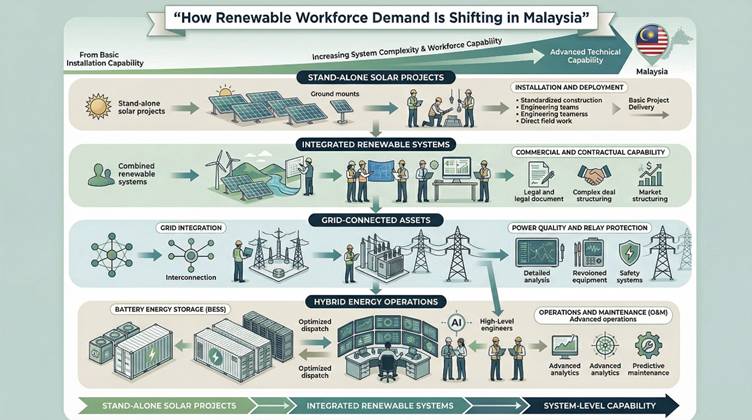
Malaysia’s renewable workforce demand is shifting from basic installation capability towards integrated, grid-connected and system-level expertise.
Storage, Grid Integration and Commercial Complexity Are Changing Workforce Needs
If solar expands the generation base, storage changes the operating logic.
In December 2025, the Energy Commission issued the request for proposal for MyBeST, a 400MW / 1,600MWh battery energy storage system programme for Peninsular Malaysia. That is a meaningful signal. Battery energy storage systems are no longer a peripheral topic in the local market. They are becoming part of the infrastructure needed for grid stability, system flexibility and renewable integration.
Storage is becoming core infrastructure
As that happens, workforce requirements also change. Organisations increasingly need teams that understand not only generation assets, but also storage behaviour, dispatch logic, system balancing, control interfaces and lifecycle performance. Those are not narrow specialist concerns anymore. They are becoming part of mainstream project and operating capability.
Commercial complexity is also becoming more important. As renewable deployment grows, organisations need people who understand how technical decisions connect to offtake arrangements, project bankability and operating value. That is one reason renewable energy corporate power purchase agreements are becoming more relevant in capability discussions. In practice, technical and contractual understanding are increasingly overlapping rather than sitting in separate silos.
Grid integration demands deeper technical teams
Grid integration makes the same point even more clearly. Renewable penetration can rise quickly, but the power system still has to remain stable, reliable and efficient. Projects may look successful at announcement stage, yet capability gaps in controls, protection, power quality, interconnection planning and commissioning can create serious performance risks later.
This is why Renewable Energy Skills Development in Malaysia should not be framed too loosely. The challenge is not simply to increase workforce numbers. The real task is to build the right depth of capability across engineering, operations and commercial decision-making. That is where many organisations will increasingly differentiate themselves.
What Transition-Ready Capability Should Actually Look Like
The market is signalling that it wants more than awareness. It wants applied capability.
Effective renewable energy training should therefore be practical, role-based and grounded in project realities. It should reflect how renewable projects actually move from planning to operation. It should also reflect the fact that Malaysia’s renewable market is becoming more integrated, more technical and more demanding.
What industry teams now need
For engineers and technical practitioners, that means stronger competence in design, interconnection, commissioning, controls, reliability, performance analysis and maintenance. For project and commercial teams, it means understanding how technical decisions affect contract structures, bankability and delivery risk. Leadership teams, meanwhile, need to recognise that capability development is part of transition readiness itself rather than a secondary people-development activity.
In practice, Renewable Energy Skills Development in Malaysia now needs to align more closely with project execution, grid integration and long-term plant performance. The best renewable energy courses will not treat solar, storage, hydro, floating solar and corporate procurement as disconnected themes. Instead, they will show how these areas overlap in real projects and why that overlap matters for resilience, reliability and long-term value.
A renewable energy course in Malaysia should also feel locally relevant. It should reflect the country’s project pipeline, infrastructure pressures and workforce needs. That local relevance matters because professionals are not operating in a generic global market. They are operating in Malaysia’s actual transition environment, with its own policy direction, project mix, operating realities and capability gaps.
This is where EnergyEdge can contribute with credibility. The value lies not in hard-selling courses into the conversation, but in helping frame the capabilities that transition-ready teams now need to understand. When industry learning is anchored in real project needs, it becomes far more useful to practitioners, managers and decision-makers alike.
Why Renewable Energy Skills Development in Malaysia Matters for Business
The business case for capability development is becoming stronger, not weaker.
In a more complex market, capability affects delivery schedules, asset reliability, operating margins and investor confidence. A project may have strong policy support and solid commercial logic, but if the organisation behind it lacks depth in engineering, commissioning, protection, controls or operations, performance risk can build quickly. Those risks often do not appear at the headline announcement stage. More often, they emerge later, when systems must perform under real operating conditions.
This issue matters to more than technical teams alone. It matters to business leaders, project sponsors and decision-makers who want to scale renewables without compromising reliability or long-term asset value. A workforce that understands the technical, operational and commercial dimensions of renewable infrastructure is no longer a nice-to-have. It is becoming part of competitive readiness.
At EnergyEdge, that broader perspective is important. The role of an industry learning platform is not only to support technical development, but also to help organisations think more clearly about the capability gaps that will shape execution in the years ahead. In a market that is becoming more interconnected, learning has to support not only knowledge transfer, but also better decision-making.
Why It Matters Now
Malaysia has momentum, and that is encouraging. The country has clearer policy direction, visible project activity and stronger signals that renewable energy will remain central to long-term planning. Momentum alone, however, will not guarantee execution quality.
The bigger challenge is depth. The industry needs depth of technical understanding, depth of operational discipline and depth of workforce capability. Without that, ambitious targets and major project announcements will be harder to translate into reliable performance.
The market is already signalling where the pressure points lie. Solar is scaling. Floating solar is expanding. Hydro and pumped hydro are becoming more relevant to flexibility. Battery storage is moving closer to the centre of the system. At the same time, grid integration is becoming more demanding. Each of these shifts increases the need for practical, role-specific learning.
The long-term success of Renewable Energy Skills Development in Malaysia will depend on whether organisations treat capability as part of transition infrastructure rather than a support function. Companies that invest early in usable, applied knowledge will be better placed to navigate a market that is becoming more technical, more integrated and more demanding.
That is why this conversation matters now. Malaysia’s renewable transition will not be shaped by targets or technology announcements alone. It will also be shaped by whether the industry has enough people who can make increasingly complex systems work together safely, efficiently and at scale.
Frequently Asked Questions
Renewable energy skills development is becoming more important in Malaysia as the country expands solar, storage, grid integration and hybrid energy systems. The transition now depends not only on policy and investment, but also on whether companies have the technical capability to design, connect, operate and maintain increasingly complex assets.
The most in-demand skills include solar PV systems, battery energy storage systems, grid integration, power systems engineering, protection and power quality, commissioning, asset reliability, hybrid system operations, and growing capability in hydro and pumped hydro energy storage. As projects become more integrated, commercial understanding around bankability and corporate PPAs is also becoming more relevant.
Malaysia’s energy transition is increasing demand for engineers, technical specialists, commissioning teams, operations personnel and asset managers who can support renewable project delivery and long-term performance. Workforce demand is shifting from general awareness of sustainability towards more applied technical capability in power systems, controls, reliability and system integration.
Effective renewable energy training in Malaysia should go beyond basic technology overviews. It should include applied knowledge in solar PV systems, battery energy storage systems, interconnection, controls, protection, maintenance, commissioning and asset performance. It should also reflect the growing importance of integrated systems, project execution, long-duration storage and the commercial trade-offs linked to bankability and delivery risk.
Companies can build transition-ready teams by focusing on role-based capability development rather than broad awareness training alone. The strongest approach combines technical upskilling, project-linked learning, systems knowledge, operational discipline and closer alignment between workforce planning and execution risk.
