
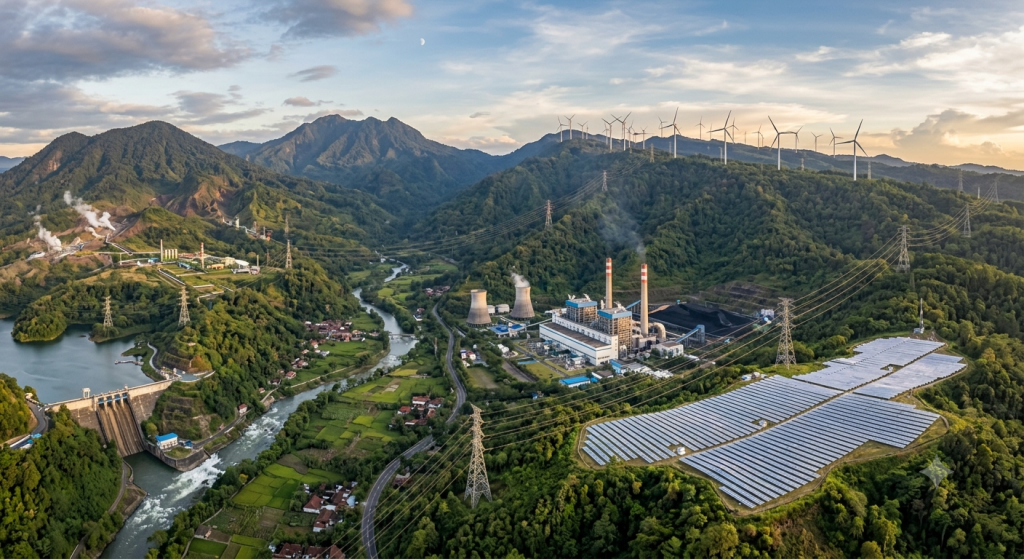
Indonesia’s power sector is going through one of the busiest periods in its history. Electricity demand is rising on the back of industrialisation, electrification, and a fast-growing digital economy, while the government is under pressure to deliver a cleaner grid without compromising reliability. For engineers, project managers, and commercial professionals working across PLN, IPPs, EPC contractors, and renewable developers, this creates a sharp and specific demand for practical, technically grounded training. Below are the ten courses from EnergyEdge that best match where the market is heading, and why each one matters right now.
Why demand for this training is rising
Three forces are reshaping Indonesia’s power sector at the same time.
Data centre growth is straining the grid. Indonesia’s data centre electricity consumption is projected to roughly quadruple from about 6.7 TWh in 2024 to 26 TWh by 2030, driven by hyperscale and colocation build-outs from major cloud providers. At the same time, the country is expected to face a data centre capacity shortfall of around 1 GW by 2030, with grid interconnection queues stretching up to 30 months outside Java-Bali. This is pushing utilities, developers, and data centre operators to seek staff who understand power quality, digital substations, smart metering, and grid-forming technologies capable of supporting always-on, high-density loads.
The renewable energy build-out is accelerating on paper, but execution is the bottleneck. Under Indonesia’s National Energy Policy (KEN) and the RUPTL 2025 to 2034, the country is targeting a new and renewable energy share of 19 to 23 percent by 2030, rising toward 70 to 72 percent by 2060, alongside a Net Zero Emissions target for 2060 or sooner. The RUPTL plans to add 69.5 GW of new generation capacity over the next decade, with a majority coming from renewables and storage. Analysts note that Indonesia will need to build renewable capacity several times faster than its current pace to stay on schedule, which is generating strong demand for people who can design, finance, and commission solar, geothermal, battery storage, and hybrid projects rather than simply plan them on paper.
Carbon and regulatory pressure is tightening. Indonesia’s carbon pricing framework, its emissions trading scheme, and its Second Nationally Determined Contribution all point toward tighter accountability for large power assets, and this sits alongside ASEAN-wide coordination on grid interconnection, cross-border power trade, and harmonised renewable energy standards. Utility and industrial teams increasingly need staff who can operate in this compliance environment, not just an engineering one.
The top 10 courses
1. Design, Implementation, and Operations of Battery Energy Storage Systems (BESS) With an optional module on BESS for data centres, this course covers battery chemistries, system design, and the contracts that govern BESS projects, directly addressing the twin pressures of grid flexibility and data centre backup power.
2. Utility-Scale Hybrid Solar PV Plants with Battery Energy Storage Systems (BESS) Focused on grid stability, design integration, and lifecycle asset management for combined solar and storage plants, a configuration increasingly favoured across Southeast Asia to manage variability and peak demand.
3. Design and Integration of PHES, BESS and Floating Solar PV This course brings together pumped storage hydropower, battery storage, and floating solar, three technologies central to Indonesia’s plan to diversify its renewable mix while working around land constraints.
4. Smart Grid, Smart Metering and Power Quality Analytics Covers smart metering architecture, cybersecurity, and power line communications, all essential for utilities managing higher loads and more distributed generation on the network.
5. Microgrid Systems: Integrating Renewables, Storage, and Control Microgrids are a practical answer for Indonesia’s dispersed archipelago geography and for industrial or data centre sites that need resilient, semi-independent power supply.
6. Planning, Design, Operation and Maintenance of Digital Substation Digital substations underpin grid stability and cybersecurity as networks modernise, a capability regulators and utilities are prioritising as more variable renewable capacity comes online.
7. Battery Energy Storage Systems (BESS) in Electricity Markets and Trading Storage assets only make commercial sense if they are monetised properly. This course equips finance, trading, and strategy professionals to evaluate revenue stacking for BESS projects.
8. Introduction to Geothermal Exploration and Development Indonesia holds some of the world’s largest geothermal reserves, and geothermal’s baseload characteristics make it a key pillar of the country’s renewable strategy alongside solar and wind.
9. Carbon Capture, Utilisation and Storage (CCS/CCUS) Training Courses As carbon pricing and emissions trading mature in Indonesia, CCUS knowledge is becoming relevant not only to oil and gas but also to gas-fired power generation seeking a lower-carbon pathway.
10. Demand Side Management Covers dynamic load forecasting, smart grid control, and market mechanisms for managing demand, all increasingly important as data centres and industrial users add large, concentrated loads to the grid.
The regional and regulatory backdrop
These courses do not sit in isolation. ASEAN member states are working toward greater cross-border power trade and grid interconnection, and Indonesia’s own energy planning documents, the KEN, RUKN, and RUPTL, are all built around the 2060 net zero target while trying to balance reliability, affordability, and sustainability. Training that blends technical depth with an understanding of this regulatory context gives professionals a genuine edge, whether they are commissioning a substation, structuring a PPA, or advising on emissions compliance.
Frequently Asked Questions
Battery storage is central to managing the variability of solar and wind, supporting grid stability, and backing up high-density loads such as data centres. As more BESS projects move from planning to construction, utilities and developers need staff who understand design, safety, and commercial structuring, not just theory.
Rapid data centre expansion is increasing pressure on Indonesia’s grid, particularly around interconnection capacity and power quality. This is driving demand for training in smart grids, digital substations, and demand side management, skills that help utilities and data centre operators keep supply reliable.
Geothermal offers baseload renewable power with a smaller land footprint than wind or solar, which is valuable for a country with Indonesia’s geography. It is treated as a long-term pillar of the national energy mix alongside solar, wind, and storage.
Policies such as the National Energy Policy (KEN), the RUPTL 2025 to 2034, and Indonesia’s Net Zero Emissions target by 2060 are pushing utilities toward higher renewable shares and tighter emissions accountability. This creates demand for professionals who understand both the engineering and the regulatory mechanics behind compliance.
ASEAN countries are moving toward greater grid interconnection and coordinated renewable energy standards. Professionals trained with a regional perspective, rather than a purely domestic one, are better positioned to work on cross-border projects and regionally financed initiatives.
