
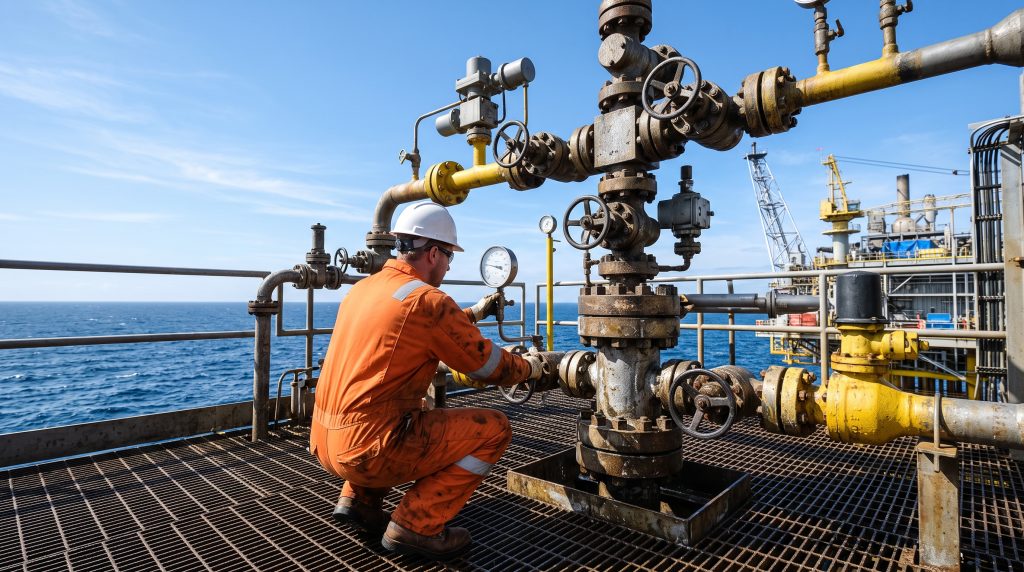
Well integrity management keeps a well’s fluids contained from first design to final abandonment. A well integrity management system (WIMS) ties together barrier definitions, monitoring data, risk assessment and clear decision rules, so an operator can show that every well is still safe to run. Across Southeast Asia, where ageing fields, shut-in wells and new offshore developments now sit in the same portfolio, that evidence has become a boardroom question, not just an engineering one.
Key takeaways
- Barriers are the foundation, but the picture changes over a well’s life. The real question is what proves they work today.
- Monitoring is shifting from periodic inspection to continuous surveillance — more data only helps if the evidence behind it holds up.
- Sustained annulus pressure is a symptom, not a diagnosis. Find the source, the path and the barrier before spending on repair.
- Shut-in wells keep degrading while idle. Their restart value depends on integrity that was tracked and preserved.
- Regulators and abandonment costs now reward a defensible decision trail across the whole well lifecycle.
In this guide
- What is well integrity management?
- A portfolio-level issue
- Barrier management: the four key questions
- From inspection to continuous surveillance
- Common failure modes
- Shut-in wells: a different problem
- Southeast Asia
- The economics of integrity
- Decommissioning and the integrity decision
- How to measure performance
- The next phase of WIMS
- Well integrity training
What is well integrity management?
Well integrity means maintaining full control of fluids within a well to prevent unintended fluid movement or loss of containment, as the SPE PetroWiki overview describes it. Well integrity management turns that goal into daily practice: it sets out who owns each well, which barriers must be in place, what evidence proves they still work, and what happens when they do not.
Standards such as ISO 16530 organise this work across five lifecycle phases — design, construction, operation, intervention and abandonment (see the PetroWiki lifecycle summary). A WIMS is the framework that holds those phases together.
Related training: new to the topic, or building a shared language across well and production teams? EnergyEdge’s Well Integrity (Basic and Advanced) course covers management and risk assessment for producing assets, over three basic and two advanced days.
Why well integrity is now a portfolio-level issue
Well integrity has always been an engineering assurance discipline, built on pressure containment, barrier verification and regulatory compliance. That has not changed. What has changed is the commercial setting around it.
Mature basins are being asked to extract more value from existing wells while controlling intervention spend, managing ageing completions, and preparing a growing share of the well stock for abandonment. New offshore developments, at the same time, bring higher pressures, more remote operations and more complex completions.
Life extension at one end and rising technical complexity at the other are turning well integrity into a broader asset-management issue — not an occasional inspection task.
The shift shows up directly in deal activity. Well integrity specialist Unity entered the Asia-Pacific market in mid-2026, partnering with Malaysian firm Reservoir Link on a three-well rigless intervention programme, drawing on three decades of North Sea mature-asset experience. That is a live signal of how much attention ageing wells across the region are now attracting.
The result: well integrity can no longer be an occasional response to anomalies. It has to run as a continuous system that decides which wells stay fit to operate, which need intervention, which can restart, and which have reached the point where more spending is not justified.
Barrier management and the four key questions
At the centre of any WIMS is the barrier philosophy: identifying, qualifying and monitoring the physical elements that stop formation fluids moving where they should not.
During production, those barriers may include tubing, casing, cement, packers, wellhead seals and subsurface safety valves. What matters is not just that they exist, but that the operator can show the barrier envelope still works under the well’s actual operating conditions — because a well can have every original component in place and still carry deteriorating risk. Cement can lose isolation. Tubing can corrode. Packers can leak. Reservoir pressure, temperature or chemistry can shift enough to introduce loads the design never saw.
The question changes from “Are the required barriers installed?” to “What evidence shows the barriers are effective today?”
That is why modern programmes combine barrier schematics with inspection records, pressure histories, operating envelopes, diagnostics and anomaly tracking, rather than relying on completion records alone.
The four questions that matter
What is supposed to contain the well?
You need a current barrier schematic, not the original completion design. Workovers, repairs and past incidents change the configuration.
What evidence shows each element works?
Pressure tests, cement evaluation, annulus behaviour, logging and inspection each prove different things. No single measurement covers the whole system.
What happens if one element fails?
Redundancy only counts if the secondary barrier is independent and able to perform the containment function on its own.
What is the consequence of continued operation?
This depends on failure probability, consequence, uncertainty and compensating controls. It is a risk decision, not a pass/fail check.
Together these four questions turn a barrier diagram from paperwork into an operating tool, and make one thing clear: a technically imperfect well is not automatically unsafe, and a productive well is not automatically acceptable to keep running.
Related training: to work through barrier evaluation, anomaly management and risk-based decisions in depth, see EnergyEdge’s Advanced Well Integrity Management course (5 days, 23–27 November 2026, Kuala Lumpur).
From periodic inspection to continuous surveillance
The biggest recent change in well integrity management is data. Annulus pressures, wellhead parameters, downhole measurements, corrosion readings and inspection histories can now flow into one centralised system, letting engineers spot trends instead of reading isolated reports. That makes it possible to ask sharper questions:
- Is tubing metal loss accelerating?
- Is annulus pressure rebuilding faster after bleed-down?
- Has a pressure relationship appeared between previously independent annuli?
- Is an anomaly stable, or is its rate of deterioration changing?
- Do several weak signals together point to a developing barrier problem?
Industry adoption is moving this way, from consolidated multifinger-caliper surveillance to digital-twin models that combine measured well behaviour with engineering models. But more data does not automatically mean better decisions.
The risk: digital confidence without engineering confidence
A modern WIMS can put hundreds or thousands of wells on one dashboard, with red-amber-green risk scores. That is useful — and it can create false confidence if the evidence underneath is thin. A polished interface cannot fix outdated schematics, missing intervention records, inconsistent pressure data, uncertain cement condition, or inconsistent risk-scoring between assets.
A good system therefore separates known acceptable condition from absence of evidence that something is wrong. Those are not the same thing. The most valuable digital tools are often the ones that make uncertainty visible, rather than the ones that just produce a score.
Common well integrity failure modes
A useful WIMS organises surveillance around credible failure mechanisms, not just an equipment list. Four matter most across mature offshore well populations.
| Failure mode | Why it matters | Evidence to gather |
|---|---|---|
| Tubing & casing degradation | Corrosion can progress gradually while conditions look normal — CO₂ corrosion, H₂S damage, oxygen ingress and erosion can all play a part. | Rate of metal loss, remaining strength, credible load cases. |
| Cement & zonal isolation | Critical for long-term containment, but hard to check once the well is live. Poor isolation complicates interventions and abandonment. | Placement records, cement evaluation, annulus behaviour. |
| Packer & completion seals | Many possible leak paths. The first sign is often changing annulus behaviour, not obvious loss of containment. | Annulus pressure history and diagnostics — never assume a symptom equals a failed part. |
| Sustained annulus pressure | Repressurising after bleed-down proves communication with a pressure source — nothing more, on its own. | Pressure source, communication path, and which barrier function is compromised. |
Related training: wells exposed to CO₂ carry extra integrity considerations — EnergyEdge’s CCUS Well Design & Monitoring course covers the integrity of CO₂-exposed wells (3 days, 30 November–2 December 2026, Jakarta). For cement failure modes and annular isolation repair specifically, see Advanced Well Cementing and Integrity Management (14–17 December 2026, Kuala Lumpur).
Sustained annulus pressure: evidence, not a diagnosis
Few anomalies illustrate the point better than sustained annulus pressure. Repressurising after bleed-down shows communication with a pressure source. It does not, by itself, show where the pressure comes from, the leak pathway, or which barrier has failed. Diagnosis has to answer three questions in order:
What is the pressure source?
What is the communication path?
Which barrier function is compromised?
Remediation based on the wrong diagnosis can spend intervention budget without removing the underlying threat.
Shut-in wells: a different integrity problem
A growing challenge is the condition of wells left shut in for long periods. In a pre-OTC 2026 interview with Offshore magazine, operators considering restarts described uncertainty around tubular corrosion, collapse, debris, scale, completion leaks and degraded cement isolation. Restart decisions often hinge on integrity risks that historical records simply do not show.
A shut-in well is not a preserved asset just because it is not producing. Integrity keeps degrading while the incentive to inspect is lower. By the time market conditions justify a restart, the technical cost of bringing the well back may have risen.
Recent North Sea data show the scale of what is at stake:
Source: NSTA 2026 Wells Insights Report. The operating environment differs from Southeast Asia, but the commercial logic transfers directly.
Related training: deciding whether to intervene, restart or abandon? EnergyEdge’s Subsea Well Intervention course covers subsea intervention systems, well integrity and well control (3 days, 20–22 October 2026, Bali, Indonesia).
Southeast Asia: one region, many well populations
Southeast Asia is a particularly interesting integrity landscape, because mature production sits right alongside continued drilling and new field development. Operators may be managing mature producers, idle wells, infill wells, intervention candidates, new offshore developments and growing abandonment portfolios — all at the same time, often within the same working area. That links production optimisation directly to integrity management: the goal is no longer just to keep wells producing, but to work out how much more can be recovered without letting integrity risk or intervention liabilities grow out of proportion.
New discovery, old infrastructure — in the same portfolio
In April 2026, Eni announced a giant gas discovery at its Geliga-1 well in the offshore Ganal Block, with preliminary in-place resources of around 5 Tcf of gas and 300 million barrels of condensate; a follow-up test in May 2026 confirmed strong deliverability.
At the same time, Pertamina Hulu Mahakam’s Handil Rejuvenation Program, completed in mid-2026 on a field that has produced for more than 50 years, replaced 350 metres of main processing pipework, retrofitted the distributed control system and renewed the safety shutdown system — lifting output by about 5%. Elsewhere in the same working area, new Sisi Nubi platforms have come online through 2026 to help offset natural decline in mature fields. One organisation, two very different well populations, one integrity system needed to bridge both.
A national contracting framework built for mature-well work
Malaysia has taken a portfolio-wide approach through PETRONAS’s Integrated Well Continuity Services (IWCS) framework, which pools intervention, workover and abandonment work across all 17 Petroleum Arrangement Contractors operating in the country, including PETRONAS Carigali, ExxonMobil, Shell, Hess and TotalEnergies. New panel contractors were appointed in mid-2026 to deliver work under the framework through to October 2029, spanning coiled tubing, wellhead maintenance, well intervention, fishing and milling, and subsea intervention.
The framework reflects a well-documented regional challenge: SPE case studies of Malaysian mature fields describe how production-driven operating philosophies and irregular integrity surveillance can compound integrity issues over decades of production, well before any single well fails outright.
Regulation is moving towards demonstrable assurance
Indonesia’s Directorate General of Oil and Gas has been actively monitoring 2026 compliance with Minister of Energy and Mineral Resources Regulation No. 32/2021, which covers technical inspection and safety examination of oil and gas installations. Separately, the ministry is running its 2026 assessment of the Oil and Gas Safety Management System (SMKM), which all upstream Production Sharing Contract contractors must implement. Other Southeast Asian regulators are moving in the same direction, tying continued operation to a demonstrable, auditable evidence trail rather than a one-off inspection record.
In practice, this raises the bar from “inspections happened” to a defensible decision trail: what each inspection established, how anomalies were assessed, which barrier remained available, why continued operation was accepted, and when reassessment is due.
The economics of well integrity
Integrity spending is often treated as a cost of compliance. That framing undersells it. The value shows up in four places: avoided loss of containment, avoided unplanned downtime, preserved production, and reduced future intervention or abandonment complexity.
These benefits land at different times, which makes capital allocation hard. Replacing a questionable component today may prevent an intervention years later; extra inspection may cut uncertainty without adding a barrel of production. The cost of proactive surveillance is visible. The cost of the failure that never happens is not — which is exactly why risk-based prioritisation matters across large well portfolios.
Decommissioning and the integrity decision
Every well eventually becomes a decommissioning obligation, and that reality now shapes integrity decisions long before production stops. UK data show the scale a mature basin can reach:
Source: NSTA decommissioning cost and performance update, 2026.
More than 1,000 further wells are forecast to enter decommissioning over the next five years, and the NSTA’s 2026 benchmarking database now holds barrier data from over 1,280 decommissioned wells. The lesson for Southeast Asian operators is not to copy North Sea practice directly — it is that poor integrity knowledge built up during a well’s productive life turns into abandonment uncertainty, and then abandonment cost. Accurate barrier histories keep paying off long after production ends.
Related training: extending asset life safely is its own discipline — EnergyEdge’s Asset Integrity and Life Extension course covers the principles of life extension within asset integrity management (7–11 December 2026, Kuala Lumpur).
How to measure well integrity performance
A falling anomaly count can mean the programme is working — or that surveillance has weakened. A rising count after better monitoring is deployed can mean the opposite of what it looks like. Better measures include:
- Wells with a verified, current barrier schematic
- Frequency of overdue barrier tests
- Surveillance compliance
- Wells operating with degraded barriers
- Exposure weighted by consequence
- High-risk wells with a defined remediation plan
- Age of unresolved anomalies
- Time from anomaly to engineering disposition
- Recurrence after remediation
- Integrity-related deferment or downtime
Broader safety data reinforce why this discipline matters: IOGP’s 2025 figures, published in June 2026, recorded 17 fatalities across five multi-fatality events, with 85% of fatal incidents involving a breach of Life-Saving Rules. That dataset spans far more than well integrity alone, so it is not a direct measure of WIMS performance — but it reinforces a simple principle: no severe incident does not mean no underlying exposure. The same logic applies to a degraded barrier that has not yet leaked.
The next phase of WIMS
Digitalisation will keep reshaping well integrity management, but the more important shift may be better integration of engineering evidence into decisions, not another sensor. The next generation of WIMS platforms needs to answer:
- What changed, and why does it matter?
- Which barrier is affected, and how certain is the diagnosis?
- What happens if the well keeps operating?
- When does intervention beat continued operation — technically and economically?
- At what point does abandonment become the rational choice?
AI and analytics can help with anomaly detection, history retrieval and pattern recognition, and can support portfolios too large to review manually. But well integrity stays a physics-based discipline: an algorithm can flag a correlation, not replace the need to understand pressure sources, leak pathways, material condition and barrier function.
From reactive integrity to lifecycle integrity
Design
Sets the barrier philosophy
Construction
Confirms barriers were delivered
Operations
Shows barriers stay effective
Monitoring
Flags degradation and uncertainty
Intervention
Restores function where justified
Abandonment
Creates permanent containment
Each stage depends on the quality of the one before it, which is why a WIMS is best treated as a lifecycle decision framework, not a database.
For Southeast Asian operators, the trade-off will not go away: too little intervention lets risk and liability build up; too much can destroy the economics of marginal wells. The edge will not come from having the most technology or the most data — it will come from knowing which evidence matters, which barriers need attention, and when continued operation stops being worth the risk.
Well integrity training with EnergyEdge
If this guide raised questions for your own well portfolio, EnergyEdge runs training that connects directly to the topics above. Please confirm dates on each course page before booking.
Well Integrity (Basic and Advanced)
Well integrity management and risk assessment in producing assets.
View course & register →Advanced Well Integrity Management
Optimise productivity while maintaining mechanical integrity.
View course & register →Advanced Well Cementing and Integrity Management
Cement failure modes, annular isolation repair and abandonment.
View course & register →Subsea Well Intervention
Subsea intervention systems, well integrity and well control.
View course & register →CCUS Well Design & Monitoring
Integrity of wells exposed to CO₂ in CCUS projects.
View course & register →Asset Integrity and Life Extension
Principles of life extension within asset integrity management.
View course & register →Need training for a whole team? EnergyEdge also runs in-house programmes tailored to your wells and operating context. Explore the courses above or contact EnergyEdge to discuss the right training approach for your team.
Well Integrity Management FAQs
It is the set of technical, operational and organisational processes that keep fluids contained within a well throughout its life — covering barrier definition, monitoring, risk assessment, anomaly management, intervention and abandonment.
A WIMS is the management framework that defines responsibilities, barrier requirements, performance standards and decision rules for every well. Software often supports it, but the system itself is broader than any dashboard.
The physical elements that prevent uncontrolled flow of formation fluids — in a producing well, that can include tubing, casing, cement, packers, wellhead seals and subsurface safety valves.
An annulus that repressurises after bleed-down is showing communication with a pressure source. Possible pathways include tubing leaks, packer leakage, casing defects, cement-channel communication and thermal effects — diagnosis needs the source, the path and the compromised barrier.
Integrity keeps degrading while a well sits idle. Corrosion, collapse, debris, scale and cement degradation may only surface at restart, so a structured assessment protects both safety and restart economics.
Don’t rely on anomaly counts alone. Track verified barrier schematics, wells with degraded barriers, overdue barrier tests, the age of unresolved anomalies, and recurrence after remediation.
Well, completion, production and integrity engineers most directly — plus asset and portfolio managers who decide whether to continue, intervene or abandon a well.
