
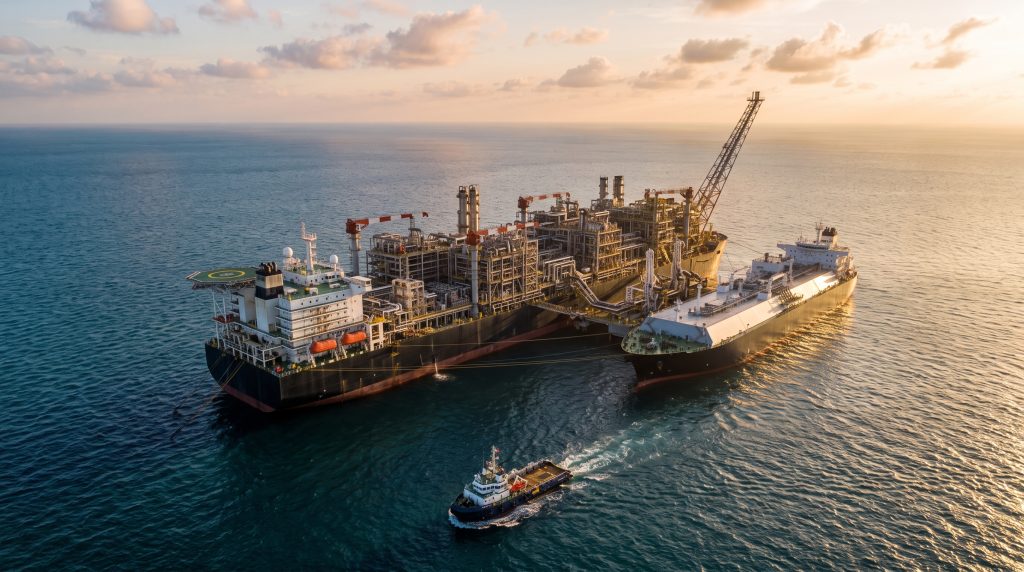
Floating LNG unit moored at sea with an LNG carrier alongside during offloading

Floating LNG puts a gas plant, LNG tanks and a loading terminal on one hull, so gas can become LNG right above an offshore field. As a result, remote gas can reach buyers even where a pipeline to shore is not possible.

Floating LNG (FLNG) is a vessel that cleans, cools, stores and offloads natural gas at sea. The process logic matches an onshore plant, but space, motion and offloading change. Use the checklist below to review a project, then pick one adjacent skill to explore.

Picture an engineer who has run an onshore gas plant for years, and whose next project floats. What changes, and what stays the same?

This guide follows that question. It starts with how FLNG works, moves on to what changes at sea and where projects get risky, and ends with a ten-point review checklist and skills to explore next. The examples begin in Southeast Asia, yet the ideas apply across the region and beyond.

It suits process, marine, terminal, safety and commercial professionals who are new to floating LNG, as well as managers who review projects.

Key takeaways

  1. An FLNG unit treats, liquefies, stores and offloads gas on one hull.
  2. The process logic stays familiar, while space, motion and offloading change.
  3. The plant fits into roughly a quarter of an onshore plant’s area, so layout drives safety.
  4. Project risks cluster around cost, weather, track record and LNG prices.
  5. A ten-point checklist and a skills map help you decide your next step.
¼ area An FLNG plant fits into roughly a quarter of the space of an onshore plant.
−162°C LNG sits near this temperature in the tanks.
488 m The Prelude FLNG hull is this long.
10 checks The guide ends with a ten-point project review checklist.

Key terms in everyday words

Liquefaction Cooling natural gas until it becomes a liquid that takes far less space.
Topsides The process plant modules that sit on the deck of the hull.
Boil-off gas Vapour that forms when a little LNG warms up inside the tanks.
Sloshing Movement of liquid in a partly filled tank as the vessel moves.
mtpa Million tonnes per annum, which is the yearly output.
FSRU A floating storage and regasification unit, which turns LNG back into gas.

Why would anyone build floating LNG?

Some gas fields are remote or small, so a pipeline and an onshore plant may not make sense. Floating LNG offers another route, because the plant goes to the field instead.

Stranded gas It can unlock gas fields that onshore infrastructure cannot serve economically.
Less land impact It reduces land-based environmental and social impacts.
Flexibility Host countries gain more choice in how they develop offshore resources.
Redeployment Operators can tow a unit to another site once a field is exhausted.

How does floating LNG work, step by step?

As Figure 1 shows, gas moves through five stages between the field and the carrier. The list below spells out each one.

From well gas to LNG cargo on an FLNG unit1. Gas arrives from the fieldRisers carry well gas to the unit2. PretreatmentRemoves impurities from the gas3. LiquefactionRefrigeration cools the gas into LNG4. Storage in the hullLNG sits near −162°C in hull tanks5. Offloading to carriersSide-by-side or tandem transfer
Gas to cargo in five stages.
  1. Gas arrives from the field through risers.
  2. Pretreatment removes impurities from the gas.
  3. Liquefaction cools the gas into LNG.
  4. The hull stores the LNG near −162°C in its tanks.
  5. Carriers collect the LNG, and often LPG and condensate, at the offloading point.

Four building blocks of an FLNG unit

Hull and storage The hull carries the LNG tanks and supports every other part of the unit.
Topsides These modules treat the gas and then cool it into a liquid.
Mooring and risers The unit stays moored over the field, while risers bring gas up from the seabed.
Offloading Carriers take the LNG, and often condensate and LPG, away to market.

Coming from gas processing? The treating and cooling steps will feel familiar, so Upstream Gas Conditioning and NGL Recovery and Gas Treatment and Sulphur Recovery are natural ways to refresh the pretreatment side.

What changes when the plant floats?

Three things change at once: space, motion and weight. Each one touches safety, so designers treat them together.

Space Equipment must fit into roughly a quarter of the area of an onshore plant. A 2011 Offshore magazine article notes that hazardous modules need gaps of about 15 to 20 m, against 5 m or less on an FPSO.
Plant motion Vessel motion affects the process plant. A 2015 Lloyd’s Register presentation lists process plant reliability as a design risk because little line pack is available. Line pack, in simple terms, is the gas volume held in the pipes.
Tank sloshing Terminals run part full, whereas LNG carriers avoid critical levels, according to the American Bureau of Shipping (ABS). Designers therefore check the structure against several sloshing scenarios.
Weight Heavy topside modules load the hull, so designers check hull yield, buckling and fatigue strength.

Those Lloyd’s Register slides also say membrane tanks may be vulnerable to sloshing damage when part full, whereas Moss tanks have no barred fill ranges.

Floating Liquefied Natural Gas (FLNG) – Design and Technology

Covers LNG behaviour on floating structures and the process from well fluids to exported LNG.

Evolving Designs and Construction Techniques of Floating LNG Terminals – FSUs and FSRUs

Covers cryogenic containment, sloshing, hull and mooring, swivels, fluid transfer and ship-to-ship transfers for FSUs and FSRUs.

How does offloading work at sea?

Next comes the handover. Carriers must connect to a moving unit, so the weather sets the pace.

Side-by-side and tandem offloading from an FLNG unit to an LNG carrier Side-by-side FLNG unit LNG carrier Wave limit: about 2.5 mArms or hoses, fendersand mooring controlGold dots show the fenders Tandem FLNG unit LNG carrier Cryogenic hoses over the gapWave limit: about 5 m
Figure 2 compares the two main offloading layouts.
Side-by-side This layout works but limits operations, because carriers find approach and departure harder and the loading arms limit the sea state.
Tandem Transfer takes place over the stern. BMT notes that tandem offloading is difficult with cryogenic LNG.
Weather BMT cites a limiting wave height of roughly 2.5 m for side-by-side transfer, against about 5 m for tandem.
Motion ABS notes that coupling and relative motion between the two vessels affect offloading.
Downtime Weather downtime is a main concern, so site-specific metocean studies help teams estimate delays.

LNG Supply Chain, Regasification, and Terminal Operations

Covers LNG carrier systems, ship-to-ship transfers, FSU and FSRU offloading, and marine and port operations.

Where is floating LNG used in Southeast Asia and beyond?

In Malaysia, PFLNG Satu has a capacity of 1.2 million tonnes per annum (mtpa). It loaded its first cargo in April 2017 at the Kanowit field, offshore Sarawak, and later moved to the Kebabangan field off Sabah. PFLNG Dua, with 1.5 mtpa, sits over the Rotan field and delivered its first cargo in March 2021.

Indonesia’s floating example sits on the import side: the Nusantara Regas Satu FSRU in Jakarta Bay supplies gas to power plants, with a design capacity of up to 3 mtpa. Further afield, the Prelude FLNG off Western Australia is 488 m long and produces 3.6 mtpa of LNG, 1.3 mtpa of condensate and 0.4 mtpa of LPG.

LNG capacity of three floating units in million tonnes per year LNG capacity of three floating units (mtpa) 1.21.53.6 PFLNG SatuPFLNG DuaPrelude
As Figure 3 shows, capacity varies widely between units. Prelude also makes condensate and LPG.

Whatever the country, every project faces waves, cold liquid and tight space, so these ideas apply across Southeast Asia and beyond.

Which FLNG project risks should you watch?

Technical and safety risks

Layout Tight space and hazardous modules need close attention, because gaps are larger on FLNG than on an FPSO.
Hull loads Heavy topsides and shallow water effects load the hull, so ABS criteria cover buckling, yielding and fatigue.
Weather Wind and waves shape the mooring, the heading and the offloading limits, and tropical storms can call for a disconnectable turret.
Track record Bracewell notes a limited operating track record and, in some emerging markets, limited local technical expertise or emergency response capacity.

Project and commercial risks

Site and gas The location and the upstream gas composition shape the design from the start.
Rules Classification societies such as ABS publish guides for floating liquefied gas terminals, so teams should plan for approval early.
Cost and schedule Early FLNG projects faced cost overruns and delays, according to Bracewell. Modular and standardised designs now aim to cut cost and shorten construction.
Market FLNG is capital-intensive, so falling LNG prices in an oversupplied market can hit marginal reserves. Contracts and cost control therefore matter.

Layer of Protection Analysis (LOPA) – Including SIL Determination and Risk-Based Functional Safety Methods

Covers LOPA, independent protection layers and the functional safety lifecycle for high-hazard facilities.

EPCIC Contract Drafting and Management: With Essential Elements of International Contract Laws

Covers contract formation, consortium risks, variation claims and dispute resolution in international EPCIC projects.

Use it: a ten-point floating LNG project review checklist

Use this list in design reviews, in onboarding or before an interview. It is general guidance, so adapt it to your own project and standards.

  1. Confirm that hazardous modules have enough gaps, because space is tight.
  2. Review the hull and topsides interface, since heavy modules load the hull.
  3. Test the tank design against partial filling, because sloshing and fatigue depend on it.
  4. Verify process plant reliability on a moving hull, where little line pack is available.
  5. Set the offloading method and its wave limit early, because they decide the downtime.
  6. Study the site’s weather data before choosing the mooring, heading and turret.
  7. Understand the gas composition, since it shapes complexity from the start.
  8. Plan the classification route early, because floating terminals follow class guides.
  9. Ask about local expertise and emergency response, which may run thin in emerging markets.
  10. Stress-test cost, schedule and market assumptions, because early projects ran over and prices can fall.

What else can you explore? Skills that travel with floating LNG

Floating LNG skills travel well. The same ideas appear in other cold-cargo, floating and process work, so many people add one adjacent topic after the basics. Figure 4 maps common starting points to topics worth exploring.

Skills to explore next, by starting role Start from your roleExplore theseProcess andgas engineersUpstream Gas ConditioningGas Treatment & Sulphur RecoveryMarine andnaval architectsFSU and FSRU DesignsFLNG Design and TechnologyTerminal andcargo teamsLNG Supply Chain, TerminalsAmmonia, Methanol, CO₂ cargoesSafety andrisk specialistsLOPAProcess Safety ManagementCommercial andproject teamsLNG Commercial and ContractsEPCIC Contract Drafting
Figure 4 uses shortened course names, so check each course page for the full title.

Adjacent paths by starting role

Process and gas engineers Upstream Gas Conditioning and NGL Recovery and Gas Treatment and Sulphur Recovery cover treating and conditioning, which sit at the front of every FLNG plant. FLNG – Design and Technology then completes the picture.
Marine and naval architects Floating LNG Terminals – FSUs and FSRUs covers hulls, mooring and transfer systems, while FLNG – Design and Technology links hull design to the process plant.
Terminal and cargo teams LNG Supply Chain, Regasification, and Terminal Operations and LNG Terminal Operations & Safety suit people who plan or run terminals. The same transfer discipline appears with new cargoes, so Ammonia as Cargo in Maritime Applications, Methanol Bunkering and CO₂ Shipping and LCO₂ Carriers are logical next steps.
Safety and risk specialists Layer of Protection Analysis (LOPA) sets protection layers, and Process Safety Management & Engineering Applications covers the wider safety lifecycle.
Commercial and project teams LNG Commercial and Operations Fundamentals links commercial strategy with operations. Gas and LNG Contracts, Markets and Strategy and EPCIC Contract Drafting and Management then cover deals and delivery.

FLNG and cross-skilling courses to explore

Each course has a button to its own page, with current dates.

CourseWho it suitsDates
Floating Liquefied Natural Gas (FLNG) – Design and TechnologyDesigners, reviewers and managers of FLNG projects.
Evolving Designs and Construction Techniques of Floating LNG Terminals – FSUs and FSRUsTeams working on hulls, mooring or fluid transfer for floating terminals.
LNG Supply Chain, Regasification, and Terminal OperationsPlanners and operators of LNG terminals and shipping interfaces.
LNG Terminal Operations & SafetyOperators and supervisors of an LNG regasification terminal.
Upstream Gas Conditioning and NGL RecoveryGas processing engineers, for whom pretreatment already feels familiar.
Gas Treatment and Sulphur RecoverySpecialists who select or troubleshoot gas treating and sulphur recovery.
LNG Commercial and Operations Fundamentals – Bridging Commercial Strategy and Technical Operations in LNGRoles that join LNG commercial strategy with operations.
Gas and LNG Contracts, Markets and Strategy – Structuring and Negotiating Gas & LNG Contracts that Optimize Value for your OrganizationNegotiators and managers of gas and LNG contracts.
Layer of Protection Analysis (LOPA) – Including SIL Determination and Risk-Based Functional Safety MethodsRisk-study teams who need to set protection layers.
Process Safety Management & Engineering Applications [IChemE Approved Training Course]Designers, operators and maintainers of major hazard plants.
EPCIC Contract Drafting and Management: With Essential Elements of International Contract LawsDrafters and managers of large international project contracts.
Ammonia as Cargo in Maritime Applications – Navigating Safe and Sustainable Marine Transport and Cargo OperationsCargo or terminal teams moving towards ammonia.
Methanol Bunkering – A Step-by-Step Framework for Risk Mitigation, SIMOPS, and Low-Flashpoint Fluid TransfersManagers of low-flashpoint fuel transfers at sea.
Design, Deployment and Value Chains in CO₂ Shipping & LCO₂ CarriersPeople working on CO₂ shipping, containment or carbon logistics.

Where to go next

Build FLNG skills in your team

Floating LNG projects combine process, marine and commercial work, so shared knowledge helps teams decide well. Browse the full calendar, or ask about training for your own team at your chosen venue and dates.

For further reading, see the PFLNG Satu release, the ABS guidance note and the Prelude report.

This article is for general information only. Please follow your own procedures, standards and local regulations for any real operation.

FAQ

What is floating LNG (FLNG)?

Floating LNG, or FLNG, means a vessel moored above an offshore gas field that cleans, liquefies and stores natural gas, and then loads the LNG onto carriers. In other words, it puts a gas plant, LNG tanks and a loading terminal on one hull.

How does an FLNG unit differ from an onshore LNG plant?

An FLNG unit must fit its equipment into roughly a quarter of the area of an onshore plant, and it must work while the hull moves with the waves. As a result, layout, safety, sloshing in partly filled tanks and offloading at sea need special design attention.

What is the difference between FLNG, FSRU and FSU?

An FLNG unit produces LNG at the gas field. In contrast, a floating storage and regasification unit (FSRU) receives LNG and turns it back into gas, while a floating storage unit (FSU) stores LNG and passes it on to other ships.

What are the main risks in FLNG projects?

The main technical risks are tight space with fire and blast hazards, heavy topsides loading the hull, long years on station in harsh weather, and cold liquid close to critical structures. In addition, project risks include a complex supply chain, site and gas composition choices, classification approval, and contracts and cost control.

Are there floating LNG examples in Southeast Asia?

Yes. Malaysia has built two FLNG units, PFLNG Satu (1.2 mtpa) and PFLNG Dua (1.5 mtpa). Indonesia has used the Nusantara Regas Satu floating import terminal in Jakarta Bay since about 2012. The same ideas apply across the region and beyond.

Which courses help engineers cross-skill into floating LNG?

Process engineers can start with Floating Liquefied Natural Gas (FLNG) – Design and Technology and Upstream Gas Conditioning and NGL Recovery. Marine teams can add the FSU and FSRU course, and terminal teams can add LNG Supply Chain, Regasification, and Terminal Operations. Safety and commercial teams can add LOPA, LNG commercial and contract courses. Please check each course page for current dates.