
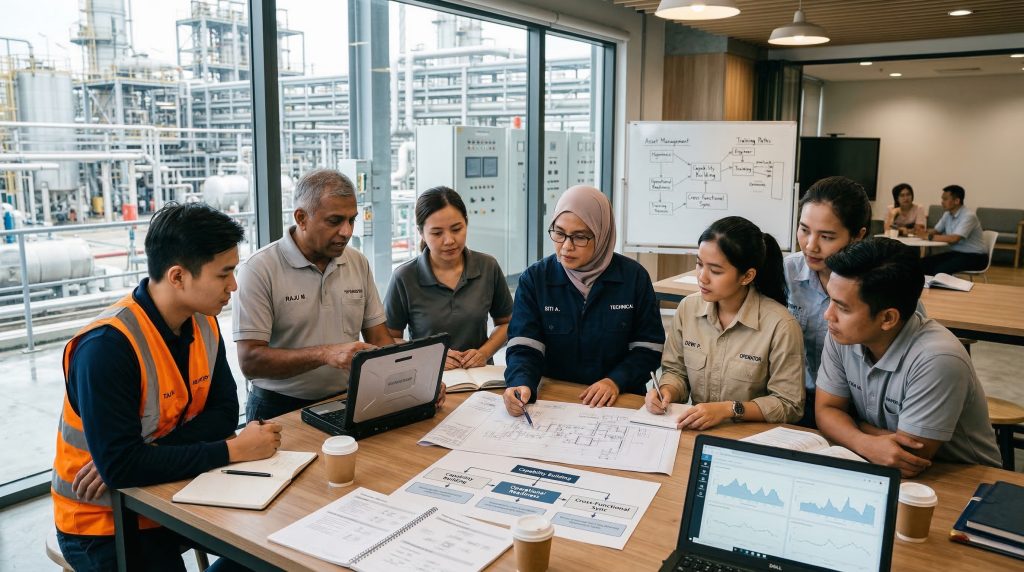
Workforce capability in Malaysia’s energy sector is becoming a more strategic issue for employers across oil and gas, power generation, LNG, petrochemicals and adjacent industrial operations. Companies are balancing cost discipline with the need to preserve technical depth, operational continuity and workforce resilience. At the same time, the nature of work is shifting. Digital tools are more deeply embedded in engineering and operations. Asset portfolios are ageing. Project execution is under tighter scrutiny. The skills mix required across the sector is also widening.
The change is no longer confined to traditional technical disciplines. Employers are responding to the growing role of data analytics, automation, artificial intelligence, machine learning and digitally enabled decision-making. Newer areas such as battery energy storage, carbon capture, hydrogen, geothermal and grid modernisation now demand broader technical and commercial understanding. Workforce planning in Malaysia’s energy sector therefore depends not only on replacing experience, but also on building capability for work that is evolving in real time.
For many employers, training is no longer a peripheral HR matter. It now sits closer to the centre of business planning. The question is no longer whether training matters. The real issue is which capability gaps are becoming strategically important, and how targeted development can address them.
This is where the conversation around the former Human Resources Development Fund (HRDF Malaysia) and the current Human Resource Development Corporation (HRD Corp) remains relevant. In 2021, HRDF rebranded to HRD Corp and widened its mandate across more industries. Even so, the practical question for employers did not change. They still need to decide how to use levy-supported development not simply as an entitlement, but as part of a more disciplined workforce strategy.
Why Workforce Capability in Malaysia’s Energy Sector Is Under Pressure
The workforce challenge in Malaysia’s energy industry is no longer confined to a narrow set of specialist vacancies. Pressure now extends across engineering, operations, maintenance, projects, commercial functions and frontline leadership. Recent public indicators suggest this pressure is structural rather than temporary. Operator outlooks continue to point to significant maintenance, turnaround and end-of-life activity. National labour data also shows that demand for skilled roles remains firm across the wider economy.
That context matters. PETRONAS’ Activity Outlook 2025–2027 emphasised human capital development alongside innovation, sustainability and financial resilience. It also pointed to substantial manpower requirements tied to maintenance, turnaround and decommissioning activity. Separate reporting on that outlook indicated workforce demand for decommissioning and restoration activity could peak at around 25,000 workers in 2026–2027. At the wider labour-market level, the Department of Statistics Malaysia reported that labour demand reached 9.21 million jobs in the fourth quarter of 2025. Skilled jobs also continued to expand.
For employers, the implication is straightforward. Competition for deployable talent is likely to remain firm. The issue is not simply filling vacancies. It is deploying people who are ready for operationally critical responsibilities without a prolonged development curve. In that sense, workforce capability across Malaysia’s energy sector has become a strategic constraint as much as a people issue.
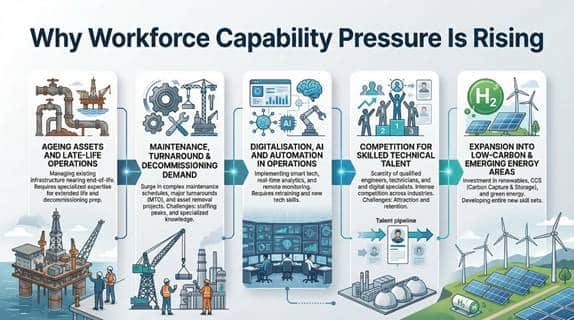
Five structural forces are reshaping workforce capability needs across Malaysia’s energy sector.
How Training Supports Workforce Capability and Operational Readiness
Several forces are converging. Mature assets require stronger discipline in asset management, asset integrity and life extension, maintenance planning, scheduling and control, and risk-based decision-making. This matters in environments where reliability, safe operations and production continuity depend on consistent technical judgement rather than reactive intervention.
Project environments have become less forgiving. Capital efficiency, schedule control, contracting discipline and delivery governance are under greater pressure. That raises the premium on capability in project execution, commercial awareness and risk management.
Digitalisation is changing role expectations. More professionals need to work effectively with digital tools, structured data and integrated workflows, even when they are not in dedicated technology roles. They also need to interpret data outputs, understand automation logic and use AI-enabled tools responsibly. These shifts affect operational, technical and planning functions alike.
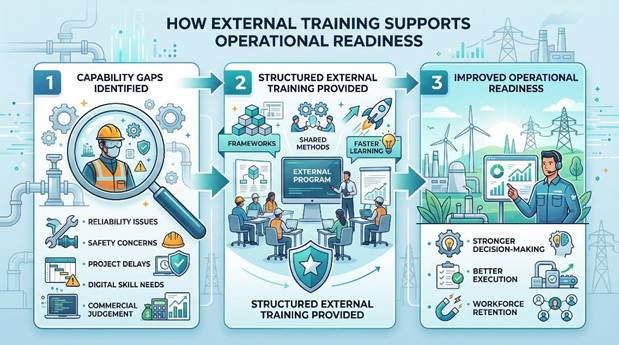
Well-targeted external training can shorten learning curves and improve execution in business-critical roles.
Why external training is regaining relevance
Against this backdrop, structured external training is regaining importance. It does not replace operational experience, but it can complement it in practical ways. Internal development remains essential, yet many organisations struggle with limited mentoring capacity, operational workload and uneven exposure across teams. Informal coaching can transfer judgement over time. Still, it may not be enough when employers need faster uplift, shared methods or recognised frameworks.
Well-selected external programmes tend to add value in three ways. They shorten the learning curve where workplace exposure is limited or inconsistent. They also help align methods across teams, particularly in technical governance, process safety, reliability improvement and commercial decision-making. Just as importantly, they reinforce retention by showing that the organisation is investing in employees whose responsibilities are becoming broader and more demanding.
The critical point is selectivity. Employers do not need more training for its own sake. They need training that improves execution, judgement and operational readiness in roles that matter. Capability development across the energy sector is therefore judged increasingly by operational relevance rather than attendance volume.
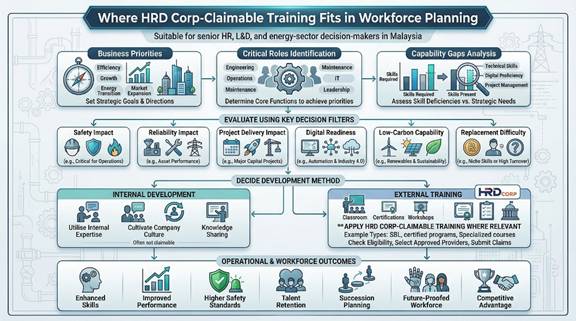
HRD Corp-claimable training creates the most value when linked to business-critical capability needs.
Where HRD Corp-Claimable Training Fits Workforce Planning in Malaysia’s Energy Sector
Within Malaysia’s employer training ecosystem, HRD Corp remains a practical enabler for firms seeking to upskill or reskill their workforce in a more structured way. However, the real value of HRDC-claimable courses depends less on the funding mechanism and more on how employers connect learning decisions to wider workforce priorities. In practice, HRD Corp support matters most when it strengthens workforce capability in Malaysia’s energy sector rather than simply increasing training activity.
Some organisations still view levy-supported programmes mainly through an administrative or utilisation lens. That approach is understandable, but limited. A more mature view treats claimable training as one instrument within a broader capability strategy.
What employers need to ask before using claimable training
Energy and industrial employers need to ask sharper questions. Some roles are becoming harder to replace. Other gaps have a greater effect on reliability, safety, project delivery or commercial performance. Digital tools, AI-assisted workflows and emerging low-carbon technologies are also changing capability needs. Employers then need to judge where internal pathways are strong enough and where external support is justified.
Seen in that light, HRDF training remains a familiar market term despite the rebranding. The strongest use case for HRDF training Malaysia today is where employers align learning spend with business-critical capability requirements rather than treating claimability as the primary criterion. This matters most when organisations need to respond quickly to capability shifts in newer fields and when internal expertise remains limited.
Skills Priorities Across Malaysia’s Energy Workforce
Although each organisation has its own operating context, several priorities are becoming clearer across the market. These shifts are helping define the next phase of Malaysia’s energy workforce and the capabilities employers will prioritise most heavily.
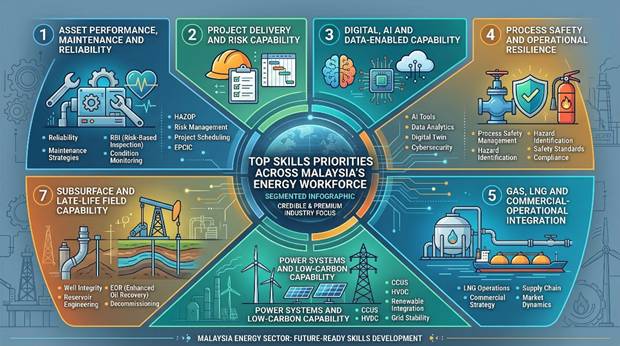
The future energy workforce will need broader capability across technical, digital and low-carbon domains.
Asset performance, maintenance and reliability
As operating assets age and capital discipline remains firm, many organisations are placing greater emphasis on lifecycle decision-making, reliability practices, fitness-for-service thinking and failure analysis. This is relevant across upstream, refining, petrochemicals, utilities and industrial plants where production continuity depends on sound technical decisions made early enough to prevent larger losses later.
Project delivery and risk capability
Engineers and technical managers are increasingly expected to operate with stronger commercial awareness, tighter schedule control and more disciplined delivery practices. This is increasing demand for development in project management, EPC and EPCIC contracting, project economics, and contract law and risk mitigation in energy. Energy businesses also remain exposed to technical, commercial and regulatory uncertainty. Teams involved in projects, supply chain, field development and operational planning need a stronger grasp of structured risk assessment and mitigation.
Digital, AI and data-enabled capability
A more visible priority now is the ability to work with digital systems beyond basic software familiarity. Energy organisations increasingly value skills in industrial data interpretation, digital performance monitoring, automation interfaces, machine learning-supported analysis and the practical use of AI tools in technical environments. The goal is not to turn every engineer into a data scientist. It is to ensure that more roles can operate confidently in data-rich environments where decision support, diagnostics, forecasting and optimisation are becoming more technology-enabled.
Process safety and operational resilience
The pressure to maintain safe and reliable operations continues to reinforce demand for competence in LNG terminal operations and safety, HAZOP, LOPA, incident investigation, Tripod Beta and process safety management. In many organisations, these are no longer treated as standalone compliance topics. Instead, they sit closer to the core of operating discipline.
Gas, LNG and commercial-operational integration
Malaysia’s position in gas and LNG means that capability needs increasingly span both technical and commercial dimensions. Skills related to gas conditioning and processing, gas distribution, LNG operations, LNG contracts, pricing, trading and hedging are becoming more relevant as organisations seek stronger integration between operations, market understanding and commercial exposure.
Power systems and low-carbon capability
The sector’s skills mix is widening through the energy transition. In power and industrial settings, this is visible in growing interest around HVDC systems engineering, HV and MV power system design and protection, smart grid applications, turbine performance and grid resilience. Beyond conventional power, organisations are also building familiarity in solar photovoltaic power plants, battery energy storage systems, floating photovoltaic systems, pumped hydro and renewable power purchase structures.
Low-carbon capability requirements are also becoming clearer. Organisations are building technical and commercial fluency in carbon capture, utilisation and storage, carbon pricing, storage-site compliance, CO2 transport, hydrogen value chains, methanol and ammonia applications, and broader decarbonisation-related project frameworks.
Subsurface and late-life field capability
In upstream-focused organisations, demand remains firm for deeper competence in mature field development, completion design, well integrity, production systems, subsea intervention, drilling fluids, geomechanics and plug and abandonment. These are established disciplines. Even so, they are taking on renewed importance as operators seek to extend field life, improve recovery and manage end-of-life obligations more efficiently.
The Trade-Offs in Energy Sector Workforce Capability
The case for capability investment may be strong, but the constraints are equally real.
Operational teams are difficult to release during turnaround periods, project peaks or lean staffing cycles. Managers may worry that investment in portable skills could increase attrition risk. Procurement functions may prioritise cost over provider quality. Training quality can also vary. Not every programme described as specialist is sufficiently grounded in industry practice. For that reason, energy sector workforce capability is shaped not only by training budgets, but also by release constraints, operational timing and role criticality.
Even so, underinvestment carries its own cost. Skills gaps rarely remain theoretical for long in energy businesses. They show up in weaker assumptions, delayed interventions, narrow decision-making, contractor overdependence, ineffective maintenance execution or uneven technical governance. In digital and emerging-energy fields, the risk can be sharper. Organisations may invest in new systems or business areas without developing enough internal capability to use them effectively.
For that reason, workforce capability in Malaysia’s energy sector cannot be strengthened through hiring alone. Employers need to develop the right people in the right capabilities at the right time. External training is most useful when it supports role criticality and operational outcomes.
A More Selective Model for Workforce Capability in Malaysia’s Energy Sector
The likely direction of travel is not indiscriminate expansion in training activity. It is a more selective, role-based and business-linked model of capability development.
What future-ready capability will look like
In practice, that means separating mandatory learning from strategic capability investment. Mid-career technical professionals may require deeper competence in reliability, project governance or late-life asset decision-making. Operational leaders may need stronger risk and decision frameworks. Teams exposed to low-carbon projects may require cross-skilling in CCUS, hydrogen, energy storage or renewable project structures. Teams working in increasingly digital environments may also require practical capability in analytics, automation, AI-assisted workflows and cross-functional data use.
Commercial and technical personnel may need a stronger shared understanding of contracts, economics and market risk. The same shift also has implications for earlier-career professionals. As digital tools, automation, AI-assisted workflows and lower-carbon technologies become more embedded in the sector, technical foundations alone may no longer be enough. Employers are increasingly likely to value professionals who can combine core engineering or operational knowledge with adaptability, data literacy and stronger cross-functional understanding.
The next phase of workforce capability in Malaysia’s energy sector will depend on more selective investment in technical, operational and leadership development. It will also depend on how quickly employers can prepare their workforce for roles that sit at the intersection of conventional energy operations, digital transformation and lower-carbon growth.
How this looks from a training provider perspective
From the standpoint of a training provider focused on the energy sector, the conversation has become more selective and more outcome-driven. Employers are increasingly looking beyond one-off attendance and focusing instead on development pathways that support operational performance, leadership depth and technical resilience. At EnergyEdge, this is reflected in demand for structured development aligned to business-critical roles, including selected programmes that are 100% HRDC claimable: the Certificate in Asset Management – IAM Certificate in Asset Management Preparatory Course, the Project Management Professional (PMP)® Examination Preparation Course, and the Risk Management Professional (RMP)® Examination Preparation Course. As with any external development intervention, the real value lies not in claimability alone, but in how effectively the training supports wider workforce priorities.
Conclusion
Workforce capability in Malaysia’s energy sector is now a business issue as much as a people issue. Capability pressures reflect ageing assets, tighter execution requirements, digitalisation, workforce mobility and the need for more resilient operating models. They also reflect the reality that AI, machine learning, automation and lower-carbon technologies are beginning to reshape what competence looks like across the sector.
For employers navigating these pressures, Human Resource Development Corporation (HRD Corp) support remains useful, but only when viewed as part of a wider capability strategy. The older language of Human Resources Development Fund (HRDF Malaysia) may still persist in market conversation, but the strategic issue has moved on. The focus now is not on training as an administrative exercise. It is on building a workforce that can operate effectively across today’s assets while preparing for the technologies and energy systems that will define the next phase of the industry.
Frequently Asked Questions
Workforce capability is the combination of technical skill, operational judgement, problem-solving ability and leadership needed to perform effectively in energy businesses. It is not just about headcount or qualifications. It reflects whether people can handle real operating conditions, make sound decisions and adapt to changing technical and commercial demands.
Energy companies are operating in a more complex environment. Ageing facilities require stronger technical discipline, digital tools are reshaping workflows, and newer energy activities are expanding the skills base. At the same time, experienced personnel can be difficult to replace, making capability development a more strategic priority.
External training helps organisations build knowledge in a more structured way, especially when internal mentoring capacity is limited. It can introduce shared methods, refresh technical understanding and support broader responsibilities. Its value is highest when learning is closely linked to operational needs and can be applied directly at work.
The main barriers are usually practical. Teams can be hard to release during busy periods, and training priorities often compete with immediate delivery pressures. Employers may also struggle to identify which skills matter most, while poorly targeted programmes can add cost without improving performance.
Workforce capacity refers to the number of people available to do the work. Workforce capability refers to whether those people can perform effectively in their roles. An organisation may have enough staff on paper but still face operational weakness if employees lack the judgement or technical depth required.
Future capability needs will combine strong operational fundamentals with broader technical adaptability. Core areas such as maintenance discipline, process safety, equipment reliability and commercial awareness will remain important. At the same time, organisations are building knowledge in digital systems, emissions-related topics, energy storage and lower-carbon technologies.