
This 5 full-day course will cover all aspects of gas turbines, co-generation and combined cycle power plants.
Post Type Archives: Training
Auditing in the Exploration & Production (E&P) Industry Level 2
This 5-day intensive training course is designed to improve the skills of those involved in the financial and contractual auditing of upstream Oil & Gas Exploration and Production activities.
Auditing in the Exploration & Production (E&P) Industry Level 1
This 3-day introductory-level course is suitable for anyone who wants to gain a broader understanding of Upstream Oil & Gas Auditing – including joint venture, financial and contractual audits by government and regulatory authorities.
Offshore Wind Vessel Chartering Management – A Comprehensive Guide to CSOV and WIV Operations, Risk Allocation, and BIMCO Standard Forms
This intensive 3-day course is designed to equip commercial and operational personnel from both the Owner and Charterer sides with the expertise needed for seamless, contention-free chartering management. Through real-life case studies and contract simulations, participants will master the complexities of risk allocation and dispute resolution to ensure profitable and sustainable operations.
Integrating Hydrogen with Renewable Power – Virtual Instructor Led Training (VILT)
This 3 half-day Virtual Instructor Led Training (VILT) is a time-efficient and accessible examination of the factors that need to be considered when connecting hydrogen production to renewable power generation.
Ultra Supercritical Steam Power Plants: Design, Selection, Applications, Operation, Maintenance, Performance Monitoring, Power Augmentation, Emission Control Methods, Carbon Capture Technology, Economics, Profit Optimization, Revenue and Life Cycle Cost Analysis
This 3 full-day course will cover all aspects of ultra supercritical steam power plants and advanced ultra supercritical power plants.
Water Chemistry for Thermal Power Station Plant Chemist & Boiler Engineers
This 5 full-day course will provide ample opportunity for robust technical discussion and expand on advanced concepts in thermal power plant cycle chemistry. It focuses only on the steam/water aspects of the thermal power cycle.
Electrical Engineering for Non-Electrical Engineers
This 5 full-day course is for individuals who would like to gain a thorough understanding of all the principles of electrical engineering in a simple and easy to grasp format.
Maintenance of Rotating Equipment: Diagnostic Testing, Troubleshooting, Maintenance, and Refurbishment
This 5 full-day course will provide a comprehensive understanding of the inspection, diagnostic testing, troubleshooting, maintenance, overhaul and refurbishment of all rotating equipment including centrifugal pumps, centrifugal and axial compressors, steam and gas turbines.
Performance Analysis for Diesel Engine Power Plant
This 5 full-day course will provide in-depth coverage of the selection, layout, operation, inspection, diagnostic testing, troubleshooting, maintenance, refurbishment, performance monitoring, power augmentation, and economics of all types of diesel engine power plants.
Transmission Lines: Design, Analysis and Applications
The objective of this 5-day training course is to deal appropriately with control systems, design characteristics and electric & magnetic fields.
Switchgears and Transformers: Selection, Maintenance & Testing
Using the latest technology, this 4-day course addresses the above objectives by covering the successful operation of motors, variable-speed drives, transformers, generators, rectifiers, inverters, uninterruptible power systems, circuit breakers, and fuses.
Smart Grid, Smart Metering and Power Quality Analytics
This 5-day course will equip you with the innovations that are shaping the power generation and distribution systems and will cover topics ranging from Smart Metering Architecture, Cybersecurity, Smart Grid Systems and Power Line Communications.
Power Quality & Harmonics in Power Systems
This training will focus on the effect the customer loads have on the supply grid, and ensure that the customer load network connection does not negatively impact the grid network.
Relay Protection in Power Systems
This 2-day course will immerse you with a solid understanding on the importance of relay protection in determining high voltage network expansion limitations, day to day operation and equipment maintenance activities.
Engineering, Procurement & Construction Contracts (EPC)
This 3-day training is specifically designed for professionals who are interested in enhancing their knowledge on EPC contracts.
(A) Energy Transition and (B) Fiscal Systems for Oil and Gas
The 4.5-day interactive computer-based training course provides participants with an intimate knowledge of petroleum upstream fiscal systems. At the same time, the rapid current developments in energy transition requires significant attention to this issue. Therefore, the participants will learn the impact of renewable resources and hydrogen on the petroleum industry and structuring of new petroleum-energy arrangements.
CO2 Capture, Processing & Technologies – Virtual Instructor Led Training (VILT)
This course will cover the technology and costs of CCS capture technologies with a focus and will include discussion on the main factors affecting separation, their technology readiness and levelized costs.
Combustion Engineering for Coal Fired Power Plants
This 5 full-day course provides detailed description of all combustion equipment and systems used in pulverized coal boilers and circulating fluidized bed (CFB) boilers including pulverized coal burning systems, coal feeder, pulverizer and classifier, pulverized coal burners, furnace and fans.
E&P Technical Services Contract
This course will particularly focus on the services contracts that are put in place to support a drilling campaign, covering all specificities of the various contracts.
Introduction to Power Systems
This course will provide a comprehensive, foundational content for a wide range of topics in power system operation and control.
Process Control and Instrumentation
This course will begin with a presentation of topics to familiarize Process and Instrumentation Engineers with procedures and practices involved in the choice of sensors related to the measurement of temperature, pressure, level and flow in relation to single-phase flows.
Reliability Centred Maintenance
In today’s business environment, there has never been more of a need to make Asset Management and Maintenance more cost effective and efficient.
Advanced Reservoir Engineering
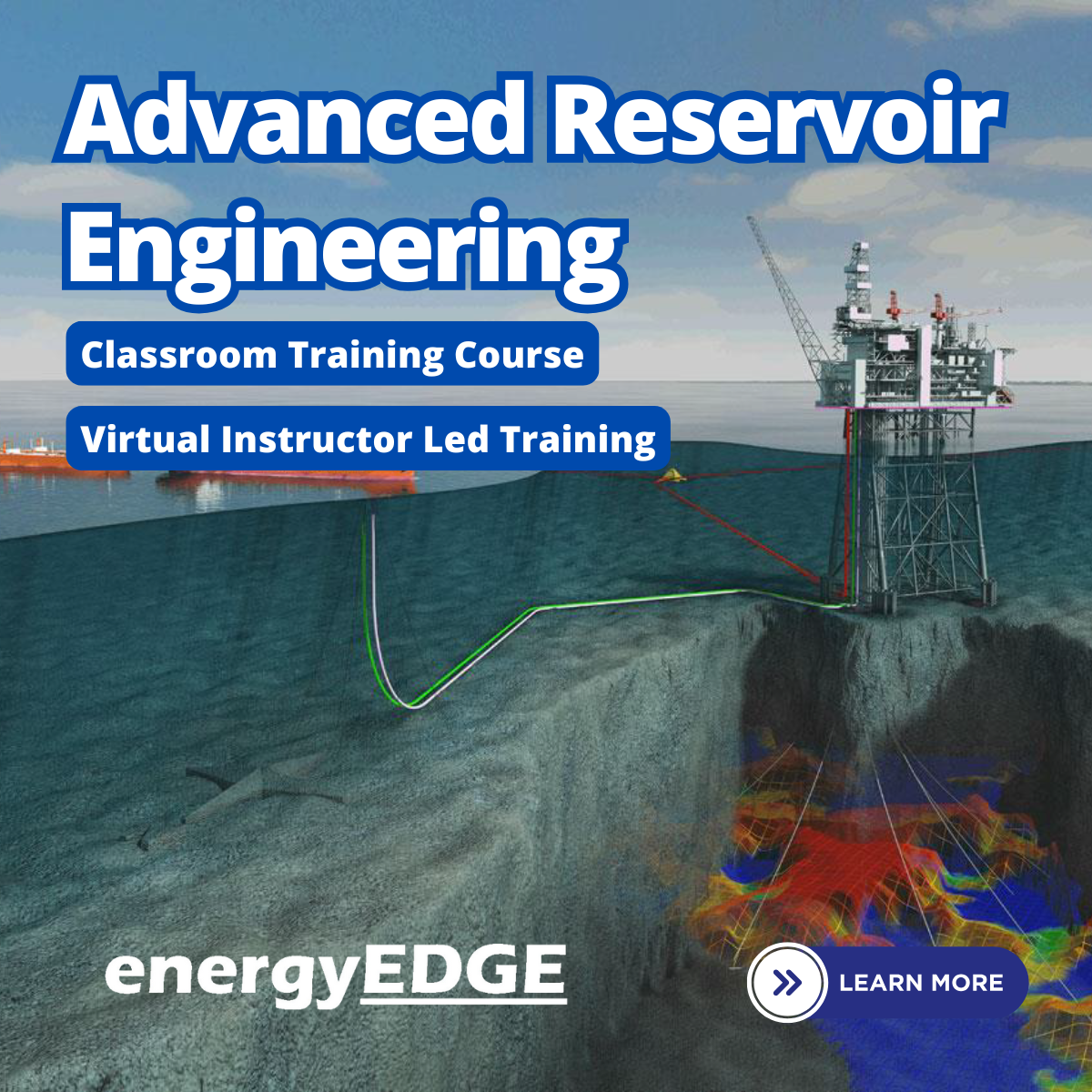
The Advanced Reservoir Engineering course will address modern practical aspects of reservoir engineering during 5 full-days packed with lectures, virtual exercises, discussions and literature reviews.
Advanced Well Engineering
This 3 full-day course aims to further develop and assess the knowledge required to work on and eventually, authorize a well delivery program as deemed fit for purpose.
Leadership & Team Dynamics in Oil & Gas
This popular 3 full-day course will equip you with key skills that you can utilise to maximise your staff’s performance in line with the company’s objectives.
Fundamentals of LNG Shipping and Operations
This course will provide an informed insight in choices and limitations of containment systems and how advances in propulsion technology, coupled with environmental legislation, are narrowing the parameters of asset operability and commercial viability.
Petroleum Geology for Non-Geologists (Featuring Virtual Reality Trips)
This course has been designed to introduce these terms and provide an insight into how oil and gas are formed, how they are found and how they are extracted. This 5 full-day course is designed to make those that attend aware of how their job can directly impact the productivity. This 5 full-day course will focus on geological fundamentals: how different basin types differ in subsidence mechanisms, basin cycles, heat flow through time, depositional systems, structural styles and their type of petroleum systems.
This 5 full-day course is aimed at engineers and supervisors who already have a basic understanding of well construction methods but who would benefit from a more detailed knowledge of completion design.
Understand the urgency of drilling requests, know more about the cost implications of drilling-related problems, and understand the risks involved in a drilling contract.
This 2 full-day Training course provides an overview of all of the functionalities and key interfaces of subsea equipment. The course will refer to relevant industry engineering standards for subsea equipment, subsea tie-backs and critical operational requirements. The sessions will cover challenges associated with equipment design and installability. This is a 2 full-day course that is aimed at providing professionals in the Oil & Gas business with a comprehensive set of core negotiating skills.
This 5 full-day blended course will focus specifically on seismic data which is the main method used in the Oil & Gas industry.
The aim of this course is to enable the participants to gain key knowledge that they will require to actively and efficiently participate in the planning, design, and/or execution of a Coiled Tubing intervention. Managed Pressure Drilling (MPD) offers opportunities to improve safety and efficiency in drilling, and it is increasingly recognised by operators and regulators. This separately bookable 3 full-day course is not designed to skill Oil & Gas engineers to be accountants, but to give the participants the confidence and ability to communicate with accountants and finance managers and to improve their own financial decision making. This intermediate to advanced level 3 full-day training course has been designed to provide participants with a detailed and up-to-date overview of the fluid mechanic fundamentals and operating practice of pumps, compressors and gas and steam turbines. This 5-day course in substation design fundamentals will guide you through a step-by-step study of the civil and electrical substation design and construction process. This course aims to help geologists, geophysicists, stratigraphers and reservoir engineers gain a thorough understanding of the concepts and practical applications of sequence stratigraphy through integration of seismic sequence stratigraphy with well log sequence stratigraphy and the application of biostratigraphy to sequence stratigraphy.
This 5 full-day course has been designed to develop skills in understanding the geometry and petrophysical characteristics of carbonate reservoirs.
As Petroleum Engineering (PE) activities continue to increase, professionals like you must grasp the language and technology of PE operations in order to maximise expenditures throughout the producing life of a well. In our pursuit to discover oil & gas in deeper horizons, wells are often drilled in a HPHT environment. To be considered a HPHT well, the downhole conditions will have pressures in excess of 10,000 psi (69 MPa) and 300° F (150° C).
This intensive two-day course moves beyond theory to provide a “Logical Project Lifecycle Management” approach. Participants will learn to identify hidden liabilities, clarify ambiguous clauses, and maintain a controlling position throughout a project’s duration. By analysing real-world Case Law Reports, attendees will gain practical insights from the industry’s collective “bitter experiences” to avoid similar pitfalls. This 3 full-day course will cover in detail what it takes to decide on minimum drill string specifications, which are able to support the loads to which it will be subjected. In addition to the need to use a drill string with minimum strength requirements, we also need to ensure that we can prevent drill string failure.
The 3 full-day course focuses on Competence Management Systems (CMS) which are typically in use within the Energy Industry, their structure and process development requirements. The aim of this 2 full-day course is to enable participants to understand the process behind Data Analytics or Data Science, equip them to find opportunities from their data to make better business decisions as well as apply the insights obtained from the data to identify potential gaps and develop improvements needed in the business. This 5 full-day course addresses reservoir engineering concepts and methods to enable cross-disciplinary team work and the smooth exchange of ideas and experience.
While subsea well interventions share fundamental principles with land and platform operations, the subsea environment introduces significantly greater technical, logistical, and operational complexity. Accessing the subsea tree via intervention risers or conducting riserless operations requires specialized vessels, dynamic positioning systems, ROV support, and advanced control systems – all of which substantially increase operational costs. As a result, non-productive time (NPT), equipment failures, or procedural errors can quickly escalate costs and risk, potentially outweighing the production gains the intervention was intended to deliver.Well Intervention and Productivity School
Basin Analysis and Petroleum Systems
Completion Design
Drilling Essentials for New Engineers and Non-Technical Professionals in Oil & Gas
Subsea Production Engineering – Incorporating Subsea Tie-backs
Negotiation Skills and Techniques for Energy Professionals
Fundamentals of Seismic for Non-Geophysicists
Coiled Tubing Operations – Equipment, Applications, Well Control, Safety & Emerging Technologies
Managed Pressure Drilling (MPD)
1) Finance for Non-Finance Professionals in Oil & Gas 2) Petroleum Fiscal Regimes & Applied Finance for Non-Finance Oil & Gas Professionals
Pumps, Compressors, Turbines & Troubleshooting
Electrical Substation: Design, Construction & Commissioning
Applied Sequence Stratigraphy
Carbonate Reservoir Geology
Petroleum Engineering for Non-Petroleum Engineering Technical Professionals
HPHT Planning and Well Control
International Contract Law and Lifecycle Management – Ensuring Profitable Execution, Claims Management, and Dispute Resolution in the Energy Industry
Drill String Design & Drilling Optimization
Creating A High Performing Workforce Module 1: Competency Management & Assessment Module 2: Managing Performance for Success
Introduction to Data Analytics & Visualization
Reservoir Engineering for Geosciences Professionals and Other Disciplines
Subsea Well Intervention – Systems, Operations and Well Control in the Subsea Environment